
7 powerful Ultra Pure Nitrogen Generator: Reliable, Cost-Effective and On-Demand Nitrogen Supply
Table of Contents
- Introduction
- What Is an Ultra Pure Nitrogen Generator?
- How Does an Ultra Pure Nitrogen Generator Work?
- Benefits of Using an Ultra Pure Nitrogen Generator
- Industrial Applications of Ultra Pure Nitrogen
- Key Features to Consider
- Why Choose a PSA Nitrogen Generator?
- PSA vs Membrane Nitrogen Generators
- Nitrogen Generator vs Cylinder Supply
- Maintenance Requirements
- Why Choose MAAS Air N Gas?
- Frequently Asked Questions
- Conclusion
Introduction
Nitrogen is an important industrial gas used wherever an inert, controlled atmosphere is required. Manufacturing plants, pharmaceutical companies, electronics manufacturers, food processors, chemical industries, and many other businesses depend on a consistent nitrogen supply for their production processes.
Traditionally, nitrogen has been supplied through cylinders or bulk liquid nitrogen. While these methods can work for certain applications, regular deliveries, storage requirements, handling, and supply planning can become important operational considerations.
An ultra pure nitrogen generator provides another approach by producing nitrogen directly at the user’s facility. Instead of depending entirely on external gas deliveries, the system uses atmospheric air as its feedstock and separates nitrogen from other components of air.
For applications requiring high purity and continuous availability, PSA nitrogen generators are particularly relevant. MAAS Air N Gas describes its PSA systems as automatic, on-demand nitrogen generation systems capable of nitrogen purity up to 99.9999%, depending on configuration.
What Is an Ultra Pure Nitrogen Generator?
An ultra pure nitrogen generator is an industrial gas-generation system designed to produce nitrogen with a high level of purity directly from compressed air.
Atmospheric air contains nitrogen, oxygen, water vapour, and other gases. A nitrogen generator uses separation technology to selectively remove unwanted components and produce nitrogen as the product gas.
The required purity depends heavily on the application. Some processes can operate with moderate-purity nitrogen, while sensitive applications may require nitrogen with purity levels approaching or exceeding 99.999%.
MAAS Air N Gas states that its PSA nitrogen generation systems can achieve nitrogen purity up to 99.9999%, depending on the system configuration and operating requirements.
The major advantage of on-site generation is that nitrogen can be produced when required, helping industries establish a more controlled supply system.
How Does an Ultra Pure Nitrogen Generator Work?
Different nitrogen-generation technologies use different separation principles. For industrial applications, Pressure Swing Adsorption (PSA) is one of the important technologies for producing high-purity nitrogen.
1. Pressure Swing Adsorption
In a PSA nitrogen generator, compressed air is passed through adsorption vessels containing Carbon Molecular Sieve (CMS).
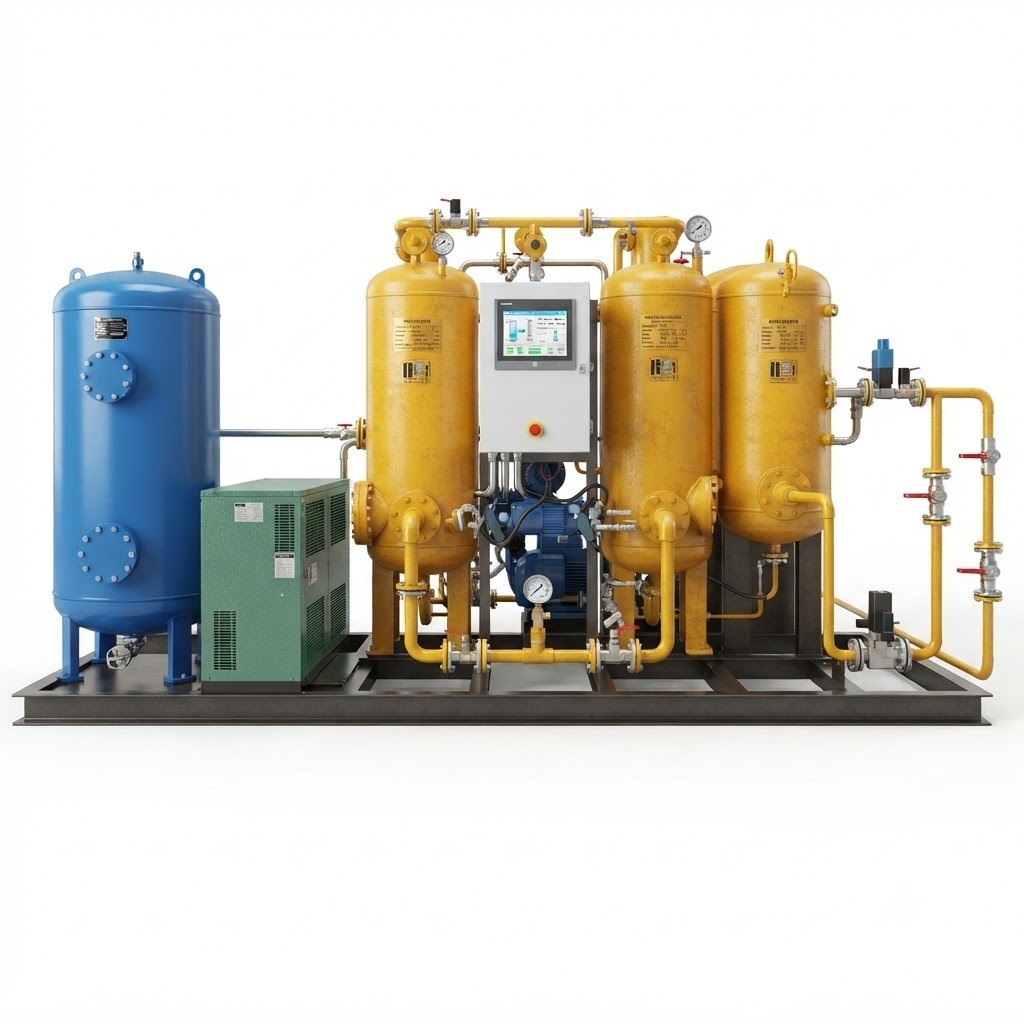
The CMS preferentially adsorbs oxygen molecules and allows nitrogen to pass through as the product gas. A twin-tower arrangement allows one vessel to remain in the production cycle while the other undergoes regeneration.
MAAS describes a twin-tower PSA system with automatic changeover valves. The compressed air is first treated with activated alumina to remove moisture before entering the CMS bed. The towers then alternate between nitrogen production and regeneration, allowing continuous operation.
2. Membrane Nitrogen Generation
Membrane systems use specially designed hollow-fibre membranes to separate gases according to their different permeation characteristics.
They can be useful where moderate nitrogen purity is sufficient and the application requires a relatively compact system.
The appropriate technology should therefore be selected according to required purity, flow, pressure, operating hours, and application conditions rather than purity alone.
3. Cryogenic Nitrogen Production
Cryogenic air separation uses very low temperatures to liquefy and separate atmospheric gases. It is generally associated with large-scale gas production and applications requiring substantial volumes.
For many industrial users who need high-purity nitrogen without operating a large cryogenic plant, PSA technology provides an alternative method of on-site nitrogen generation.
Benefits of Using an Ultra Pure Nitrogen Generator
Installing an ultra pure nitrogen generator can change how a facility manages its nitrogen supply.
Cost Efficiency
On-site generation can reduce dependence on repeated cylinder purchases and deliveries. MAAS describes its PSA nitrogen systems as generating nitrogen on demand and states that nitrogen can be produced at a fraction of cylinder-gas cost, depending on the application and operating conditions.
Actual savings depend on factors such as electricity consumption, nitrogen demand, compressor efficiency, purity requirement, operating hours, and the cost of purchased nitrogen.
Continuous Availability
A generator can produce nitrogen whenever the system is operating and compressed air is available.
This can be particularly useful for processes where an interruption in nitrogen supply can affect production.
Controlled Purity
Different industrial processes require different nitrogen specifications. A properly configured PSA system can be designed around the required purity and flow conditions.
MAAS states that its PSA nitrogen systems can achieve purity up to 99.9999%.
Reduced Cylinder Handling
On-site production can reduce the need for regular cylinder handling, storage, and delivery coordination.
This can simplify nitrogen logistics for facilities with continuous or high-volume requirements.
Scalable Supply
Nitrogen requirements can change as production capacity increases. PSA-based systems can be configured according to required capacity, and MAAS states that PSA gas generators can be upgraded and their capacity increased.
Industrial Applications of Ultra Pure Nitrogen
High-purity nitrogen is used across a wide range of industrial processes.
Electronics Manufacturing
Electronics and semiconductor manufacturing can require controlled atmospheres to reduce unwanted reactions and contamination.
Nitrogen can be used in processes such as soldering, heat treatment, component manufacturing, and controlled-environment applications.
Pharmaceutical Industry
Pharmaceutical manufacturing and packaging may use nitrogen for inerting, blanketing, and protecting sensitive materials from unwanted exposure to oxygen or moisture.
The required gas specification should always be determined according to the particular pharmaceutical process and applicable quality requirements.
Food and Beverage Packaging
Nitrogen is widely used for modified-atmosphere packaging and other food-packaging processes.
Replacing or reducing oxygen in a package can help support product quality and shelf-life objectives, depending on the food product, packaging system, and process conditions.
Laser Cutting
Nitrogen is used as an assist gas in certain laser-cutting operations. The gas helps support cutting processes where an inert environment is desired.
An on-site nitrogen generator can provide a continuous supply without requiring frequent cylinder replacement.
Chemical and Petrochemical Industries
Nitrogen is commonly associated with applications such as purging, inerting, and blanketing.
In these environments, nitrogen purity, pressure, flow, and reliability must be matched to the specific process requirements.
MAAS lists food and beverage, pharmaceuticals and chemicals, electronics, metals and glass, fire-suppression systems, automotive, and tyre-related applications among the application areas for its PSA nitrogen systems.
Key Features to Look for in an Ultra Pure Nitrogen Generator
Selecting a nitrogen generator should begin with the actual requirements of the application.
Nitrogen Purity
Purity is one of the most important specifications. Depending on the application, requirements can range from moderate purity to very high-purity nitrogen.
A system should therefore be selected according to the required specification rather than simply choosing the highest possible purity.
Flow Capacity
The generator must be capable of supplying the required nitrogen flow.
Important parameters can include:
- Required nitrogen flow
- Peak nitrogen demand
- Operating pressure
- Daily operating hours
- Required purity
- Future production expansion
Air Treatment
Compressed-air quality is important for PSA nitrogen generation. MAAS describes the use of activated alumina before the CMS stage to remove moisture from compressed air.
Appropriate filtration and drying help protect the adsorption system and support consistent operation.
Automation
Automatic tower changeover allows the system to move between adsorption and regeneration cycles without continuous manual operation.
MAAS describes its PSA nitrogen generation system as fully automatic with automatic changeover valves.
Monitoring and Control
Depending on configuration, industrial nitrogen systems may include pressure controls, purity monitoring, alarms, valves, PLC-based controls, and other instrumentation.
These features help operators monitor system performance and maintain the required operating conditions.
Why Choose a PSA Nitrogen Generator?
A PSA nitrogen generator is particularly useful when an industrial facility needs high-purity nitrogen continuously rather than occasional small quantities.
The basic PSA process uses compressed air, adsorption vessels, molecular sieve material, automatic switching, and controlled regeneration.
MAAS’s PSA system uses a twin-tower arrangement. While one tower produces nitrogen, the second tower regenerates. Automatic valves coordinate the changeover, while a surge vessel helps maintain the nitrogen supply pressure before delivery to the consumer point.
This design allows the generator to produce nitrogen continuously rather than requiring the operator to manually switch between vessels.
PSA vs Membrane Nitrogen Generators
| Feature | PSA Nitrogen Generator | Membrane Nitrogen Generator |
|---|---|---|
| Separation method | Adsorption using molecular sieve | Selective gas permeation |
| Typical use | High-purity industrial applications | Moderate-purity applications |
| Purity capability | Can reach very high purity depending on configuration | Generally suited to lower purity requirements |
| Operation | Automated adsorption/regeneration cycles | Continuous membrane separation |
| Application suitability | Electronics, pharmaceuticals, chemicals and other high-purity processes | Applications where moderate purity is sufficient |
| Selection factors | Purity, flow, pressure and operating cost | Purity, flow, pressure and space requirements |
The choice between PSA and membrane technology should be based on the required nitrogen purity, flow rate, pressure, operating conditions, and total system cost.
Nitrogen Generator vs Cylinder Supply
Nitrogen cylinders can be practical for low-volume or intermittent requirements. However, facilities with regular nitrogen consumption may need to manage ordering, deliveries, storage, handling, and cylinder replacement.
An industrial nitrogen gas generator changes the supply model by producing nitrogen at the point of use.
Potential operational advantages include:
- On-demand nitrogen generation
- Reduced dependence on deliveries
- Lower cylinder-storage requirements
- Continuous production during operation
- Greater control over nitrogen availability
- Ability to configure capacity around production requirements
MAAS describes its PSA systems as generating nitrogen as needed and being designed for relatively simple installation and maintenance.
The financial comparison should nevertheless consider the complete cost of ownership, including compressor power, maintenance, filtration, electricity, installation, and capital investment.
Maintenance of an Ultra Pure Nitrogen Generator
Regular maintenance is important for maintaining nitrogen purity and system reliability.
A nitrogen generation system depends on several interconnected components, including the compressor, filters, dryers, adsorption vessels, valves, molecular sieve, controls, and pressure-management equipment.
Important maintenance activities can include:
- Inspecting and replacing filters when required
- Checking compressed-air quality
- Monitoring operating pressure
- Inspecting valves and pneumatic components
- Checking CMS performance
- Verifying nitrogen purity
- Calibrating relevant sensors and instruments
- Inspecting electrical and control systems
- Following the manufacturer’s preventive-maintenance schedule
MAAS states that it provides yearly maintenance programmes as well as system upgrades and purity correction/system modification services for PSA gas generators.
Why Choose MAAS Air N Gas?
MAAS Air N Gas Technologies Pvt. Ltd. works in adsorption-based gas separation systems, air filters, air dryers, PSA plants, and related gas-treatment technologies.
The company states that its systems are designed according to individual customer requirements and that its work covers conceptualization, designing, manufacturing, setup, and commissioning.
Its product portfolio includes:
- PSA Nitrogen Gas Generation Plants
- PSA Oxygen Plants
- Ammonia Crackers for Hydrogen Generation
- Biogas-to-CNG Technology
- Air and Gas Dryers
MAAS also states that it provides PSA gas-generator upgrades, system modifications, annual maintenance, and configuration adjustments based on customer requirements.
For a nitrogen-generation project, the correct configuration depends on application-specific parameters such as purity, flow rate, pressure, compressed-air quality, operating hours, and future capacity requirements.
Frequently Asked Questions
What purity level can an ultra pure nitrogen generator provide?
The achievable purity depends on the technology and system configuration. MAAS states that its PSA nitrogen generation systems can provide nitrogen purity up to 99.9999%.
Can a nitrogen generator replace cylinders?
For applications with suitable flow, pressure, purity, and operating requirements, an on-site nitrogen generator can replace or substantially reduce dependence on cylinder supply. The appropriate system capacity should be determined from actual nitrogen consumption.
Which industries use high-purity nitrogen?
High-purity nitrogen can be used in electronics, pharmaceuticals, chemicals, food and beverage, metal processing, laser cutting, and other applications requiring an inert or controlled gas environment. MAAS lists several of these sectors among its PSA nitrogen applications.
Is PSA nitrogen generation fully automatic?
MAAS describes its PSA nitrogen generation system as fully automatic, using automatic changeover valves to alternate the adsorption and regeneration cycles.
Can nitrogen-generation capacity be increased later?
Capacity planning and system configuration depend on the project. MAAS states that PSA gas generators can be upgraded and their capacity increased, making future expansion an important consideration during system design.
What information is required before selecting a nitrogen generator?
The most useful information includes required nitrogen purity, flow rate, operating pressure, peak demand, operating hours, compressed-air availability, installation conditions, and future expansion requirements.
Conclusion
An ultra pure nitrogen generator can provide industries with a controlled, on-site source of high-purity nitrogen without relying entirely on cylinder or bulk-gas deliveries. Among the available technologies, PSA is an important option for applications requiring high purity and continuous generation.
The right system should not be selected on purity alone. Flow capacity, pressure, compressed-air quality, energy consumption, automation, maintenance, installation conditions, and future expansion should all be considered. https://www.india.gov.in/
MAAS Air N Gas provides PSA nitrogen generation systems and related gas-treatment technologies, with solutions configured around industrial requirements. Its published PSA nitrogen system information states purity capability up to 99.9999%, automatic operation, and on-demand generation.
Leave A Comment