
PSA Plant: 7 Powerful Benefits for Efficient Gas Separation
Table of Contents
- Introduction to Pressure Swing Adsorption
- What Is a PSA Plant?
- Main Components of a PSA Plant
- How Does a PSA Plant Work?
- PSA Plant Process Flow
- Types of PSA Plants
- Benefits of PSA Technology
- Factors Affecting PSA Plant Performance
- PSA Plant Maintenance
- PSA Plant Safety Considerations
- Industrial Applications of PSA Plants
- How to Select the Right PSA Plant
- Importance of Automation in PSA Plants
- Frequently Asked Questions About PSA Plants
- Conclusion
Introduction to Pressure Swing Adsorption
Pressure Swing Adsorption (PSA) is an advanced gas separation and purification technology used in various industrial applications. It works on the principle of selective adsorption, where certain components of a gas mixture are captured by a specially selected adsorbent material under pressure. When the pressure is reduced, the adsorbed gases are released and the adsorbent material is regenerated for the next cycle.
PSA technology is widely used because it provides an efficient method for separating and purifying gases without requiring complex cryogenic processes for many applications. Depending on the process design, PSA systems can be used for nitrogen generation, oxygen generation, hydrogen purification, carbon dioxide removal, biogas upgrading and several other industrial gas applications.
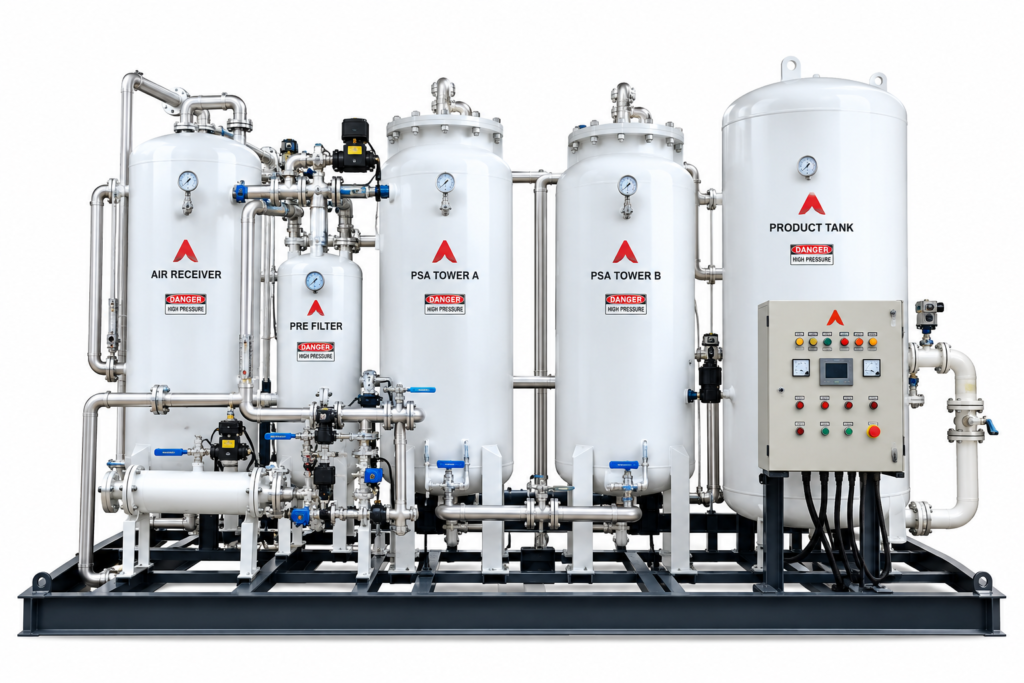
The PSA plant shown in the image consists of multiple pressure vessels, an air receiver, pre-filter, PSA adsorption towers, product tank, process piping, valves, pressure gauges and an automatic control panel. All these components work together to provide controlled and continuous gas separation.
One of the major advantages of PSA technology is that the adsorption and regeneration processes can be performed repeatedly in different vessels. While one tower is processing the feed gas, another tower can be regenerated. This alternating operation allows the system to provide a continuous supply of the desired product gas.
For industries that require a reliable supply of industrial gases, a properly designed PSA plant can be an important part of the production process. The system can be customized according to gas purity, flow rate, feed pressure, product pressure and specific application requirements.
What Is a PSA Plant?
A PSA Plant is a complete gas separation system based on Pressure Swing Adsorption technology. It separates specific gases from a gas mixture by using pressure changes and adsorption materials.
The basic working principle is relatively simple. A gas mixture enters an adsorption vessel containing a suitable adsorbent. Under increased pressure, the adsorbent preferentially captures certain components of the gas while allowing the required product gas to pass through.
After the adsorption material becomes loaded with the unwanted gas components, the pressure inside the vessel is reduced. This causes the adsorbed components to be released. The vessel is then regenerated and prepared for another adsorption cycle.
A PSA plant generally consists of two or more adsorption towers. Multiple towers are useful because the adsorption process cannot continue indefinitely in one vessel. When one tower reaches the required adsorption condition, the process switches to another tower while the first tower undergoes regeneration.
This repeated cycle allows a PSA system to produce gas continuously.
Basic Principle of PSA Technology
The main principle of PSA can be explained through two basic conditions:
- High pressure: Selected gas components are preferentially adsorbed.
- Low pressure: Adsorbed gas components are released from the adsorbent.
- Regeneration: The adsorbent is prepared for another cycle.
- Continuous cycling: Multiple towers operate in sequence.
The exact operating cycle depends on the application, feed-gas composition, adsorbent type, required product purity and plant capacity.
Main Components of a PSA Plant
A PSA plant is made up of several interconnected components. Each component has a specific role in ensuring efficient and reliable operation.
Air Receiver
The air receiver is used to provide a buffer for compressed air in systems where compressed air is the feed gas.
It helps maintain a stable supply of compressed air to the downstream treatment and PSA section. Since PSA plants operate through repeated pressure cycles, stable feed conditions can be important for consistent operation.
The receiver also helps accommodate temporary variations between compressed-air production and process demand.
Pre-Filter
The pre-filter is installed before the PSA adsorption towers to remove unwanted particles and contaminants from the incoming gas.
Clean feed gas is particularly important because contaminants can affect the performance and life of the adsorbent.
A suitable filtration system can help remove:
- Dust and solid particles
- Oil aerosols
- Moisture-related contaminants
- Other unwanted impurities
Proper pre-treatment can help protect the adsorption material and downstream components.
PSA Towers
The PSA towers are the main process vessels of the system.
In the image, two large vessels are identified as PSA Tower A and PSA Tower B. These towers contain the adsorbent material responsible for selective gas separation.
The towers operate alternately. One tower may be in the adsorption stage while the other is undergoing regeneration. The control system then switches their operating roles according to the programmed cycle.
The number of towers used in a PSA plant can vary depending on the required production capacity and process configuration.
Adsorbent Material
The adsorbent is one of the most important parts of a PSA system.
It is a porous solid material with a large surface area that preferentially attracts and retains selected gas molecules. Different applications require different adsorbents.
Commonly used adsorbent materials may include:
- Molecular sieves
- Zeolites
- Carbon molecular sieve
- Activated carbon
- Activated alumina
- Silica gel
- Application-specific adsorbents
The selection of the adsorbent depends on the gas mixture, required purity, pressure, temperature and desired separation performance.
Automatic Valves
Automatic valves control the direction of gas flow throughout the PSA system.
Because PSA operation consists of repeated adsorption, depressurization, regeneration and repressurization stages, accurate valve sequencing is extremely important.
The automatic valves determine which tower receives feed gas, which tower is regenerated and where the product or exhaust gas is directed.
Process Piping
The stainless-steel or metallic piping network connects the different components of the PSA plant.
The piping system carries feed gas, product gas and regeneration or exhaust streams between the various vessels and process components.
Proper piping design is important because excessive pressure loss can negatively affect the overall performance of the system.
Product Tank
The product tank provides storage or buffering for the generated gas.
Because PSA production takes place through cyclic operation, a product tank can help stabilize the product supply and reduce fluctuations in downstream gas demand.
The required product-tank capacity depends on the gas flow rate, operating pressure, application and system design.
Control Panel
The control panel is used to operate and monitor the PSA plant.
Modern PSA plants can use PLC-based control systems and HMI displays to manage automatic valve sequencing, pressure monitoring, alarms and operating cycles.
The control panel shown in the image contains various indicators, gauges, switches and control components that allow the operator to monitor plant operation.
How Does a PSA Plant Work?
The working of a PSA plant takes place through a series of controlled steps. Although the exact cycle differs according to the application, the basic process remains based on adsorption at higher pressure and desorption at lower pressure.
Feed Gas Entry
The process begins when the feed gas enters the system.
For a nitrogen or oxygen PSA plant, compressed atmospheric air may be used as the feed gas. Before reaching the adsorption towers, the air can pass through filtration and other pre-treatment equipment.
The purpose of this treatment is to provide feed gas with suitable quality for the adsorption process.
Pressurization
The selected adsorption tower is pressurized with the feed gas.
As pressure increases, the adsorbent preferentially captures the gas components for which it has greater adsorption affinity.
The operating pressure is an important parameter because it influences adsorption capacity and overall process performance.
Adsorption
During the adsorption stage, the feed gas enters the active PSA tower.
The adsorbent selectively retains unwanted components while the desired product gas passes through the adsorption bed.
For example, in a nitrogen PSA system, carbon molecular sieve can preferentially adsorb oxygen and allow nitrogen to pass through as the product gas.
The actual separation behavior depends on the selected adsorbent and process conditions.
Product Gas Collection
The desired product gas exits the active tower and moves toward the product outlet.
It may be directed directly to the application or stored temporarily in a product tank.
The product tank shown in the image can act as a buffer between the PSA system and the downstream application.
Depressurization
Once the adsorption stage is completed, the saturated tower is depressurized.
As the pressure decreases, the components retained by the adsorbent are released.
The released gases can be directed toward an exhaust or regeneration pathway depending on the system design.
Regeneration
During regeneration, the adsorption bed is restored so that it can perform another adsorption cycle.
Regeneration may involve pressure reduction, purge gas or other process steps depending on the PSA cycle.
Once regeneration is completed, the tower can be pressurized again.
Tower Switching
The control system switches the towers according to the programmed cycle.
For example:
- Tower A performs adsorption.
- Tower B undergoes regeneration.
- Tower A moves to regeneration.
- Tower B starts adsorption.
- The cycle repeats.
This coordinated operation allows the PSA plant to maintain a continuous product-gas supply.
PSA Plant Process Flow
The general process flow of a PSA plant can be understood as follows:
Feed Gas → Air Receiver → Pre-Filter → PSA Tower → Product Gas → Product Tank → Application
During regeneration, the flow path changes according to the programmed cycle, allowing the saturated tower to release the adsorbed gases.
| Component | Main Function |
|---|---|
| Air Receiver | Provides feed-gas buffering |
| Pre-Filter | Removes contaminants |
| PSA Tower A | Adsorption/regeneration |
| PSA Tower B | Adsorption/regeneration |
| Adsorbent | Selectively adsorbs gas components |
| Automatic Valves | Controls gas flow |
| Product Tank | Stores/buffers product gas |
| Control Panel | Controls and monitors the system |
| Pressure Gauges | Monitor operating pressure |
Types of PSA Plants
PSA technology can be designed for different gas separation requirements. The equipment configuration and adsorbent material depend on the desired product gas.
Nitrogen PSA Plant
A nitrogen PSA plant is designed to generate nitrogen-rich gas from compressed air.
Carbon molecular sieve is commonly used as the adsorbent. It preferentially adsorbs oxygen and allows nitrogen to pass through as the product.
Nitrogen generated through PSA can be used for various industrial applications where an inert or low-oxygen atmosphere is required.
Typical applications include:
- Food packaging
- Pharmaceutical manufacturing
- Chemical processing
- Metal processing
- Electronics manufacturing
- Oil and gas applications
- Tank blanketing
Oxygen PSA Plant
An oxygen PSA plant uses an adsorbent that preferentially captures nitrogen from air.
The process produces an oxygen-enriched gas stream that can be used for industrial or other suitable applications.
Oxygen PSA systems are commonly designed according to the required oxygen concentration, flow rate and application conditions.
Hydrogen PSA Plant
Hydrogen PSA systems are used to purify hydrogen from hydrogen-rich gas mixtures.
The feed gas may contain hydrogen along with methane, carbon monoxide, carbon dioxide and other components. Depending on the adsorbent and process design, impurities can be selectively adsorbed while purified hydrogen passes through as the product.
Hydrogen PSA technology is particularly relevant to industries that require high-purity hydrogen.
Biogas PSA System
PSA technology can also be used in biogas upgrading.
Biogas contains methane along with carbon dioxide and other impurities. In an appropriately designed PSA system, selected components can be removed to produce a methane-rich gas.
Depending on the complete plant design, pre-treatment may be required to remove moisture, hydrogen sulfide and other contaminants before the PSA stage.
Benefits of PSA Technology
PSA technology provides several advantages for industries that require on-site gas separation and purification.
Efficient Gas Separation
PSA provides an effective method for separating selected gases based on their adsorption properties.
The technology can be designed according to the required product purity and gas flow rate.
Continuous Gas Production
Multiple towers can operate in alternating cycles.
While one tower performs adsorption, another can be regenerated. This allows continuous product generation.
Automatic Operation
Modern PSA systems can be automated using PLC and HMI-based control systems.
Automatic operation helps control valve sequencing and process timing with limited manual intervention.
Compact Plant Design
PSA systems can be assembled on skid-mounted frames, as shown in the image.
A compact design can simplify transportation, installation and commissioning.
Flexible Applications
PSA technology can be adapted for:
- Nitrogen generation
- Oxygen generation
- Hydrogen purification
- Biogas upgrading
- Carbon dioxide removal
- Gas recovery
- Industrial gas purification
On-Site Gas Generation
A PSA plant can allow suitable industries to generate gas at their own facility rather than depending entirely on external gas deliveries.
This can provide greater control over gas availability and production planning.
Scalable System
PSA systems can be engineered for different capacities.
The size and number of towers, adsorbent quantity, cycle configuration and product storage can be selected according to the specific requirement.
Factors Affecting PSA Plant Performance
The efficiency of a PSA plant depends on several operating and design parameters.
Feed Gas Quality
The quality of the feed gas has a direct impact on the performance and life of the adsorption material.
Excessive moisture, oil or particulate contamination can affect the adsorbent.
Adsorbent Selection
Selecting the correct adsorbent is essential for achieving the desired separation.
The material should be compatible with the feed gas and target product.
Operating Pressure
The adsorption pressure and regeneration pressure affect the overall performance of the PSA cycle.
Incorrect pressure conditions can reduce separation efficiency or increase energy consumption.
Cycle Time
The timing of each stage affects the balance between product purity, recovery and production capacity.
A suitable cycle must be established for the particular application.
Valve Performance
Automatic valves need to operate correctly because even small leakage or switching problems can disturb the PSA cycle.
Regular valve inspection can help maintain reliable operation.
Product Purity
Product purity requirements should be defined before designing or selecting a PSA plant.
Higher purity requirements may influence product recovery, energy consumption and plant capacity.
PSA Plant Maintenance
Regular maintenance is essential for maintaining the reliability and efficiency of a PSA plant.
The pre-filter should be inspected regularly, and filter elements should be replaced when required. Pressure gauges and other instruments should also be checked to ensure accurate monitoring.
Automatic valves are another important maintenance area. Valve leakage or improper operation can affect cycle performance.
The adsorption material should be protected from contamination. Depending on the application and operating conditions, the adsorbent may eventually require replacement.
Important Maintenance Activities
- Check filters and replace them when necessary.
- Inspect automatic valves for leakage.
- Check pressure gauges and transmitters.
- Inspect process piping and connections.
- Check for gas leakage.
- Test control-panel functions.
- Check alarms and emergency systems.
- Monitor product-gas quality.
- Inspect the adsorption beds according to the manufacturer's maintenance schedule.
Proper maintenance can reduce unexpected downtime and help extend the operating life of the plant.
PSA Plant Safety Considerations
A PSA plant contains pressurized gas and pressure vessels, so safety must be considered during design, installation, operation and maintenance.
Operators should follow the manufacturer's operating instructions and applicable pressure-vessel and industrial safety requirements.
Before maintenance, the relevant equipment should be isolated and depressurized according to the approved safety procedure.
Important Safety Practices
- Operate the plant only through trained personnel.
- Regularly inspect pressure vessels and piping.
- Check pressure-relief and safety arrangements.
- Inspect valves and connections for leakage.
- Maintain suitable ventilation.
- Test alarms and emergency-stop systems.
- Follow proper startup and shutdown procedures.
- Use appropriate personal protective equipment.
- Maintain inspection and maintenance records.
Industrial Applications of PSA Plants
PSA plants are used across many industries because the technology can be adapted to different gas separation requirements.
Food and Beverage Industry
Nitrogen generated by PSA can be used in food packaging and controlled-atmosphere applications.
The use of nitrogen can help create a low-oxygen environment for suitable packaging processes.
Pharmaceutical Industry
Nitrogen and oxygen systems can be used in various pharmaceutical and laboratory applications depending on required gas quality and purity.
Chemical Industry
Chemical plants may require nitrogen for inerting, blanketing and process applications.
PSA technology can provide an on-site gas source where the process requirements are suitable.
Metal Processing
Nitrogen can be used in selected metal-processing and heat-treatment applications.
The required gas purity and flow depend on the specific process.
Electronics Industry
Certain electronics manufacturing processes require controlled atmospheres. Nitrogen generated using PSA can be used where the required purity and flow are compatible with the application.
Oil and Gas Industry
PSA systems can be used for hydrogen purification, gas separation and selected gas-recovery processes.
Renewable Energy and Biogas
PSA technology can be incorporated into biogas upgrading systems to separate carbon dioxide and produce a methane-rich gas stream.
How to Select the Right PSA Plant
Selecting the correct PSA plant requires understanding the complete gas requirement rather than looking only at the vessel size.
The first step is to determine the required product gas. After that, the required purity and flow rate should be established.
Feed-gas conditions are equally important. Pressure, temperature, composition and contamination levels can affect the PSA design.
Important Selection Parameters
- Required product gas
- Required gas purity
- Product flow rate
- Feed pressure
- Product pressure
- Feed-gas composition
- Operating hours
- Installation location
- Available space
- Electrical requirements
- Product storage requirements
- Maintenance requirements
A properly designed PSA system should balance purity, recovery, energy consumption, reliability and total operating cost.
Importance of Automation in PSA Plants
Automation plays an important role in modern PSA systems.
The PSA process requires repeated switching between different operating stages. Manual operation of every valve would be complicated and could lead to inconsistent cycle timing.
A PLC-based control system can automatically manage the operating sequence.
The HMI can provide the operator with information about plant status, pressure conditions, alarms and operating stages.
Advantages of Automation
- Automatic valve sequencing
- Accurate cycle timing
- Process monitoring
- Alarm indication
- Easier operation
- Reduced manual intervention
- Consistent process performance
- Improved operational control
The control panel shown in the image is therefore an important part of the overall PSA plant rather than simply an electrical enclosure.
Frequently Asked Questions About PSA Plants
What does PSA stand for?
PSA stands for Pressure Swing Adsorption.
What is a PSA plant used for?
A PSA plant is used for gas separation and purification. Depending on the design, it can be used for nitrogen generation, oxygen generation, hydrogen purification, biogas upgrading and other industrial gas applications.
How does a PSA plant work?
A PSA plant uses an adsorbent material to selectively capture specific gas components at higher pressure. When pressure is reduced, those components are released and the adsorbent is regenerated.
Why are two PSA towers used?
Two towers allow the adsorption and regeneration processes to alternate. While one tower produces product gas, the other tower can undergo regeneration.
What is the purpose of the pre-filter?
The pre-filter removes contaminants from the incoming gas before it enters the adsorption towers. It helps protect the adsorbent and downstream equipment.
What is the purpose of the product tank?
The product tank provides gas storage or buffering. It can help maintain a stable supply of product gas to the downstream application.
What adsorbent is used in a PSA plant?
The adsorbent depends on the application. Carbon molecular sieve, zeolites, molecular sieves, activated carbon and other specialized adsorbents may be used.
Can PSA produce nitrogen?
Yes. Nitrogen PSA systems are commonly designed to separate nitrogen from compressed air using an appropriate adsorbent.
Can PSA produce oxygen?
Yes. Oxygen PSA systems can separate nitrogen from air and produce an oxygen-enriched product gas.
Is PSA suitable for hydrogen purification?
Yes. PSA is widely used for purification and recovery of hydrogen from hydrogen-containing gas streams.
Can PSA be used for biogas upgrading?
Yes. PSA can be used as part of a biogas upgrading process to remove selected components such as carbon dioxide and produce a methane-rich gas.
Is a PSA plant fully automatic?
Modern PSA plants can be designed for automatic operation using PLC, HMI, sensors and automatic valves. The level of automation depends on the system design.
What affects PSA plant efficiency?
Feed-gas quality, adsorbent selection, pressure, cycle timing, valve performance, product purity requirements and overall system design can affect PSA plant performance.
How often does a PSA plant require maintenance?
Maintenance frequency depends on the equipment design, operating conditions and manufacturer's recommendations. Filters, valves, instruments, piping and control systems should be inspected regularly.
Conclusion
A Pressure Swing Adsorption Plant is an efficient and versatile solution for industrial gas separation and purification. By using selective adsorption and controlled pressure changes, PSA technology can separate specific components from gas mixtures and produce a required gas stream. https://www.india.gov.in/
The PSA plant shown in the image demonstrates a complete industrial arrangement consisting of an air receiver, pre-filter, PSA towers, product tank, automatic valves, process piping, pressure gauges and a control panel. Each component has an important role in maintaining the overall performance of the system.
The two PSA towers operate in an alternating sequence. While one tower is engaged in adsorption, another tower can be regenerated. This cyclic operation makes it possible to maintain a continuous product-gas supply.
The major benefits of PSA technology include efficient gas separation, continuous gas production, automatic operation, compact design, flexible applications, scalability and on-site gas generation.
PSA systems can be used for nitrogen generation, oxygen generation, hydrogen purification, biogas upgrading and several other industrial applications. However, the correct system should always be selected according to feed-gas conditions, required purity, flow rate, operating pressure and specific process requirements.
With suitable filtration, correct adsorbent selection, reliable valves, accurate instrumentation, proper automation and regular maintenance, a PSA plant can provide a dependable solution for industrial gas generation and purification.
Leave A Comment