
Heat of Compression Dryer | Energy Efficient Air Dryer
Discover MAAS Energy Solutions’ Heat of Compression Dryer for energy-efficient compressed air drying. Achieve ultra-dry air, lower energy use and reliable industrial performance.
Compressed air is an essential part of modern industrial operations. From manufacturing plants and pharmaceutical facilities to food processing units, packaging industries and engineering workshops, compressed air powers a wide range of machines, tools and production processes. However, the quality of compressed air plays an important role in maintaining equipment performance, product quality and operational reliability. Moisture present in compressed air can create several challenges, including corrosion, contamination, malfunctioning pneumatic equipment and unwanted production interruptions.
A Heat of Compression Dryer is an industrial compressed air drying solution designed to remove moisture from compressed air while utilizing the heat generated during the compression process. Instead of depending entirely on additional electric heaters or compressed air purge for regeneration, heat of compression technology uses available compressor heat to regenerate the drying material. This can reduce the additional energy requirements of the drying process when the dryer is properly matched with a suitable compressor and operating conditions.
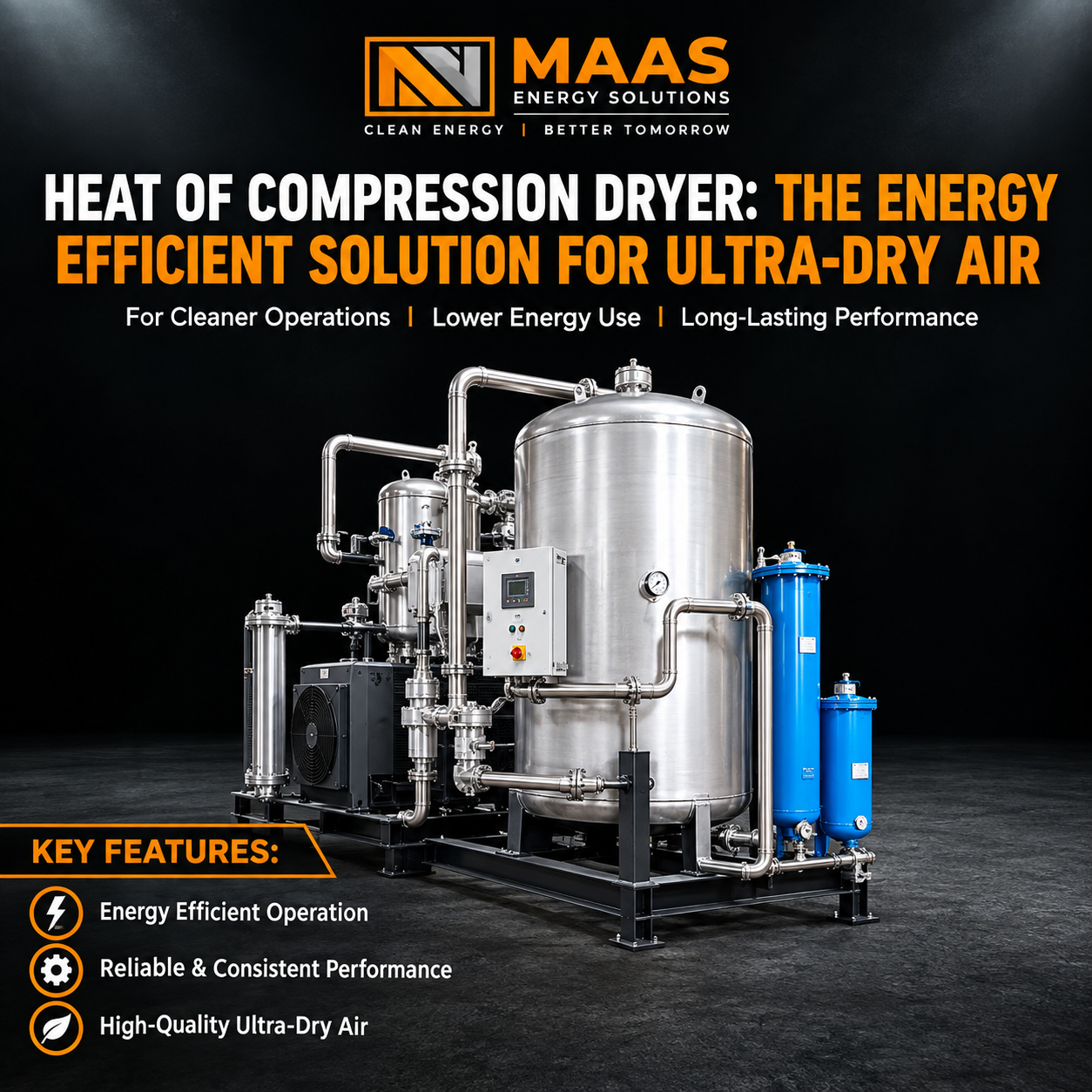
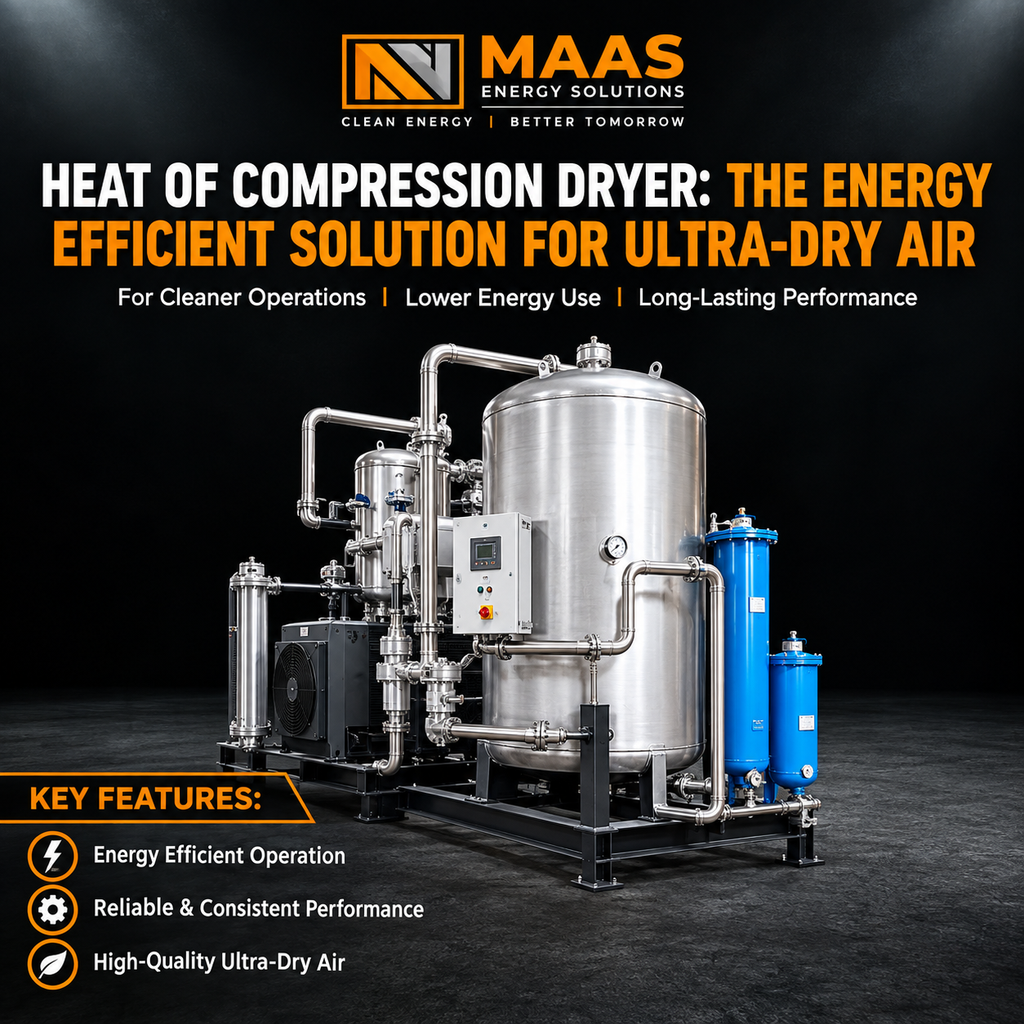
MAAS Energy Solutions focuses on industrial energy solutions designed to support cleaner operations, efficient energy use and long-lasting performance. The Heat of Compression Dryer shown in the featured image represents an industrial drying system built around stainless-steel vessels, connected piping, valves, instrumentation and a control panel. Such equipment is used as part of compressed air treatment systems where moisture control and reliable dry air are important.
This blog explains the working principle, major features, benefits, applications and selection considerations of Heat of Compression Dryers. It also explains why using compressor-generated heat can be a useful approach for industries looking to improve compressed air efficiency.
Table of Contents
- Introduction to Heat of Compression Dryer
- What Is a Heat of Compression Dryer?
- Why Is Dry Compressed Air Important?
- How Does a Heat of Compression Dryer Work?
- Key Features of Heat of Compression Dryer
- Energy Efficiency and Operating Benefits
- Applications of Heat of Compression Dryer
- Heat of Compression Dryer vs Other Air Dryers
- Important Factors Before Selecting an HOC Dryer
- Maintenance and Performance Considerations
- Frequently Asked Questions
- Conclusion
Introduction to Heat of Compression Dryer
Compressed air contains moisture because atmospheric air naturally contains water vapour. During compression, air temperature increases and the air is subsequently cooled in the compressed air system. As the air cools, moisture can condense and enter downstream pipelines, equipment and production areas. This is why industrial compressed air systems often require suitable drying equipment.
A compressed air dryer helps reduce moisture so that the air delivered to the plant meets the required quality level. Different industrial applications require different levels of dryness. Some general-purpose applications may use refrigerated dryers, while processes requiring lower pressure dew points may need desiccant-based drying systems.
Heat of Compression Dryers belong to the regenerative desiccant dryer category. Their operating principle is based on utilizing heat generated by the air compressor for regeneration of moisture-loaded desiccant. According to the U.S. Department of Energy, heat-of-compression dryers use compressor-generated heat to regenerate the desiccant material. The exact design can involve twin towers or a rotating desiccant drum.
For industries operating suitable compressors, this technology can offer an approach to dry compressed air while reducing the need for external regeneration energy.
What Is a Heat of Compression Dryer?
A Heat of Compression Dryer, commonly called an HOC Dryer, is a compressed air drying system that uses the heat naturally produced during air compression to regenerate a desiccant material.
The desiccant absorbs moisture from compressed air during the drying process. When the desiccant becomes moisture-loaded, it needs regeneration to restore its moisture-removal capacity. In a Heat of Compression Dryer, hot air from a suitable compressor is used as the heat source for regeneration.
Unlike a conventional heatless desiccant dryer, which uses a portion of dry compressed air for regeneration, an HOC dryer can be designed to reduce or eliminate regeneration purge-air losses. However, actual performance depends on the dryer design, compressor type, inlet conditions, required dew point and operating load.
Main Components of a Heat of Compression Dryer
An industrial Heat of Compression Dryer generally includes several components working together to provide continuous or cyclic compressed air drying.
- Drying vessels or desiccant chambers.
- Regeneration air piping.
- Heat-resistant valves and connecting pipelines.
- Moisture separation and condensate drainage components.
- Pressure gauges and instrumentation.
- Control panel for automatic operation.
- Supporting skid or structural frame.
- Desiccant material designed for the required drying performance.
The featured MAAS Energy Solutions image shows a large stainless-steel vessel, additional vertical vessels, connected metallic piping, blue filter-like components and a control panel mounted on a supporting frame. The exact internal configuration, capacity and operating specifications should be confirmed from the manufacturer’s technical datasheet.
Why Is Dry Compressed Air Important?
Moisture control is an important part of industrial compressed air management. When wet compressed air enters a production system, it can affect both equipment and the final manufacturing process. The impact depends on the amount of moisture, pressure, temperature and the sensitivity of the application.
Compressed air dryers are used to reduce water vapour and prevent moisture-related problems in compressed air networks. Desiccant dryers are particularly relevant when a lower pressure dew point is required than a refrigerated dryer can provide.
Protection of Pneumatic Equipment
Pneumatic cylinders, valves, actuators and air-operated tools require suitable compressed air quality. Moisture can contribute to corrosion, lubricant problems and operational issues in pneumatic equipment.
Using an appropriate dryer helps maintain the air quality required for the equipment and can support reliable operation.
Improved Product and Process Quality
Many industrial manufacturing processes depend on clean and dry compressed air. In applications where compressed air comes into contact with products or sensitive instruments, moisture control becomes particularly important.
Dry compressed air can help reduce the risk of moisture-related contamination and process disruption when the drying system is correctly selected.
Reduced Moisture in Air Pipelines
Water condensation inside compressed air pipelines can create operational problems. Moisture can collect in low points, damage components and increase maintenance requirements.
A suitable air dryer, combined with proper moisture separation and drainage, helps control water vapour in the air distribution system.
Importance of Pressure Dew Point
Pressure dew point, or PDP, is the temperature at which water vapour in compressed air begins to condense at the specified pressure. A lower pressure dew point indicates that the air can remain free of condensation at lower temperatures.
Different applications require different PDP values. Desiccant dryers are commonly selected for low-dew-point requirements, including standard ratings such as −20°C, −40°C and −70°C depending on the technology and operating conditions.
How Does a Heat of Compression Dryer Work?
A Heat of Compression Dryer works by combining moisture adsorption and heat-based desiccant regeneration. The system uses a drying section to remove moisture from compressed air and a regeneration section to restore the drying capability of the desiccant.
The exact sequence depends on whether the dryer uses a twin-tower design, a rotating drum or another specialized configuration. In a twin-tower arrangement, one vessel generally dries the compressed air while the other vessel undergoes regeneration. In a rotary drum design, different sections of the desiccant drum perform drying and regeneration simultaneously.
Step 1: Compressed Air Enters the Drying System
Compressed air from the compressor enters the air treatment system. Depending on the design, hot compressor discharge air may be routed through the regeneration section, while the air intended for drying is cooled and directed through the active desiccant section.
The air treatment arrangement must be designed according to the compressor discharge temperature, pressure, flow rate and moisture load.
Step 2: Moisture Is Captured by the Desiccant
The air passes through a desiccant material that attracts and holds water vapour on its surface. This is called adsorption.
As the compressed air flows through the drying section, moisture is removed from the air. The resulting dry air is then delivered to the downstream compressed air network.
Step 3: Compressor Heat Regenerates the Desiccant
During normal compressor operation, a considerable amount of energy used in compression is converted into heat. A Heat of Compression Dryer uses suitable compressor heat for desiccant regeneration.
Hot air is directed through the moisture-loaded desiccant section. The heat helps drive moisture away from the desiccant so that the material can be used again for drying.
The U.S. Department of Energy describes this principle as using hot air from the compressor discharge for regeneration before the air passes through cooling and drying stages.
Step 4: Moisture Is Removed from the System
The moisture released during regeneration is carried away by the regeneration air. Depending on the design, cooling and moisture separation stages may be included to support the required air treatment process.
Condensate separation and drainage are important because liquid water must be managed before it reaches moisture-sensitive components.
Step 5: Drying and Regeneration Continue
In a twin-tower HOC dryer, the drying and regeneration functions alternate between vessels. This allows the system to maintain a continuous supply of treated compressed air.
The control system manages valve operation, timing, pressure conditions and switching sequences according to the dryer design.
Key Features of Heat of Compression Dryer
The featured industrial dryer image highlights a robust compressed air treatment arrangement with stainless-steel vessels, piping, control equipment and a supporting base frame. The following are important features commonly associated with Heat of Compression Dryer technology. Actual features depend on the selected model.
1. Energy-Efficient Operation
One of the main advantages of HOC technology is the utilization of compressor-generated heat for regeneration. This can reduce the requirement for additional electric heating in suitable installations.
Heat of Compression Dryers are recognized as a regeneration approach that recovers heat from compression rather than relying only on external heating.
2. Reduced Regeneration Air Loss
Traditional heatless desiccant dryers use dry compressed air to regenerate the desiccant. That purge air is vented and is not available for production.
A Heat of Compression Dryer can be designed with little or no regeneration purge-air consumption, depending on its configuration. This can help improve the amount of compressed air available to the plant.
3. Reliable and Consistent Performance
A properly selected dryer can provide a consistent pressure dew point under suitable operating conditions. Reliable performance depends on correct sizing, inlet air quality, compressor compatibility and maintenance.
Automatic controls and properly designed switching arrangements help maintain the required drying cycle.
4. High-Quality Ultra-Dry Air
Desiccant-based dryers are used for applications requiring lower pressure dew points. Heat of Compression Dryers can be configured for low-dew-point compressed air, depending on the model and operating conditions.
For example, desiccant dryer technologies are commonly used for applications requiring pressure dew points below freezing.
5. Robust Industrial Construction
The image showcases a large stainless-steel vessel assembly with connected piping, pressure instrumentation, a control panel and a skid-mounted frame. Such construction is suitable for industrial equipment layouts where durability, organized piping and accessible controls are important.
Material selection, vessel design, welding standards and pressure ratings should be verified through the equipment specification.
6. Automatic Control System
An automatic control panel can manage valve switching, operating cycles, alarms and system monitoring.
Depending on the model, instrumentation may include pressure gauges, temperature sensors, dew point monitoring and control indicators.
7. Reduced Additional Heating Requirements
By using suitable compressor heat, the system may reduce or eliminate the need for an external regeneration heater. This can lower additional electrical energy requirements, but the actual result depends on compressor discharge temperature and dryer configuration.
8. Industrial Skid-Mounted Design
The image features equipment mounted on a structural base frame. Skid-mounted construction helps organize vessels, piping and control components in a compact industrial arrangement.
It can also support installation, alignment and integration into a larger compressed air system.
Energy Efficiency and Operating Benefits
Energy efficiency is a major reason industries consider Heat of Compression Dryers. Compressed air systems consume significant energy, and drying methods can affect the overall operating cost.
A conventional heatless desiccant dryer may use a portion of compressed air for regeneration. The compressor must produce that air, which means the plant spends energy to generate air that is later released during the drying cycle.
A Heat of Compression Dryer uses heat already generated by a suitable compressor. This can reduce the additional energy required for regeneration and, in certain designs, reduce compressed air losses.
Reduced Energy Consumption
The use of waste heat from compression can lower the need for electric heaters or purge-air regeneration. This may reduce the incremental energy required by the dryer.
However, energy savings should be calculated from actual plant data, including compressor type, operating hours, inlet temperature, pressure, air flow and dryer load.
Lower Compressed Air Waste
Some desiccant dryers use purge air for regeneration. HOC systems can be designed to minimize or eliminate that loss.
Reducing compressed air waste can help improve system efficiency because the compressor does not need to generate as much air that will be vented during regeneration.
Better Use of Compressor Heat
Air compression naturally generates heat. In many installations, this heat is removed through cooling systems. Heat of Compression technology can use suitable compressor heat for regeneration instead of relying only on external heating.
This is an example of recovering energy already available in the compressed air process.
Important Energy Efficiency Considerations
- Compressor discharge temperature must be sufficient for the selected dryer.
- Compressor and dryer should be compatible.
- Air flow and operating pressure should match the required design.
- Pressure drop across the dryer should be considered.
- Moisture load and required dew point should be evaluated.
- The system should be maintained and monitored regularly.
Applications of Heat of Compression Dryer
Heat of Compression Dryers are used in industrial compressed air systems where moisture control and energy efficiency are important. Their suitability depends on the application requirements and compressor configuration.
Pharmaceutical Manufacturing
Pharmaceutical manufacturing processes often require controlled air quality. Moisture can affect sensitive processes, instruments and equipment.
A suitable compressed air dryer can support the required air quality when used with appropriate filtration and monitoring.
Food and Beverage Industry
Food processing and packaging plants may use compressed air for pneumatic equipment, automation and process operations.
Dry compressed air can help reduce moisture-related issues in air lines and equipment. Where air contacts food products, the complete air quality specification must be addressed.
Chemical and Process Industries
Chemical plants use compressed air for instrumentation, pneumatic control valves and automation systems.
A reliable dryer can help reduce moisture-related problems in instrument air systems and support consistent plant operation.
Engineering and Manufacturing Plants
Industrial engineering and manufacturing facilities use compressed air for air tools, machinery, automation and production equipment.
HOC technology may be considered where a suitable compressor is available and the plant requires low-dew-point compressed air.
Automotive and Component Manufacturing
Automotive production facilities may use compressed air for pneumatic tools, control systems, cleaning and manufacturing operations.
Dry air can help reduce moisture-related issues in equipment and support reliable compressed air use.
Instrumentation and Automation
Pneumatic instruments and control systems can be sensitive to moisture. A suitable low-dew-point dryer may be used where air quality requirements demand it.
General Industrial Air Treatment
Heat of Compression Dryers may also be considered in other industries that need controlled moisture levels, reliable compressed air and efficient regeneration.
Heat of Compression Dryer vs Other Air Dryers
Different compressed air drying technologies use different regeneration methods. The best selection depends on required dew point, compressor type, flow rate, air quality and operating cost.
| Feature | Heat of Compression Dryer | Heatless Desiccant Dryer | Refrigerated Air Dryer |
|---|---|---|---|
| Drying technology | Desiccant regeneration using compressor heat | Desiccant regeneration using purge air | Cooling and moisture condensation |
| Regeneration energy | Uses suitable compressor heat | Uses dry compressed air | Uses refrigeration system |
| Purge air | Can be zero or very low, depending on design | Commonly uses purge air | Usually no desiccant regeneration purge |
| Low dew point capability | Depends on model and conditions | Commonly used for low dew points | Usually suited to less demanding dew point requirements |
| Compressor compatibility | Requires suitable compressor heat and air quality | Broadly applicable with suitable design | Broadly applicable with suitable design |
| Operating cost | Can be low for compatible installations | Depends on purge and energy use | Depends on refrigeration power |
| Best suited for | Suitable industrial compressor and low-dew-point applications | Low-dew-point applications with appropriate purge management | General compressed air drying |
Heatless desiccant dryers use purge air for regeneration, while refrigerated dryers use cooling to remove moisture. Heat of Compression Dryers use compressor heat as a regeneration source.
Why Compressor Compatibility Matters
Heat of Compression Dryers depend on the temperature and characteristics of compressor discharge air. They are commonly associated with suitable oil-free compressors because oil contamination can affect desiccant performance.
The U.S. Department of Energy notes that HOC dryers require sufficiently hot compressor air and are used mainly with centrifugal or lubricant-free rotary screw compressors.
Important Factors Before Selecting an HOC Dryer
Choosing the right dryer is important for achieving the required air quality and operating performance. A dryer should not be selected only by looking at its capacity or physical size.
Air Flow and Pressure
The dryer should be sized according to the required compressed air flow and operating pressure. Oversizing or undersizing can affect cost, performance and efficiency.
Required Pressure Dew Point
The required pressure dew point should be defined before selecting the dryer. Different applications may require different dryness levels.
Compressor Type
The compressor type is a key selection factor for HOC technology. Compressor discharge temperature and air quality must be suitable for the dryer.
Inlet Air Temperature
Hot air from the compressor is important for regeneration. The dryer should be evaluated using actual compressor operating conditions.
Moisture Load
Ambient humidity, compressor inlet conditions and operating environment influence the moisture entering the compressed air system.
Filtration and Drainage
Liquid water and contaminants must be managed before they reach the desiccant. Proper pre-filtration, moisture separation and drainage are important for reliable operation.
Installation Space
The installation area should provide sufficient room for vessels, piping, maintenance access, ventilation and control equipment.
Maintenance Support
Availability of replacement parts, service support and technical assistance should be considered before installation.
Maintenance and Performance Considerations
Regular maintenance helps support the long-term performance of industrial compressed air dryers. Even energy-efficient drying equipment requires proper monitoring and service.
Inspect Filters and Drains
Filters should be checked for contamination and pressure drop. Moisture separators and drains should operate correctly to prevent water carryover.
Monitor Dew Point
Dew point monitoring helps verify that the dryer is meeting the required compressed air quality. A change in dew point can indicate a problem with operating conditions, desiccant condition or control operation.
Check Valves and Piping
Valves, seals and piping connections should be inspected for leaks, wear and abnormal operating conditions.
Verify Compressor Conditions
The compressor should provide the required discharge temperature and air quality. Changes in compressor operation can affect HOC dryer performance.
Follow Manufacturer Guidelines
Desiccant replacement, inspection intervals, calibration and servicing should be carried out according to the manufacturer’s recommendations.
Frequently Asked Questions
What is a Heat of Compression Dryer?
A Heat of Compression Dryer is a regenerative desiccant compressed air dryer that uses heat generated during air compression to regenerate moisture-loaded desiccant. This can reduce the need for external regeneration energy.
How does a Heat of Compression Dryer save energy?
It utilizes suitable compressor-generated heat for desiccant regeneration. This can reduce the need for electric heaters and, depending on the design, reduce compressed air purge losses.
Is a Heat of Compression Dryer suitable for every compressor?
No. HOC dryers require suitable compressor operating conditions, including sufficient discharge temperature and compatible air quality. They are commonly used with suitable oil-free compressors.
What is the difference between HOC and heatless dryers?
A Heat of Compression Dryer uses compressor heat for regeneration. A heatless dryer uses a portion of dry compressed air to regenerate the desiccant. The HOC approach can reduce purge-air losses when correctly designed.
Can a Heat of Compression Dryer provide ultra-dry air?
HOC dryers can be designed for low pressure dew points, but the achievable dew point depends on the dryer model, compressor conditions and application requirements. The required specification should be confirmed with the manufacturer.
Does an HOC Dryer require an electric heater?
Some HOC dryer designs use compressor heat without an external regeneration heater. Certain systems may use supplementary heating or additional cooling arrangements. The actual configuration depends on the model.
What industries use Heat of Compression Dryers?
Potential applications include pharmaceutical manufacturing, food processing, chemical plants, engineering industries, automotive manufacturing, instrumentation and industrial automation.
Why is moisture removal important in compressed air?
Moisture can cause corrosion, equipment problems and process issues. A suitable air dryer helps maintain compressed air quality and supports reliable operation.
What is pressure dew point?
Pressure dew point is the temperature at which water vapour in compressed air begins to condense at a specified pressure. Lower PDP requirements generally call for more advanced drying technology.
How do I select the correct HOC Dryer?
Selection should consider compressed air flow, operating pressure, compressor type, discharge temperature, required dew point, moisture load, installation conditions and maintenance requirements.
Conclusion
A Heat of Compression Dryer is an important compressed air treatment solution for industries looking to maintain dry air quality while utilizing available compressor heat. By using heat generated during compression for desiccant regeneration, the technology can reduce additional regeneration energy and, in suitable designs, minimize compressed air purge losses.
The featured MAAS Energy Solutions industrial dryer image represents the type of equipment used in compressed air drying systems where robust construction, connected piping, automatic controls and efficient operation are important. Its stainless-steel vessels, instrumentation and supporting frame reflect the industrial nature of compressed air treatment equipment. https://www.digitalindia.gov.in/
Selecting the right dryer requires more than simply choosing a machine with a suitable flow capacity. Compressor compatibility, required pressure dew point, air quality, operating temperature and maintenance requirements must all be evaluated.
Leave A Comment