
Table of Contents
- Introduction
- What Is a Biogas Purification Plant?
- How Does a Biogas Purification Plant Work?
- Key Features of a Biogas Purification Plant
- Major Components of a Biogas Purification System
- Benefits of Biogas Purification
- Applications of Biogas Purification Plants
- Biogas Purification vs Raw Biogas
- Factors to Consider When Selecting a Biogas Purification Plant
- VPSA Technology for Biogas Purification
- Why Pre-Treatment Is Important in Biogas Purification
- Biogas Purification Plant Maintenance
- Why Choose MAAS Air N Gas for Biogas Purification Solutions?
- Frequently Asked Questions
- Conclusion
Introduction
Explore Biogas Purification Plant technology, working process, adsorber towers, key features, benefits, applications and Bio Gas to CNG purification solutions.
Biogas is an important renewable energy source generated from the anaerobic digestion of organic materials. However, raw biogas contains not only methane but also carbon dioxide, moisture, hydrogen sulfide, volatile organic compounds and other impurities. For many applications, these unwanted components need to be removed or reduced before the gas can be used further.
A Biogas Purification Plant is designed to treat and upgrade raw biogas by removing contaminants and increasing the concentration of methane in the product gas. Depending on the selected technology and application, the purified gas can be used for industrial applications or further processed for Bio-CNG/CBG production.
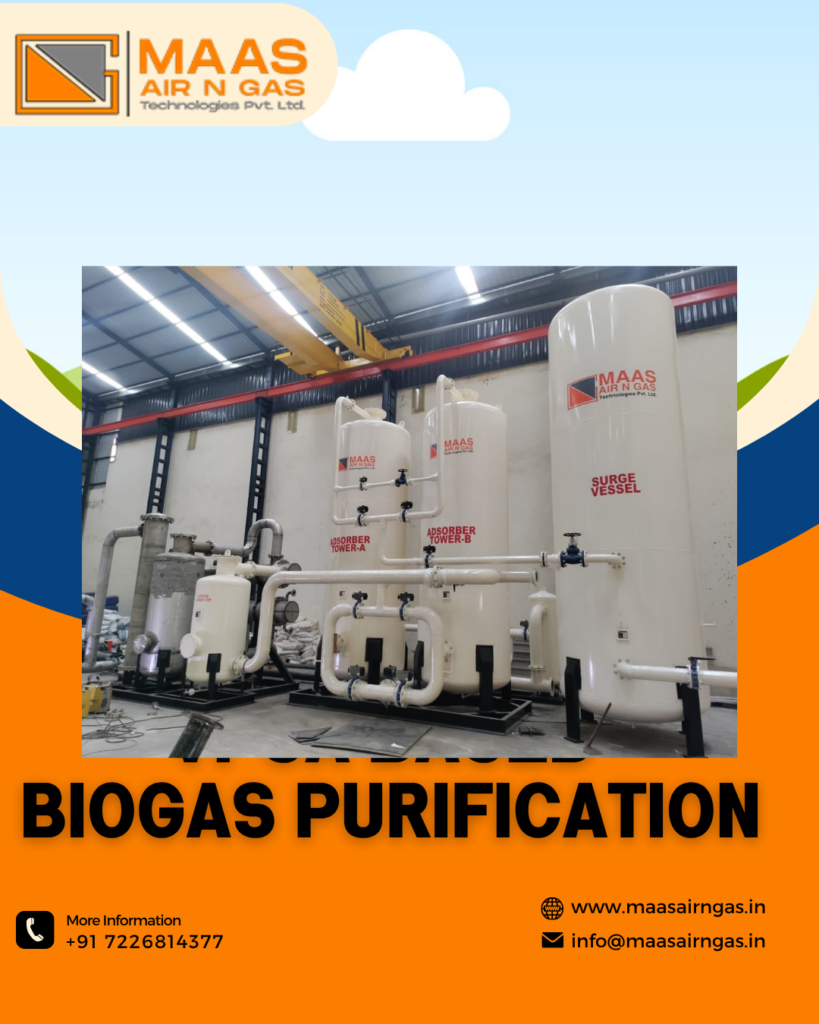
The image featured in this article shows a biogas purification installation from MAAS Air N Gas Technologies Pvt. Ltd., with clearly visible Adsorber Tower-A, Adsorber Tower-B and Surge Vessel. These components are associated with adsorption-based gas purification systems.
MAAS Air N Gas’s official Bio Gas to CNG technology page describes a multi-stage pre-treatment process followed by moisture removal, activated carbon filtration and VPSA technology for removing CO₂ from cleaned and dehumidified biogas.
What Is a Biogas Purification Plant?
A Biogas Purification Plant is an industrial gas-treatment system used to remove unwanted components from raw biogas and produce cleaner, methane-rich gas.
Raw biogas can contain different gases depending on the feedstock and digestion process. Methane is the main combustible component, while carbon dioxide and other contaminants need to be managed according to the intended application.
A typical purification system may include:
- Biogas pre-treatment
- Moisture removal
- Hydrogen sulfide removal
- Activated carbon filtration
- CO₂ removal
- Adsorption-based gas separation
- Gas quality monitoring
- Surge vessel
- Product gas storage or further compression
The exact process configuration depends on raw biogas composition, flow rate, required product-gas quality and final application.
How Does a Biogas Purification Plant Work?
Biogas Collection and Feed
The purification process begins when raw biogas generated from an anaerobic digestion system is collected and directed toward the purification plant.
The gas composition should be analyzed before selecting the purification system because methane concentration, moisture, H₂S, CO₂ and other contaminants can vary significantly.
Pre-Treatment of Biogas
Raw biogas normally requires pre-treatment before entering the main upgrading section.
Pre-treatment can include removal or reduction of moisture, hydrogen sulfide, VOCs, siloxanes and other contaminants depending on the feed gas and system design.
MAAS Air N Gas describes a four-stage pre-treatment process for removing contaminants such as H₂S, VOCs and moisture.
Moisture Removal
Moisture removal is an important part of biogas treatment.
Water vapor can cause condensation, corrosion and operational problems in downstream equipment. Dehumidification helps prepare the gas for the purification stage.
MAAS Air N Gas describes a custom-designed low-pressure dehumidifier for moisture removal in its Bio Gas to CNG process.
Hydrogen Sulfide and Impurity Removal
Hydrogen sulfide is an unwanted contaminant in biogas. Depending on concentration and process design, an appropriate treatment system is used to reduce H₂S.
MAAS Air N Gas states that its process uses activated carbon filtration for removing impurities such as H₂S, VOCs and siloxanes.
Carbon Dioxide Removal
After pre-treatment and moisture removal, the gas can enter the main upgrading section.
In the VPSA process described by MAAS Air N Gas, dry biogas enters adsorption columns containing molecular-sieve materials. CO₂ is adsorbed while methane-rich gas exits the top of the adsorption towers.
Key Features of a Biogas Purification Plant
Adsorber Tower System
The image prominently shows two vessels identified as Adsorber Tower-A and Adsorber Tower-B.
Adsorption-based systems use adsorbent materials to selectively capture particular gas components. Multiple towers allow different stages of adsorption and regeneration to be coordinated.
Surge Vessel
The large vessel shown in the image is labelled Surge Vessel.
A surge vessel can provide an intermediate volume for the treated gas and help stabilize the gas flow and pressure before the gas moves to the next stage.
In the MAAS process description, purified dry methane from the adsorption towers is sent to a surge vessel for analysis before being sent toward final storage when the required methane percentage is achieved.
Automatic Changeover
In an adsorption-based system, the towers can operate in alternating cycles.
MAAS Air N Gas describes automatic changeover valves controlled through a PLC, allowing one tower to operate in adsorption while the other undergoes regeneration.
PLC-Based Control
A PLC-based control system can coordinate the process sequence and automatic valve operation.
The company describes its biogas purification plant as having man-less operation through PLC with HMI and provision for remote process-control access.
Multi-Stage Pre-Treatment
Effective pre-treatment helps protect downstream adsorption equipment from contaminants.
MAAS Air N Gas specifically highlights pre-treatment for H₂S, VOCs and moisture as a feature of its biogas purification plant.
Customized Configuration
Biogas purification systems need to be selected according to the characteristics of the particular project.
Important parameters include gas flow, pressure, methane concentration, CO₂ concentration, contaminants, required product quality and final application.
MAAS Air N Gas states that its plants are designed to meet individual client requirements and use cases.
Major Components of a Biogas Purification System
Pre-Treatment System
The pre-treatment section prepares raw biogas for the main purification process by reducing contaminants that could affect downstream equipment.
Dehumidification System
The dehumidification system removes water vapor from the biogas stream.
Activated Carbon Filter
Activated carbon can be used for removing selected impurities such as H₂S, VOCs and siloxanes, depending on the process design.
Adsorber Towers
Adsorber towers contain specialized adsorbent materials used for selective gas separation.
The image shows a twin-tower arrangement with Adsorber Tower-A and Adsorber Tower-B.
Vacuum System
In VPSA systems, a vacuum pump can assist with regeneration of the adsorbent material after the adsorption stage.
MAAS Air N Gas describes regeneration through depressurization and vacuum using a vacuum pump.
Surge Vessel
The surge vessel receives treated gas and can provide an intermediate storage/buffering function before further processing.
PLC and HMI System
The control system can monitor and coordinate the different operating cycles of the plant.
Gas Quality Monitoring
Gas quality analysis is important for verifying that the product gas meets the required specification for its intended application.
Benefits of Biogas Purification
Higher Methane Concentration
Purification and upgrading can increase the methane concentration of biogas by removing unwanted components such as CO₂.
Better Gas Quality
Removing moisture, H₂S and other contaminants can improve the quality of gas supplied to downstream equipment.
Supports Bio-CNG Production
Purified methane-rich gas can be further compressed and used as Bio-CNG/CBG when it meets the applicable specifications.
Protection of Downstream Equipment
Pre-treatment and contaminant removal can help reduce exposure of downstream equipment to moisture, H₂S and other unwanted substances.
Automated Operation
PLC-based automation can reduce routine manual intervention and coordinate the operating cycles of the purification system.
Continuous Gas Processing
Alternating adsorption and regeneration cycles can allow the purification process to continue while individual towers operate in different stages.
Waste-to-Energy Applications
Biogas purification can form part of a larger waste-to-energy system in which organic material is converted into biogas and the biogas is upgraded into a useful energy product.
Applications of Biogas Purification Plants
Bio-CNG and CBG Production
Biogas purification is an important stage when raw biogas is being upgraded for Bio-CNG or compressed biogas applications.
Industrial Fuel
Methane-rich purified gas can be considered for suitable industrial fuel applications, subject to gas quality and equipment requirements.
Power Generation
Biogas treatment can be integrated with gas-engine or other power-generation systems where the gas specification is suitable.
Agricultural Waste Projects
Agricultural residues and animal waste can be used as feedstock for anaerobic digestion, followed by biogas treatment and upgrading.
Food Processing Industries
Food-processing facilities can generate biodegradable waste that may be suitable for anaerobic digestion and subsequent biogas purification.
Wastewater Treatment
Biogas generated during wastewater treatment can be treated and utilized depending on the project configuration and gas quality.
MAAS Air N Gas also lists biogas dehydration applications associated with wastewater treatment plants, wineries and breweries, cheese plants and other facilities.
Biogas Purification vs Raw Biogas
| Parameter | Raw Biogas | Purified / Upgraded Biogas |
|---|---|---|
| Methane | Present | Higher concentration after upgrading |
| Carbon Dioxide | Relatively significant | Reduced through purification |
| Moisture | Can be high | Reduced through dehumidification |
| H₂S | May be present | Reduced through treatment |
| VOCs / Siloxanes | May be present | Can be reduced through appropriate filtration |
| Gas Quality | Variable | Controlled according to application |
| Further Compression | Requires appropriate treatment | Can be suitable for further processing when specifications are met |
| Main Purpose | Produced from anaerobic digestion | Fuel, industrial use or Bio-CNG processing |
Factors to Consider When Selecting a Biogas Purification Plant
Biogas Flow Rate
The plant capacity should be selected according to the expected raw biogas flow.
Raw Gas Composition
A gas analysis is important for determining the appropriate purification technology and pre-treatment requirements.
Methane Concentration
The starting methane concentration affects the upgrading process and expected product-gas quality.
CO₂ Concentration
The amount of CO₂ in the raw gas is an important parameter when selecting a gas-upgrading system.
H₂S and Other Contaminants
H₂S, VOCs, siloxanes and moisture should be evaluated before finalizing the treatment system.
Required Product Quality
The required final gas quality depends on whether the gas will be used for heating, power generation, Bio-CNG production or another application.
Automation Level
Project requirements should determine the desired level of PLC, HMI, remote monitoring and automatic valve operation.
Maintenance and Service
Maintenance requirements, availability of spare parts, technical support and service arrangements should also be considered.
VPSA Technology for Biogas Purification
What Is VPSA?
VPSA stands for Vacuum Pressure Swing Adsorption.
It is an adsorption-based gas separation process in which changes in pressure and vacuum conditions are used to help separate selected components from a gas mixture.
How VPSA Works in Biogas Purification
In the process described by MAAS Air N Gas, dry biogas enters the adsorption column from the bottom.
The adsorption material selectively adsorbs CO₂, while methane-rich gas exits from the top of the tower.
When one tower is in adsorption mode, the other tower undergoes regeneration through depressurization and vacuum. Automatic valves then change the operating sequence between the towers.
This alternating arrangement allows the system to continue processing biogas while the adsorption material in another tower is regenerated.
Why Pre-Treatment Is Important in Biogas Purification
Protects Adsorbent Material
Contaminants can affect the performance and useful life of adsorption materials. Appropriate pre-treatment helps reduce this exposure.
Controls Moisture
Moisture removal helps prevent condensation and prepares the gas for downstream purification.
Removes H₂S and Other Impurities
Activated carbon and other suitable treatment methods can reduce contaminants before the main adsorption stage.
Improves Process Stability
Consistent pre-treated gas can support more stable operation of the purification process.
Biogas Purification Plant Maintenance
Regular Filter Inspection
Filters and contaminant-removal systems should be inspected according to operating conditions and manufacturer recommendations.
Adsorber Inspection
Adsorber vessels, valves and associated instrumentation should be checked periodically.
Monitoring Pressure
Pressure readings across the system can help identify abnormal operating conditions.
Checking Gas Quality
Regular gas analysis helps verify the performance of the purification system.
PLC and Valve Maintenance
Automatic valves, PLC systems, sensors and control components should be maintained as specified by the equipment manufacturer.
Preventive Maintenance
A preventive maintenance program can help identify equipment issues before they result in unexpected downtime.
MAAS Air N Gas states that it provides yearly maintenance programs and system optimization/upgrade services.
Why Choose MAAS Air N Gas for Biogas Purification Solutions?
MAAS Air N Gas Technologies Pvt. Ltd. lists Bio Gas to CNG Technology among its products and describes its work in adsorption-based gas separation systems and biogas purification.
According to its official Bio Gas to CNG technology page, the company describes features including multi-stage pre-treatment, stainless-steel pre-treatment equipment, moisture removal, molecular sieves, methane-loss recovery, PLC/HMI-based operation and remote process-control provisions.
The company also describes its project workflow as including conceptualization, designing, manufacturing, setup and commissioning.
For a project-specific Biogas Purification Plant, the final configuration should be selected after evaluating feedstock, raw biogas composition, flow rate, pressure, contaminants and required product-gas quality.
Frequently Asked Questions
What is a Biogas Purification Plant?
A Biogas Purification Plant is a gas-treatment system designed to remove unwanted components such as moisture, H₂S, CO₂ and other contaminants from biogas and produce cleaner, methane-rich gas.
How does a Biogas Purification Plant work?
The process generally involves pre-treatment, moisture removal, contaminant removal and gas upgrading. In adsorption-based systems, CO₂ can be separated using adsorption towers. The exact process depends on the selected technology and gas composition.
What are Adsorber Towers used for?
Adsorber towers contain specialized adsorption material that selectively captures certain components of the gas mixture. In the MAAS VPSA process, CO₂ is adsorbed while methane-rich gas exits from the tower.
What is the purpose of a Surge Vessel?
A surge vessel provides an intermediate volume for treated gas and can help stabilize the process before the gas proceeds to the next stage. MAAS describes sending purified gas to a surge vessel for analysis before final storage when the required methane percentage is achieved.
What impurities are removed from biogas?
Depending on the purification system, contaminants can include moisture, hydrogen sulfide, carbon dioxide, VOCs, siloxanes and other unwanted components.
What is VPSA technology?
VPSA means Vacuum Pressure Swing Adsorption. It uses pressure and vacuum cycles with adsorption materials to separate selected components from a gas mixture.
Can purified biogas be converted into Bio-CNG?
Yes, purified methane-rich biogas can be further processed and compressed for Bio-CNG/CBG applications when it meets the required gas-quality and safety specifications.
Why is moisture removal important?
Moisture removal helps reduce condensation and protects downstream equipment and purification components from moisture-related problems.
Is the Biogas Purification Plant automatic?
The level of automation depends on the plant design. MAAS Air N Gas describes PLC and HMI-based control, automatic changeover valves and provision for remote process control in its biogas purification technology.
What information is required before selecting a Biogas Purification Plant?
Important information includes raw biogas flow rate, pressure, methane percentage, CO₂ concentration, H₂S concentration, moisture level, other contaminants, desired product-gas quality and intended application.
Where are Biogas Purification Plants used?
They can be used in Bio-CNG projects, agricultural waste facilities, food-processing plants, wastewater treatment facilities, industrial applications and other anaerobic-digestion projects.
Does MAAS Air N Gas provide Biogas Purification solutions?
MAAS Air N Gas lists Bio Gas to CNG Technology and biogas purification among its solutions. Its official website also provides information about its gas-treatment technologies and project services.
Conclusion
A Biogas Purification Plant is an important part of a modern biogas-to-energy system. Raw biogas contains methane along with CO₂, moisture, H₂S and other contaminants. Appropriate pre-treatment and purification can remove these unwanted components and produce methane-rich gas suitable for further use.
The system shown in the image includes Adsorber Tower-A, Adsorber Tower-B and a Surge Vessel, which are key components of an adsorption-based gas purification arrangement. In the VPSA process described by MAAS Air N Gas, adsorption towers operate in alternating adsorption and regeneration cycles, while automatic valves controlled through a PLC coordinate the process. https://www.indiamart.com/
Biogas purification can support applications such as Bio-CNG production, industrial fuel, power generation, agricultural waste management and wastewater-treatment projects. The right plant configuration depends on raw gas composition, flow rate, contaminants, required product quality and final application.
For project-specific requirements, MAAS Air N Gas provides Bio Gas to CNG and related gas-treatment technologies and describes its engineering process as covering conceptualization, design, manufacturing, installation and commissioning.
Leave A Comment