
Biogas is becoming an important renewable energy source for industries, commercial facilities, wastewater treatment plants, and sustainable energy projects. As organizations look for cleaner and more efficient energy solutions, the quality of biogas plays a major role in determining the performance of downstream equipment. However, raw biogas often contains water vapour and other impurities that can affect gas handling systems, engines, and purification equipment.
A Biogas Dryer is designed to address one of the most important challenges in biogas processing: excess moisture. By reducing moisture in the gas stream, an appropriate drying system can help control condensation, reduce corrosion-related risks, and support more stable gas treatment and utilization. Research on biogas purification identifies condensation, adsorption, and absorption as common approaches to moisture removal.
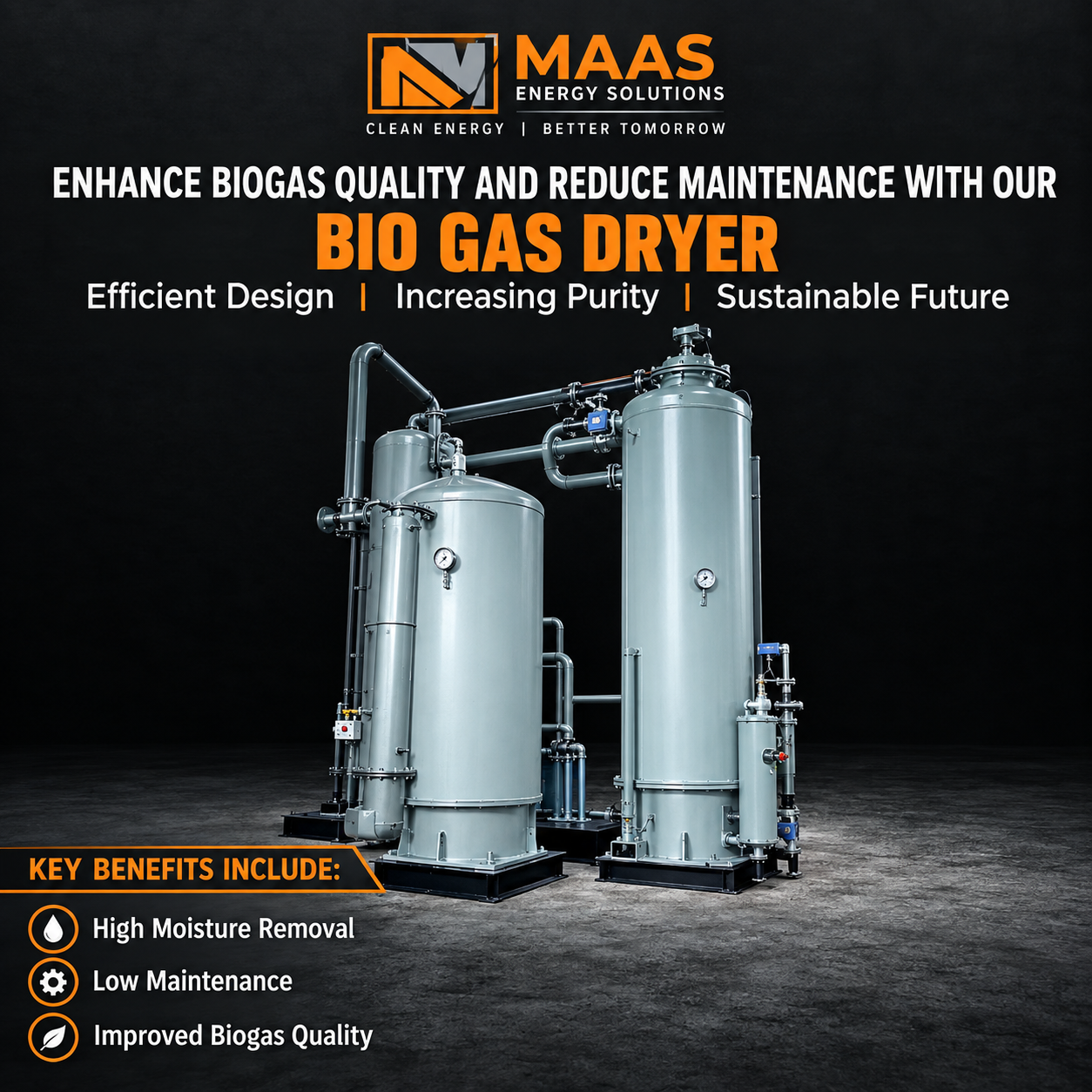
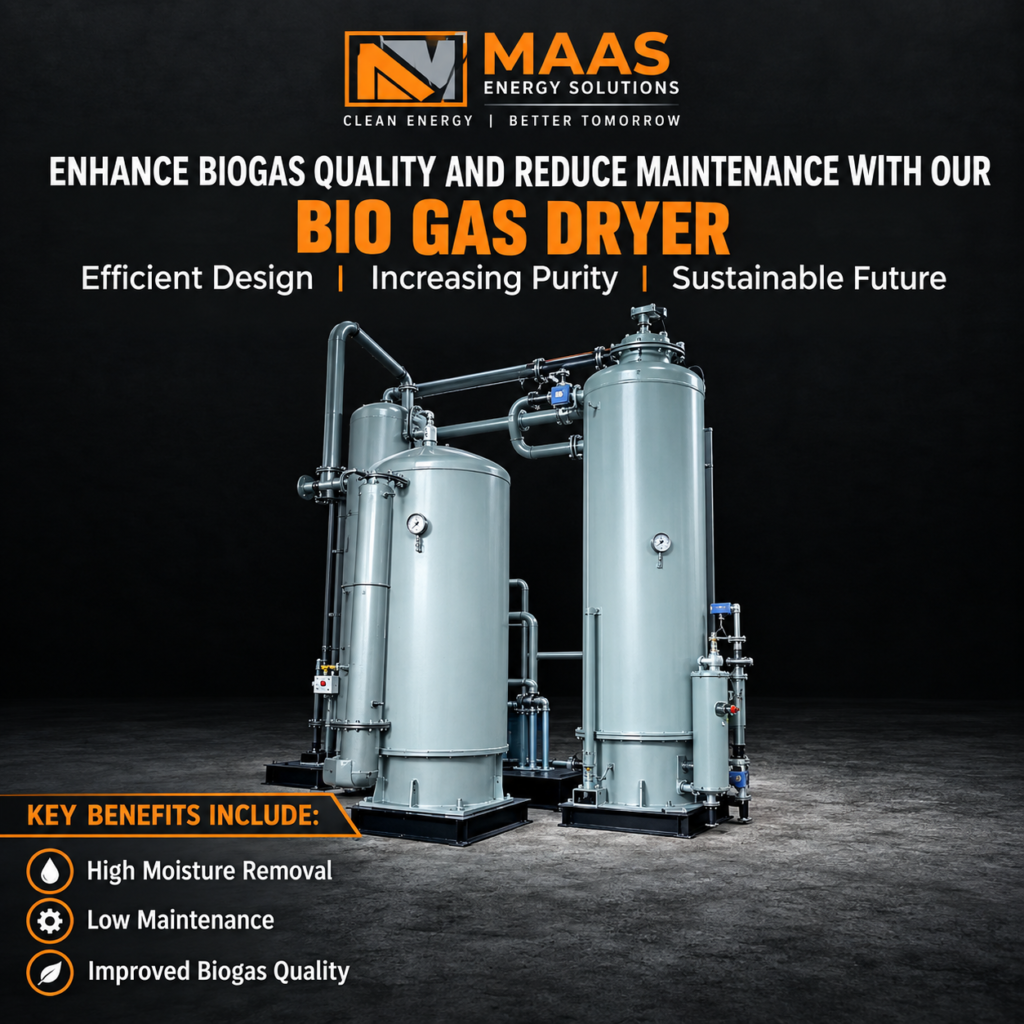
MAAS Energy Solutions presents its Biogas Dryer with a focus on efficient design, increasing purity, and a sustainable future. The equipment shown in the image features industrial cylindrical vessels, connected piping, valves, and instrumentation, representing a gas-processing system intended for moisture management.
This blog explains the importance of biogas drying, how the process works, the key features to consider, and why moisture removal is an important part of modern biogas treatment.
Table of Contents
- Introduction to Biogas Dryer
- What Is a Biogas Dryer?
- Why Moisture Removal Is Important in Biogas
- How Does a Biogas Dryer Work?
- Key Features of a Biogas Dryer
- Benefits of Using a Biogas Dryer
- Applications of Biogas Drying Systems
- Biogas Dryer vs. Traditional Moisture Removal
- Factors to Consider Before Choosing a Biogas Dryer
- Maintenance and Operating Considerations
- Frequently Asked Questions
- Conclusion
Introduction to Biogas Dryer
Biogas is produced through the anaerobic digestion of organic materials such as agricultural waste, food waste, sewage, and other biodegradable feedstocks. The resulting gas mainly contains methane and carbon dioxide, along with water vapour and smaller quantities of other impurities. The exact composition depends on the feedstock and digestion conditions.
When biogas leaves a digester, it is commonly saturated or highly loaded with moisture. As the gas travels through pipelines or enters equipment at a lower temperature, water vapour can condense into liquid water. This condensation can create operational challenges in gas pipelines, filters, compressors, engines, and other downstream systems.
A Biogas Dryer helps manage this moisture before it causes problems in the rest of the gas treatment or energy utilization process. Depending on the system design, drying may use cooling and condensation, adsorption, absorption, or a combination of technologies.
For industries seeking cleaner and more reliable energy operations, moisture control is an important part of maintaining gas quality and protecting equipment.
What Is a Biogas Dryer?
Definition of Biogas Dryer
A Biogas Dryer is an industrial gas-treatment system used to reduce moisture from biogas. Its primary purpose is to remove water vapour or condensed water from the gas stream so that the biogas can move through downstream treatment and utilization equipment with better moisture control.
The term “Biogas Dryer” can refer to different types of drying equipment. Some systems cool the gas to condense moisture, while others use materials such as silica gel, activated alumina, or molecular sieves to adsorb water. The appropriate method depends on the gas flow rate, moisture level, required outlet dew point, operating conditions, and intended application.
Role of MAAS Energy Solutions
The supplied product image from MAAS Energy Solutions highlights the following message:
- Enhance biogas quality.
- Reduce maintenance.
- Efficient design.
- Increasing purity.
- Sustainable future.
The image also highlights high moisture removal, low maintenance, and improved biogas quality as key benefits. These are the main themes of the product presentation. Actual moisture-removal performance, outlet dew point, flow capacity, and maintenance intervals should be confirmed from the manufacturer's technical specifications for the selected model.
Why Moisture Removal Is Important in Biogas
Excess Moisture Can Affect Gas Quality
Water vapour takes up part of the gas volume. It can dilute the combustible gas mixture and affect the effective energy content of biogas. Removing moisture helps create a more controlled gas stream for subsequent treatment and use.
Drying does not mean that methane concentration automatically reaches a specific purity level. Methane upgrading and moisture removal are separate treatment objectives. A dryer primarily manages water; other impurities may require additional treatment equipment.
Protecting Pipelines and Equipment
Condensed water can accumulate in gas pipelines, low points, and equipment. In the presence of corrosive components such as hydrogen sulphide, moisture can contribute to corrosion-related problems. Water accumulation may also increase the risk of blockages and unstable gas flow.
A properly designed drying system helps reduce these moisture-related risks.
Supporting Downstream Purification
Many biogas plants use additional treatment systems for hydrogen sulphide, siloxanes, carbon dioxide, and other impurities. Moisture control can support the performance and operating conditions of downstream filters and upgrading systems. For example, some activated-carbon treatment processes benefit from suitable gas humidity conditions.
Reducing Maintenance Challenges
Excess water can create problems in gas handling equipment, including condensate collection, corrosion, and maintenance requirements. Moisture removal can help reduce these issues, although the actual maintenance savings depend on system design, operating conditions, and the condition of the gas entering the dryer.
How Does a Biogas Dryer Work?
Step 1: Wet Biogas Enters the System
Raw or partially treated biogas enters the dryer through an inlet connection. The gas may contain water vapour, suspended droplets, and other contaminants depending on the upstream process.
Before drying, the system should be designed with suitable pretreatment and protection against liquids or particles where required. Moisture-removal performance depends on the condition of the incoming gas.
Step 2: Cooling or Drying Takes Place
There are different technologies used for biogas moisture removal.
Cooling and condensation: The gas is cooled, commonly using a heat exchanger. When the temperature falls below the dew point, water vapour condenses into liquid water. A separator or knockout
Adsorption drying: The gas passes through a vessel containing a moisture-adsorbing material such as silica gel, activated alumina, or a molecular sieve. Water molecules are retained by the adsorbent material. The material must be replaced or regenerated according to the operating design.
Absorption drying: In some systems, the gas contacts a liquid absorbent such as glycol. Moisture is transferred from the gas into the liquid. This method is more suitable for selected operating conditions and gas flow requirements.
Step 3: Condensate or Moisture Is Removed
In a cooling-based dryer, the condensed water is collected and drained from the system. Drainage arrangements may include a condensate trap, automatic drain, siphon, or pump, depending on the equipment configuration.
A condensate removal system is important because water should not remain accumulated inside the gas line or treatment vessel.
Step 4: Drier Gas Moves to Further Treatment
After moisture removal, the gas proceeds to the next stage. This could be a hydrogen sulphide filter, gas upgrading unit, compressor, engine, boiler, or another gas-utilization system.
The exact outlet requirements depend on the downstream equipment. A Biogas Dryer should therefore be selected according to the complete plant process rather than only the gas inlet flow rate.
Key Features of a Biogas Dryer
High Moisture Removal
High moisture removal is one of the main purposes of a biogas drying system. The supplied MAAS Energy Solutions image highlights this benefit. A well-designed dryer should achieve the moisture-removal target required by the downstream process.
The actual result depends on gas temperature, pressure, flow rate, inlet moisture, and dryer technology.
Efficient Design
An efficient design can support consistent gas treatment while making effective use of space, energy, and equipment components. Cooling dryers may use heat exchangers and condensate separation, while adsorption dryers may use one or more drying vessels.
The image shows multiple vertical vessels connected through piping, but it does not establish the internal process arrangement or exact operating specifications.
Improved Biogas Quality
Moisture removal supports gas quality by controlling water content. It can help improve the suitability of biogas for subsequent treatment and utilization.
However, moisture removal alone does not guarantee complete purification. Hydrogen sulphide, carbon dioxide, siloxanes, and other contaminants may require additional processes.
Low Maintenance Design
The product image highlights low maintenance as a key benefit. In practice, maintenance requirements depend on the type of dryer, drainage system, valves, instrumentation, cooling equipment, and operating conditions.
A design that provides convenient access to filters, drains, valves, and service components can make maintenance easier.
Industrial Construction
The pictured equipment uses vertical cylindrical vessels and connected industrial piping. This style of construction is commonly associated with gas treatment and separation equipment.
The exact materials, pressure rating, vessel thickness, and safety specifications must be verified from the manufacturer's product documentation.
Sustainable Energy Support
By helping control moisture in biogas, a dryer supports the wider process of using renewable gas for energy generation and other applications. It forms one part of a complete biogas treatment system.
Benefits of Using a Biogas Dryer
1. Better Moisture Control
Moisture control helps prevent excessive water accumulation in pipelines and equipment. This is especially useful in systems where biogas travels through long pipelines or passes through multiple treatment stages.
A suitable drying system can improve the consistency of the gas condition entering downstream equipment.
2. Reduced Corrosion-Related Risks
Water and corrosive gas components can create challenging conditions for metal pipelines and equipment. Moisture removal can help reduce the presence of liquid water and lower moisture-related corrosion risks.
It should be used alongside suitable materials, corrosion management, gas cleaning, and routine inspection.
3. Support for Equipment Protection
Dryer systems can help protect equipment that is sensitive to moisture, such as compressors, engines, filters, and gas-treatment components. The level of protection depends on the moisture specification and the equipment's requirements.
4. Improved Gas Treatment Conditions
Drying may help prepare biogas for further purification and upgrading. In some systems, controlling humidity improves the conditions for downstream adsorption or filtration.
This can support more consistent process operation, but it does not replace the need for appropriate gas cleaning.
5. Lower Moisture-Related Maintenance
When condensate accumulation and moisture-related issues are reduced, some maintenance challenges may also be reduced. The actual cost savings depend on the system's original condition, operating hours, and maintenance practices.
6. Support for Sustainable Energy Projects
Biogas dryers contribute to the overall treatment of renewable gas. By managing moisture before gas utilization, they support energy projects that aim to use biogas in a more controlled and reliable manner.
Applications of Biogas Drying Systems
Biogas Power Generation
Biogas dryers can be used in systems where biogas is supplied to engines or combined heat and power equipment. Moisture control helps support gas quality before combustion and can reduce condensation-related risks in downstream equipment.
Wastewater Treatment Plants
Wastewater treatment facilities may generate biogas during anaerobic digestion. Drying equipment can be part of the gas treatment system used before energy recovery or further gas purification.
Agricultural Biogas Plants
Agricultural and farm-based biogas plants may use drying systems to manage moisture before biogas is sent to boilers, engines, or upgrading equipment.
Food Waste and Organic Waste Plants
Food waste processing facilities can generate biogas through anaerobic digestion. A dryer may be installed as part of the gas cleaning and conditioning system.
Biomethane and CBG Projects
Biogas drying can be part of a larger biomethane or compressed biogas treatment process. Moisture removal is one of the gas-conditioning steps, alongside other purification and upgrading requirements.
Biogas Dryer vs. Traditional Moisture Removal
Biogas moisture can be removed using several methods. The choice depends on the plant's gas flow, required moisture level, investment budget, and operating conditions.
| Moisture Removal Method | How It Works | Important Considerations |
|---|---|---|
| Condensation drying | Cools gas so water vapour condenses. | Requires cooling, condensate separation, and drainage. |
| Adsorption drying | Uses materials that retain water molecules. | Adsorbent replacement or regeneration is required. |
| Absorption drying | Uses a liquid absorbent to remove moisture. | Suitable for selected gas flow and operating conditions. |
| Passive condensate removal | Collects condensed water from gas pipelines or traps. | Useful for basic moisture management but may not meet deep-drying requirements. |
These methods are described in biogas treatment literature and technical guidance.
Factors to Consider Before Choosing a Biogas Dryer
Gas Flow Rate
The dryer should be sized according to the actual biogas flow rate. An undersized system may not achieve the required moisture removal, while an oversized system may increase unnecessary investment.
Inlet and Outlet Moisture
The moisture content entering the dryer and the required moisture level at the outlet are important design parameters. The outlet dew point should be matched to the downstream equipment.
Operating Pressure and Temperature
Gas pressure and temperature affect moisture behavior and drying performance. Cooling-based systems and adsorption systems may require different operating conditions.
Downstream Equipment
The requirements of engines, compressors, upgrading units, filters, or storage systems should be considered before choosing a dryer. Different applications may need different moisture specifications.
Maintenance and Service
Check access to condensate drains, filters, valves, instrumentation, and other service components. Ask the supplier about inspection schedules, replacement parts, and operating support.
Safety and Compliance
Biogas is a combustible gas and may contain hazardous impurities. The dryer should be selected, installed, and operated according to applicable safety requirements and the manufacturer's instructions.
Maintenance and Operating Considerations
Routine Inspection
Regular inspection helps identify leaks, abnormal pressure changes, condensate accumulation, and unusual operating conditions.
Condensate Drainage
For condensation-based dryers, condensate drainage is an important operating requirement. Water should be removed as specified by the equipment design.
Filter and Adsorbent Checks
If the dryer uses filtration or adsorption materials, check their condition and service requirements. Adsorbents may need regeneration or replacement to maintain performance.
Monitor Gas Quality
Monitoring moisture, temperature, pressure, and other relevant gas parameters can help confirm that the dryer is operating as intended.
Follow Manufacturer Guidelines
The actual maintenance schedule depends on the specific dryer model. MAAS Energy Solutions should be consulted for model-specific specifications, installation guidance, and recommended maintenance intervals.
Frequently Asked Questions
What is a Biogas Dryer?
A Biogas Dryer is an industrial system used to remove excess moisture from biogas. It helps control water vapour and condensation before the gas reaches downstream treatment or energy utilization equipment.
Why is moisture removal important in biogas?
Moisture removal helps reduce condensation, control corrosion-related risks, and support suitable gas conditions for downstream equipment. Water removal is an important part of biogas treatment
Does a Biogas Dryer remove hydrogen sulphide?
A Biogas Dryer primarily removes moisture. Hydrogen sulphide removal generally requires a separate treatment process, such as an appropriate scrubber or activated-carbon filter, unless the system has additional integrated treatment stages.
What are the main types of biogas dryers?
Common moisture-removal methods include condensation drying, adsorption drying, and absorption drying. The right method depends on gas flow, moisture requirements, operating conditions, and the intended application
Can a Biogas Dryer be used in power generation plants?
Yes. Biogas drying can be part of the gas treatment system for biogas power generation. It helps control moisture before the gas enters engines or other downstream equipment.
How do I choose the right Biogas Dryer?
Consider gas flow rate, inlet moisture, outlet dew point, pressure, temperature, downstream equipment, maintenance requirements, and applicable safety standards. Consult the manufacturer for a model suitable for your process.
Conclusion
A Biogas Dryer is an important part of modern biogas treatment and gas conditioning. By managing moisture, it can help reduce condensation-related issues, support downstream purification, and improve the operating conditions of gas utilization equipment.
The MAAS Energy Solutions Biogas Dryer image highlights high moisture removal, low maintenance, and improved biogas quality. These benefits reflect the importance of moisture management in a sustainable energy system. The actual performance of any dryer depends on its design, operating conditions, and maintenance.
For industries planning a new biogas treatment project or looking to improve an existing gas-processing system, selecting the right drying technology is an important step. A suitable solution can support better gas conditioning, equipment protection, and reliable renewable energy operations. https://www.mygov.in/
Leave A Comment