
Table of Contents
- Introduction
- What Is a Bio Gas Dryer?
- Why Is Biogas Drying Important?
- How Does a Bio Gas Dryer Work?
- Key Features of a Bio Gas Dryer
- Major Components of a Bio Gas Dryer
- Benefits of Using a Bio Gas Dryer
- Applications of Bio Gas Dryers
- Bio Gas Dryer vs Untreated Biogas
- Factors to Consider Before Selecting a Bio Gas Dryer
- Maintenance of a Bio Gas Dryer
- Why Choose MAAS Air N Gas?
- Frequently Asked Questions
- Conclusion
Introduction
A Bio Gas Dryer is an important gas-treatment system used to reduce moisture and water vapour from biogas before it is supplied to downstream equipment or further purification processes. Biogas generated through anaerobic digestion naturally contains moisture, and controlling this moisture can help reduce condensation and support the reliable operation of compressors, pipelines, engines and gas-upgrading equipment.
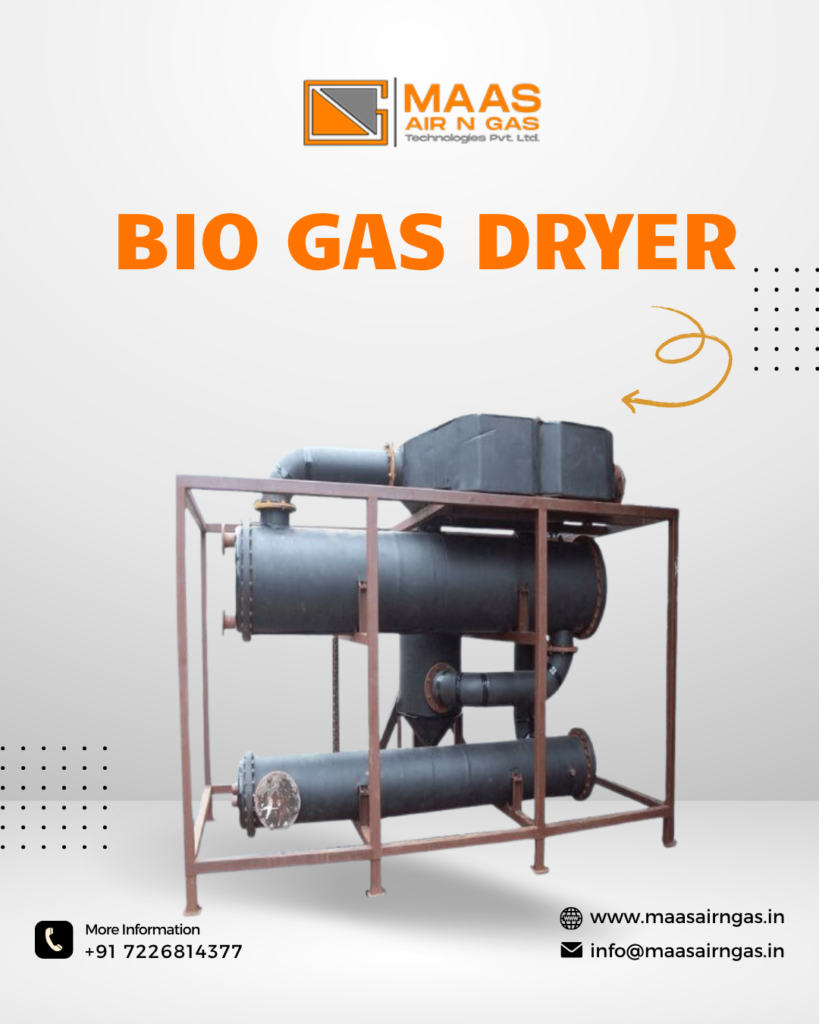
The Bio Gas Dryer shown in the image is associated with MAAS Air N Gas Technologies Pvt. Ltd., a company offering air and gas drying, biogas purification and gas-treatment solutions. MAAS describes its Bio Gas Dryer as a system for conditioning anaerobically digested methane and removing water vapour from landfill gas and biogas. The company’s published specifications include stainless-steel wetted components, a moisture separator, modular construction and a listed dew point of 3°C.
This blog explains the working principle, important features, components, benefits, applications, maintenance requirements and selection factors of a Bio Gas Dryer.
What Is a Bio Gas Dryer?
Definition of a Bio Gas Dryer
A Bio Gas Dryer is a gas dehydration system designed to remove water vapour and moisture from biogas. Raw biogas can contain methane, carbon dioxide, hydrogen sulphide, moisture and other trace components. Before this gas is used in engines, compressors, boilers, purification systems or Bio-CNG plants, moisture may need to be controlled.
The primary purpose of a Bio Gas Dryer is therefore gas dehydration. It conditions the gas by reducing its moisture content and separating condensed water from the gas stream.
MAAS Air N Gas states that its Bio Gas Dryer was developed for conditioning anaerobically digested methane for applications such as microturbines and combustion engines, as well as removing water vapour to protect gas compressors and to treat low-BTU gas.
Why Moisture Is Present in Biogas
Biogas is generated during anaerobic digestion of organic materials. Since the gas is produced in a biological and generally humid environment, the gas stream can carry water vapour.
The moisture content can vary according to factors such as:
- Gas temperature
- Digester conditions
- Feedstock
- Gas pressure
- Gas cooling
- Gas-storage conditions
- Ambient conditions
When warm biogas cools during transportation or processing, water vapour can condense into liquid water.
Role of a Bio Gas Dryer
A Bio Gas Dryer helps control this moisture before the gas reaches downstream equipment.
The drying stage can be especially relevant where biogas is supplied to:
- Gas engines
- Compressors
- Gas pipelines
- Bio-CNG plants
- Gas purification systems
- Industrial burners
- Microturbines
- Other gas-processing equipment
Why Is Biogas Drying Important?
Protection of Downstream Equipment
Excessive moisture can result in condensation inside pipelines and equipment. Removing water vapour helps provide better-conditioned gas for downstream processes.
For equipment such as compressors and engines, controlling moisture can be an important part of gas conditioning.
Reduction of Condensation
As gas moves through pipelines and equipment, temperature changes can cause water vapour to condense. A suitable drying system reduces the amount of moisture available for condensation.
Better Gas Conditioning
Biogas drying is generally one part of a broader gas-treatment process. Drying does not necessarily remove every impurity present in raw biogas. Other treatment stages may be required for H₂S, CO₂, VOCs, siloxanes and other contaminants.
MAAS’s published Bio Gas to CNG process, for example, includes water scrubbing, chemical scrubbing, biogas dehumidification, activated-carbon filtration and VPSA-based CO₂ removal.
Importance in Bio-CNG Production
Moisture removal can be particularly important in Bio-CNG or biogas-upgrading systems.
According to MAAS, its biogas dehumidifier cools the gas to approximately 8–10°C, allowing moisture to condense before it is removed through a cyclonic moisture separator and automatic drain arrangement.
How Does a Bio Gas Dryer Work?
Step 1: Moist Biogas Enters the Dryer
The process begins when moisture-containing biogas enters the drying system through the gas inlet.
The actual inlet pressure, temperature, gas flow rate and moisture level depend on the upstream biogas plant.
Step 2: Gas Cooling
In a refrigerated drying arrangement, the gas is cooled so that some of the water vapour reaches its condensation point.
This converts part of the water vapour into liquid moisture.
Step 3: Moisture Condensation
As the temperature decreases, water vapour condenses.
The condensed water then needs to be separated from the gas stream to prevent it from travelling further into the process.
Step 4: Moisture Separation
A moisture separator separates liquid water from the gas.
MAAS describes a cyclonic moisture separator in its biogas dehumidification process, with the collected moisture discharged through an automatic drain valve.
Step 5: Dry Gas Outlet
After moisture separation, the conditioned gas leaves the dryer through the outlet.
The treated gas can then be supplied to the next stage, such as gas filtration, compression, purification or utilization.
Step 6: Further Gas Treatment
A Bio Gas Dryer should not automatically be considered a complete biogas purification system.
Depending on the application, additional treatment may be required. MAAS’s VPSA biogas purification process uses activated carbon to address H₂S, VOCs and siloxanes and subsequently uses VPSA technology for CO₂ removal.
Key Features of a Bio Gas Dryer
Stainless-Steel Wetted Components
MAAS states that all wetted components of its Bio Gas Dryer are made from stainless steel. This is an important design feature for equipment exposed to biogas and condensate.
Moisture Separator
The moisture separator is responsible for separating condensed liquid from the gas stream after cooling.
Dew Point of 3°C
MAAS lists a 3°C dew point for its Bio Gas Dryer. The required outlet dew point for a specific project should be selected according to the actual process and downstream requirements.
CFC-Free Refrigerant
The company’s published Bio Gas Dryer information specifies a CFC-free refrigerant arrangement.
Modular Construction
The dryer is described as having a modular design intended to support easier maintenance and installation.
Structural Steel Base
MAAS lists a structural solid-steel base as another feature of its Bio Gas Dryer design.
Dew Point and Flood-Level Control
The company also describes dew-point sensing and flood-level control as product characteristics.
Major Components of a Bio Gas Dryer
Gas Inlet and Outlet
The inlet allows wet or moisture-containing biogas to enter the system, while the outlet transfers the conditioned gas to the next stage.
Heat Exchanger
A heat exchanger can be used as part of the cooling process to transfer heat and help achieve the required gas temperature.
MAAS specifically describes stainless-steel heat exchanger tubes in its Bio Gas Dryer information.
Cooling System
The cooling section reduces the gas temperature to encourage moisture condensation.
Moisture Separator
The separator removes condensed water from the gas stream.
Drain System
Collected moisture needs to be discharged from the system. Automatic drainage can reduce the need for continuous manual intervention.
Dew Point Sensor
A dew point sensor can be used to monitor gas moisture conditions and support process control.
Control System
Depending on the plant configuration, temperature, pressure, moisture and other operating parameters can be monitored through suitable instrumentation and controls.
Benefits of Using a Bio Gas Dryer
Effective Moisture Removal
The main benefit of a Bio Gas Dryer is the reduction of water vapour in the biogas stream.
Better Gas Conditioning
Drying prepares biogas for downstream processes that require controlled moisture conditions.
Protection of Gas Equipment
Moisture control can help reduce condensation-related operating issues in compressors, pipelines, engines and other gas-handling equipment.
Supports Bio-CNG Processing
Drying can form part of the pretreatment process before biogas upgrading and compression.
MAAS’s published VPSA process specifically describes moisture removal before the dry biogas enters adsorption columns for CO₂ removal.
Reduced Moisture-Related Problems
Removing moisture before downstream processing can help reduce problems associated with water accumulation and condensation.
Industrial Application Flexibility
Biogas dryers can be designed for different gas flow rates, temperatures, pressures and process requirements.
Applications of Bio Gas Dryers
Anaerobic Digestion Plants
Biogas produced through anaerobic digestion can require moisture conditioning before further utilization.
Wastewater Treatment Plants
Wastewater treatment facilities can produce digester gas that may require drying before utilization or further treatment. MAAS specifically lists wastewater-cleaning plants among its Bio Gas Dryer applications.
Landfill Gas Dehydration
Landfill gas can contain water vapour, making dehydration relevant before certain gas-utilization processes.
MAAS lists landfill gas dehydration as an application for its Bio Gas Dryer.
Bio-CNG Plants
Biogas upgrading facilities can integrate moisture removal into their pretreatment systems.
In MAAS’s published Bio Gas to CNG process, a customized biogas dehumidifier is positioned after scrubbing and before further treatment.
Gas Engine Applications
Biogas used in combustion engines can require gas conditioning, including moisture management.
Microturbine Applications
MAAS identifies conditioning anaerobically digested methane for microturbines among the applications of its Bio Gas Dryer.
Food and Beverage Industries
MAAS lists wineries, breweries and cheese-making plants among applications for the dryer.
Bio Gas Dryer vs Untreated Biogas
| Parameter | Biogas After Drying | Untreated Moist Biogas |
|---|---|---|
| Water vapour | Reduced | Higher |
| Moisture control | Controlled | Limited |
| Condensation potential | Reduced with appropriate drying | Higher |
| Downstream conditioning | Better prepared | May require additional treatment |
| Equipment protection | Better moisture management | More moisture-related concerns |
| Gas processing | Suitable for subsequent treatment | Additional conditioning may be required |
| Application | Engines, purification, Bio-CNG and other systems | Raw gas handling |
The actual performance of a drying system depends on gas composition, inlet conditions, flow rate, pressure, temperature and the selected dryer configuration.
Factors to Consider Before Selecting a Bio Gas Dryer
Gas Flow Rate
The dryer should be selected according to the required gas flow. Accurate flow information helps determine the appropriate equipment capacity.
Inlet Temperature
Gas temperature affects the amount of water vapour present in the gas. The expected operating temperature should therefore be considered during system selection.
Operating Pressure
The dryer should be compatible with the pressure of the incoming biogas and the requirements of the downstream process.
Required Dew Point
The desired outlet dew point should be defined before selecting the equipment.
Gas Composition
The composition of biogas can vary depending on the feedstock and digestion process. Methane, carbon dioxide, H₂S, moisture and trace contaminants should be considered.
Downstream Equipment
The final application has an important role in determining the required gas-quality specification.
Material Compatibility
Materials exposed to biogas and condensate should be selected according to the operating conditions and expected contaminants.
Maintenance Requirements
A dryer should provide reasonable access to components requiring inspection, cleaning or servicing.
Maintenance of a Bio Gas Dryer
Regular Equipment Inspection
Regular inspection helps identify leaks, unusual operating conditions, drainage problems and other issues at an early stage.
Check the Moisture Separator
The moisture separator should be inspected to ensure that condensed water is being separated effectively.
Inspect the Drain System
Automatic drains should be checked periodically to confirm that collected moisture is being discharged correctly.
Monitor Dew Point
The outlet dew point should be monitored according to the system’s operating requirements.
Check Cooling Performance
Cooling-system performance should be monitored because insufficient cooling can affect moisture condensation and drying performance.
Follow Manufacturer Recommendations
Maintenance schedules should follow the equipment manufacturer’s recommended procedures, operating limits and service requirements.
Why Choose MAAS Air N Gas?
Gas and Air Treatment Expertise
MAAS Air N Gas Technologies Pvt. Ltd. provides solutions in areas including air and gas dryers, PSA gas-generation systems and biogas purification. Its website lists Bio Gas to CNG Technology and Air and Gas Dryers among its products and technologies.
Customized System Approach
MAAS states that its plants are designed to meet individual client specifications and use cases. This can be important for biogas drying because every application may have different flow, pressure, temperature and gas-composition requirements.
Biogas Purification Knowledge
The company also publishes a detailed VPSA-based biogas purification process incorporating pretreatment, dehumidification, activated-carbon filtration and CO₂ removal.
Industrial Gas Engineering
MAAS describes its work across adsorption-based gas separation, air filters, air dryers and biogas purification technologies.
Integrated Gas Treatment Solutions
Depending on project requirements, a Bio Gas Dryer can be used as an individual dehydration system or integrated with a larger biogas purification and Bio-CNG system.
Frequently Asked Questions
What is a Bio Gas Dryer?
A Bio Gas Dryer is a gas dehydration system used to reduce water vapour and moisture from biogas before the gas is used or sent to further purification and processing stages.
Why does biogas need to be dried?
Biogas contains water vapour. When the gas cools, this moisture can condense. Drying helps control moisture before the gas reaches downstream equipment.
How does a Bio Gas Dryer remove moisture?
A cooling-based system reduces the gas temperature so that water vapour condenses. The condensed liquid is then separated from the gas using a moisture separator.
What is the dew point of the MAAS Bio Gas Dryer?
MAAS’s published product information lists a 3°C dew point for its Bio Gas Dryer. The required dew point for a particular installation should be confirmed according to the process conditions.
Where are Bio Gas Dryers used?
Applications include landfill gas dehydration, digester gas dehydration, wastewater treatment plants, wineries, breweries, cheese plants, microturbines and combustion-engine applications.
Can a Bio Gas Dryer be used in a Bio-CNG plant?
Yes. Moisture removal can be incorporated into the pretreatment stage of a Bio-CNG or biogas-upgrading plant. MAAS describes a customized biogas dehumidifier as part of its Bio Gas to CNG process.
Does a Bio Gas Dryer remove CO₂ from biogas?
The primary purpose of a Bio Gas Dryer is moisture removal, not CO₂ removal. Additional technologies may be required for CO₂ separation. MAAS describes VPSA technology for CO₂ removal in its biogas purification process.
Does a Bio Gas Dryer remove H₂S?
A dryer is primarily designed for moisture removal. H₂S treatment generally requires an additional purification stage. MAAS describes water scrubbing, chemical scrubbing and activated-carbon filtration for contaminant treatment in its Bio Gas to CNG process.
Can the Bio Gas Dryer be customized?
The required configuration can depend on gas flow, temperature, pressure, gas composition, dew point and downstream application. MAAS states that its plants are designed around individual client specifications and use cases.
What information is required before selecting a Bio Gas Dryer?
Important information includes gas flow rate, inlet temperature, operating pressure, gas composition, moisture level, required outlet dew point and the intended downstream application.
Conclusion
A Bio Gas Dryer plays an important role in biogas dehydration and gas conditioning. Biogas naturally contains moisture, and controlling this moisture can help prepare the gas for compressors, engines, pipelines, gas purification systems and Bio-CNG applications.
The drying process generally involves cooling the gas, condensing water vapour and separating the resulting liquid moisture. The exact process configuration depends on the gas composition, operating conditions and required outlet gas quality.
For larger biogas-upgrading applications, drying can become an important part of a complete pretreatment system. MAAS Air N Gas’s published Bio Gas to CNG process includes biogas dehumidification before further filtration and VPSA-based CO₂ separation. https://www.bis.gov.in/
MAAS Air N Gas Technologies Pvt. Ltd. offers Bio Gas Dryers and gas-treatment solutions for applications including landfill gas, digester gas and wastewater-related gas systems.
Leave A Comment