
PSA Nitrogen Gas Generation Plant technology provides industries with a reliable way to produce nitrogen directly at the point of use. Instead of depending completely on nitrogen cylinders or bulk liquid nitrogen deliveries, industrial facilities can generate nitrogen from compressed air whenever it is required.
A PSA nitrogen generation system uses Pressure Swing Adsorption (PSA) technology and Carbon Molecular Sieve (CMS) to separate nitrogen from other components of compressed air. The technology is suitable for applications where a continuous and controlled nitrogen supply is important. Depending on the system design and operating requirements, nitrogen can be produced at different purity levels for different industrial applications.
For industries looking for reliable on-site gas generation, MAAS Air N Gas Technologies Pvt. Ltd. provides PSA-based gas generation solutions designed around specific application requirements. You can learn more about the company’s solutions through the MAAS Air N Gas website.
Table of Contents
- What Is a PSA Nitrogen Gas Generation Plant?
- How Does a PSA Nitrogen Generation Plant Work?
- Main Components of a PSA Nitrogen Plant
- 7 Major Benefits of PSA Nitrogen Gas Generation
- Industrial Applications of PSA Nitrogen
- Factors to Consider Before Selecting a Nitrogen Plant
- Why Compressed Air Quality Matters
- PSA Nitrogen Plant vs Nitrogen Cylinders
- Maintenance and Operation
- Why Choose MAAS Air N Gas?
- Frequently Asked Questions
- Conclusion
What Is a PSA Nitrogen Gas Generation Plant?
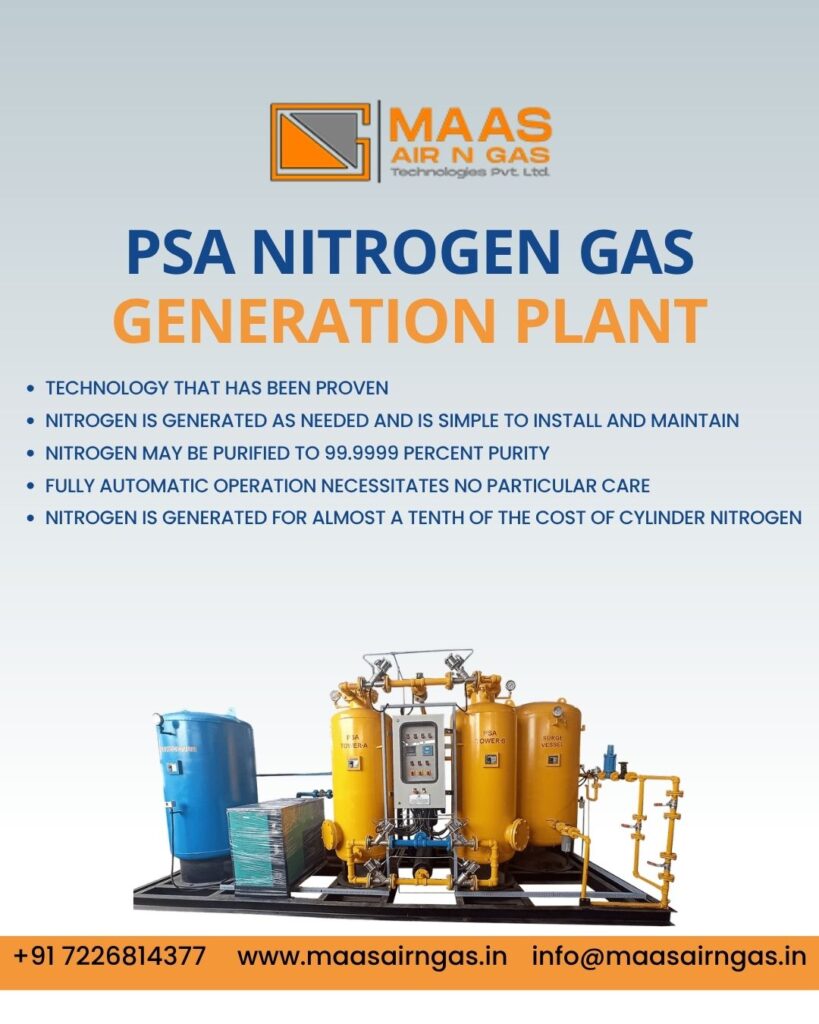
A PSA Nitrogen Gas Generation Plant is an industrial system designed to produce nitrogen from compressed atmospheric air. The basic principle is based on Pressure Swing Adsorption, in which specially selected adsorbent material separates oxygen and other gases from nitrogen.
The process allows nitrogen to be generated on-site according to the actual requirements of the facility. This can be particularly useful for manufacturing plants where nitrogen consumption is continuous or where transportation and storage of nitrogen cylinders can become inconvenient.
In a typical PSA system, compressed air first passes through appropriate filtration and air-treatment equipment. The treated air then enters adsorption towers containing Carbon Molecular Sieve. CMS preferentially adsorbs oxygen and allows nitrogen to pass through as the product gas.
The two-tower arrangement allows one tower to produce nitrogen while the other is regenerated. The towers alternate between adsorption and regeneration cycles, supporting continuous nitrogen production.
For additional information about nitrogen as a chemical substance, the NIST Chemistry WebBook provides reference data for nitrogen (N₂).
How Does a PSA Nitrogen Generation Plant Work?
The working principle of a PSA Nitrogen Gas Generation Plant is relatively straightforward, although the system incorporates several components to achieve stable and controlled operation.
Atmospheric air contains nitrogen, oxygen, and smaller quantities of other gases. The PSA process uses the different adsorption characteristics of these gases to separate nitrogen from the compressed air stream.
During the adsorption cycle, clean and dry compressed air enters one PSA tower. The Carbon Molecular Sieve inside the tower preferentially retains oxygen and other unwanted components. Nitrogen passes through the CMS and exits the tower as the product gas.
At the same time, the second tower can be regenerated by reducing its pressure. The adsorbed gases are released, preparing the CMS for the next production cycle. Automatic valves control the switching between the two towers.
The basic process can be summarized as:
- Compressed air enters the treatment system.
- Moisture, oil, and particles are removed through suitable filtration and drying.
- Treated air enters the PSA adsorption tower.
- Carbon Molecular Sieve preferentially adsorbs oxygen.
- Nitrogen passes through the adsorption bed.
- Product nitrogen is collected and supplied to the application.
- The second tower undergoes regeneration.
- Automatic valves switch the towers to maintain continuous production.
This alternating process is one of the important characteristics of PSA nitrogen generation technology.
Main Components of a PSA Nitrogen Gas Generation Plant
A properly designed PSA Nitrogen Gas Generation Plant consists of several interconnected components. Each component contributes to the reliability, purity, and efficiency of the nitrogen-generation process.
The compressed-air system is particularly important because the quality of the incoming air directly affects the performance and service life of the adsorption material. Filters and dryers help remove contaminants and moisture before the air reaches the PSA towers.
The PSA towers contain a Carbon Molecular Sieve, which performs the main gas-separation function. Automatic changeover valves control the adsorption and regeneration cycles, while the control panel manages the operating sequence.
A surge vessel can also be incorporated to stabilize the product nitrogen supply and pressure before the gas is delivered to the application.
Typical components include:
- Air compressor
- Air receiver
- Air filters
- Air dryer
- PSA adsorption towers
- Carbon Molecular Sieve
- Automatic changeover valves
- Control panel
- Nitrogen surge vessel
- Pressure regulators
- Nitrogen purity monitoring equipment
The exact configuration depends on required nitrogen purity, flow rate, operating pressure, application, and site conditions.
7 Major Benefits of PSA Nitrogen Gas Generation
1. On-Demand Nitrogen Production
One of the primary advantages of a PSA Nitrogen Gas Generation Plant is the ability to produce nitrogen when it is required. The facility does not necessarily need to depend on frequent cylinder deliveries for its regular nitrogen consumption.
On-site generation can make nitrogen supply easier to manage because production can be matched more closely with the facility’s actual demand. This is particularly useful for manufacturing environments where nitrogen is consumed regularly throughout production.
Instead of maintaining a large inventory of cylinders, an appropriately sized PSA system can provide nitrogen directly at the point of use.
2. High Nitrogen Purity
Different industrial applications require different nitrogen purity levels. PSA technology can be configured to produce nitrogen according to the requirements of the application.
The purity requirement is an important factor when selecting the appropriate adsorption system, CMS grade, flow rate and operating conditions. Higher purity requirements generally influence the design and operating parameters of the generator.
For this reason, nitrogen generation systems should be designed around the actual application rather than selecting equipment based only on nominal capacity.
3. Reduced Dependence on Nitrogen Cylinders
Regular cylinder supply can involve transportation, storage, handling and replacement. For facilities with significant nitrogen consumption, these activities can become an operational burden.
A PSA Nitrogen Gas Generation Plant provides an alternative by producing nitrogen at the facility. This can simplify supply management and reduce dependence on external gas deliveries.
The economic advantage will depend on nitrogen consumption, electricity costs, compressor efficiency, required purity and the cost of externally supplied nitrogen. Therefore, a proper cost analysis should be carried out before installation.
4. Fully Automatic Operation
Modern PSA nitrogen systems can incorporate automated controls for tower switching, pressure management and operating cycles. Automation reduces the amount of manual intervention required during normal operation.
Automatic operation can also help maintain consistent process conditions when the system is correctly designed, installed, and maintained.
Typical automated functions may include:
- Automatic tower changeover
- Pressure monitoring
- Cycle timing
- Alarm indications
- System start and stop controls
- Nitrogen pressure monitoring
- Purity monitoring, depending on configuration
This makes PSA technology suitable for industrial facilities where reliable gas supply is an important part of production.
5. Easy Installation and Maintenance
A well-designed PSA nitrogen generator can be installed as an integrated or skid-mounted system, depending on capacity and project requirements. Proper installation also requires attention to compressed-air quality, piping, ventilation, electrical connections and nitrogen distribution.
Maintenance is important because filters, valves, CMS and other components influence system performance. Regular inspection helps identify potential issues before they affect nitrogen production.
For industrial plants, preventive maintenance can include:
- Checking air filters
- Inspecting valves
- Monitoring pressure
- Checking moisture levels
- Inspecting tubing and connections
- Monitoring nitrogen purity
- Checking control-panel functions
- Inspecting the CMS system according to manufacturer recommendations
MAAS Air N Gas also highlights annual maintenance, system upgrades and optimization as part of its gas-generation support approach.
6. Better Control Over Nitrogen Supply
Production facilities often require nitrogen at a specific pressure, flow rate, and purity. Relying entirely on delivered gas can make supply planning more complicated.
With on-site generation, the facility has greater control over when and how nitrogen is produced. The generator can be sized according to the expected demand, and the system can incorporate storage or surge capacity where necessary.
This approach can be especially useful for plants where interruptions in nitrogen supply could affect production, packaging, inerting or other processes.
7. Potentially Lower Operating Costs
The cost advantage of a PSA Nitrogen Gas Generation Plant depends on the specific application. When nitrogen consumption is sufficiently high and continuous, producing nitrogen on-site can reduce expenses associated with cylinder rental, transportation, and repeated gas purchases.
However, the complete economic evaluation should include the compressor, electricity consumption, maintenance, replacement parts, and system installation.
A proper comparison should consider:
- Current nitrogen purchase price
- Monthly nitrogen consumption
- Cylinder or bulk-gas delivery costs
- Compressor electricity consumption
- Required nitrogen purity
- Maintenance costs
- Expected operating hours
- Initial equipment investment
This provides a more realistic picture of the potential return on investment.
Industrial Applications of PSA Nitrogen
Nitrogen is used across many industrial processes because it can provide an inert atmosphere for applications where oxygen needs to be minimized or controlled.
A PSA Nitrogen Gas Generation Plant can therefore be considered for applications across manufacturing and processing industries. The correct purity and flow requirements depend on the specific process.
Common applications include:
- Food and beverage packaging
- Pharmaceutical manufacturing
- Chemical processing
- Metal processing
- Electronics manufacturing
- Heat treatment
- Laser cutting
- Oil and gas applications
- Tank blanketing
- Inerting applications
- Preventing oxidation during selected processes
For example, nitrogen can be used in packaging applications to help create a controlled atmosphere. In metal-processing applications, nitrogen can also be used for selected cutting and processing requirements.
Factors to Consider Before Selecting a PSA Nitrogen Plant
Choosing a PSA Nitrogen Gas Generation Plant should begin with the actual nitrogen requirement rather than simply choosing a standard machine.
The first consideration is nitrogen consumption. The required flow rate should be established in units such as Nm³/hr or another appropriate specification. The plant should also account for peak demand rather than only average consumption.
Purity is another major consideration. A facility requiring high-purity nitrogen may need a different configuration from an application where lower purity is sufficient. Operating pressure, available compressed-air capacity and expected running hours should also be considered.
Important selection parameters include:
| Parameter | Why It Matters |
|---|---|
| Nitrogen purity | Determines suitability for the process |
| Flow rate | Determines generator capacity |
| Operating pressure | Influences system configuration |
| Compressed-air quality | Protects the CMS and system components |
| Duty cycle | Helps determine production requirements |
| Storage capacity | Helps manage fluctuations in demand |
| Installation space | Determines plant layout |
| Automation | Determines operational requirements |
| Maintenance support | Helps maintain long-term performance |
A technical assessment before purchase can prevent problems associated with undersizing or oversizing the system.
Why Compressed Air Quality Matters
The quality of compressed air entering a PSA system is critical. Moisture, oil and particulate contamination can negatively affect filtration equipment, valves and adsorption media.
This is why air treatment is an important part of a complete nitrogen-generation system. The compressed air should be appropriately filtered and dried according to the PSA manufacturer’s requirements.
A properly maintained air-treatment system can help protect the Carbon Molecular Sieve and contribute to stable nitrogen production.
The MAAS Air N Gas PSA Nitrogen Gas Generation Plant page provides additional information about its twin-tower PSA process, activated alumina drying and CMS-based nitrogen separation.
PSA Nitrogen Plant vs Nitrogen Cylinders
Both PSA generation and nitrogen cylinders can be appropriate depending on the application. Cylinders may be practical for low or occasional consumption, while on-site generation can become more attractive as nitrogen demand increases.
With cylinders, the facility must manage deliveries, storage, and cylinder handling. An on-site PSA system instead uses compressed air as the feed source and generates nitrogen at the facility.
The best choice depends on consumption volume, purity requirement, available infrastructure, capital budget, and operating costs.
For businesses considering an installation, it is useful to calculate the total cost of nitrogen over several years rather than comparing only the initial purchase price of the equipment.
Maintenance and Operation of a PSA Nitrogen Generation Plant
Although automated operation reduces manual intervention, regular maintenance remains important. A PSA Nitrogen Gas Generation Plant contains valves, filters, adsorption material, control systems, and pressure-related components that require periodic inspection.
Maintenance requirements depend on the operating environment and manufacturer specifications. Monitoring nitrogen purity and pressure can help identify performance changes.
Operators should also maintain records of maintenance activities and investigate unusual changes in pressure, flow, purity or compressor performance.
A planned maintenance program can help reduce unexpected downtime and support consistent plant operation.
Why Choose MAAS Air N Gas?
MAAS Air N Gas Technologies Pvt. Ltd. focuses on adsorption-based gas separation systems, including PSA nitrogen and oxygen generation plants, air and gas dryers and filtration solutions. Its website states that the company provides customized configurations, maintenance support, system upgrades and optimization services.
For businesses evaluating a PSA Nitrogen Gas Generation Plant, the most important step is to match the plant configuration with the actual process requirements. Nitrogen purity, flow, pressure, compressed-air availability and operating conditions should all be assessed before finalizing the equipment.
You can also explore the company’s Nitrogen Gas Generator solution for additional information about on-site nitrogen generation.
For inquiries about a customized system, visit the MAAS Air N Gas Contact Page.
Frequently Asked Questions
What is a PSA Nitrogen Gas Generation Plant?
A PSA Nitrogen Gas Generation Plant produces nitrogen from compressed air using Pressure Swing Adsorption technology. Carbon Molecular Sieve selectively adsorbs oxygen and allows nitrogen to pass through as the product gas.
What is CMS in a PSA nitrogen generator?
CMS stands for Carbon Molecular Sieve. It is the primary adsorption material used in many PSA nitrogen systems to preferentially adsorb oxygen and separate it from nitrogen.
What nitrogen purity can a PSA plant produce?
The achievable purity depends on the plant design, CMS, operating conditions, and required flow rate. PSA systems can be engineered for different purity levels according to the application.
Is a PSA nitrogen generator fully automatic?
Modern systems can be designed for automatic operation, including automatic tower changeover and control of the adsorption and regeneration cycles.
Is compressed air required for a PSA nitrogen generator?
Yes. Compressed atmospheric air is the feed gas for the PSA process. Appropriate filtration and drying are important before the air enters the adsorption towers.
Is a PSA nitrogen plant better than nitrogen cylinders?
It depends on the application. For regular and higher nitrogen consumption, on-site generation can provide greater control over supply and potentially reduce recurring gas-delivery costs. For occasional or low-volume use, cylinders may remain practical.
Conclusion
A PSA Nitrogen Gas Generation Plant can provide industries with a practical method for producing nitrogen directly at the point of use. By using Pressure Swing Adsorption and Carbon Molecular Sieve technology, the system separates nitrogen from compressed air and can deliver nitrogen at a purity and flow rate suited to the application.
The major advantages include on-demand generation, automated operation, reduced dependence on cylinder deliveries, greater supply control and the potential to reduce long-term nitrogen costs. However, the right system must be selected according to actual flow, purity, pressure, compressed-air quality and operating requirements.
For industrial facilities evaluating on-site nitrogen generation, a detailed technical and economic assessment is recommended before selecting the plant configuration. MAAS Air N Gas Technologies Pvt. Ltd. provides PSA-based nitrogen-generation solutions and related gas-treatment equipment for industrial requirements.
Leave A Comment