24/7 Phone Services

-
-
Visit Our Place
S. G. Highway, Ahmedabad - 380051
Ammonia Cracker for Clean Hydrogen Generation: Working, Features, Benefits and Industrial Applications
Blog Description
An Ammonia Cracker for Hydrogen Generation is an industrial system designed to produce hydrogen by breaking ammonia into its constituent gases, primarily hydrogen and nitrogen. The technology can be considered for industries that require a reliable hydrogen source and want to generate hydrogen at or near the point of use instead of depending entirely on transported hydrogen supplies.
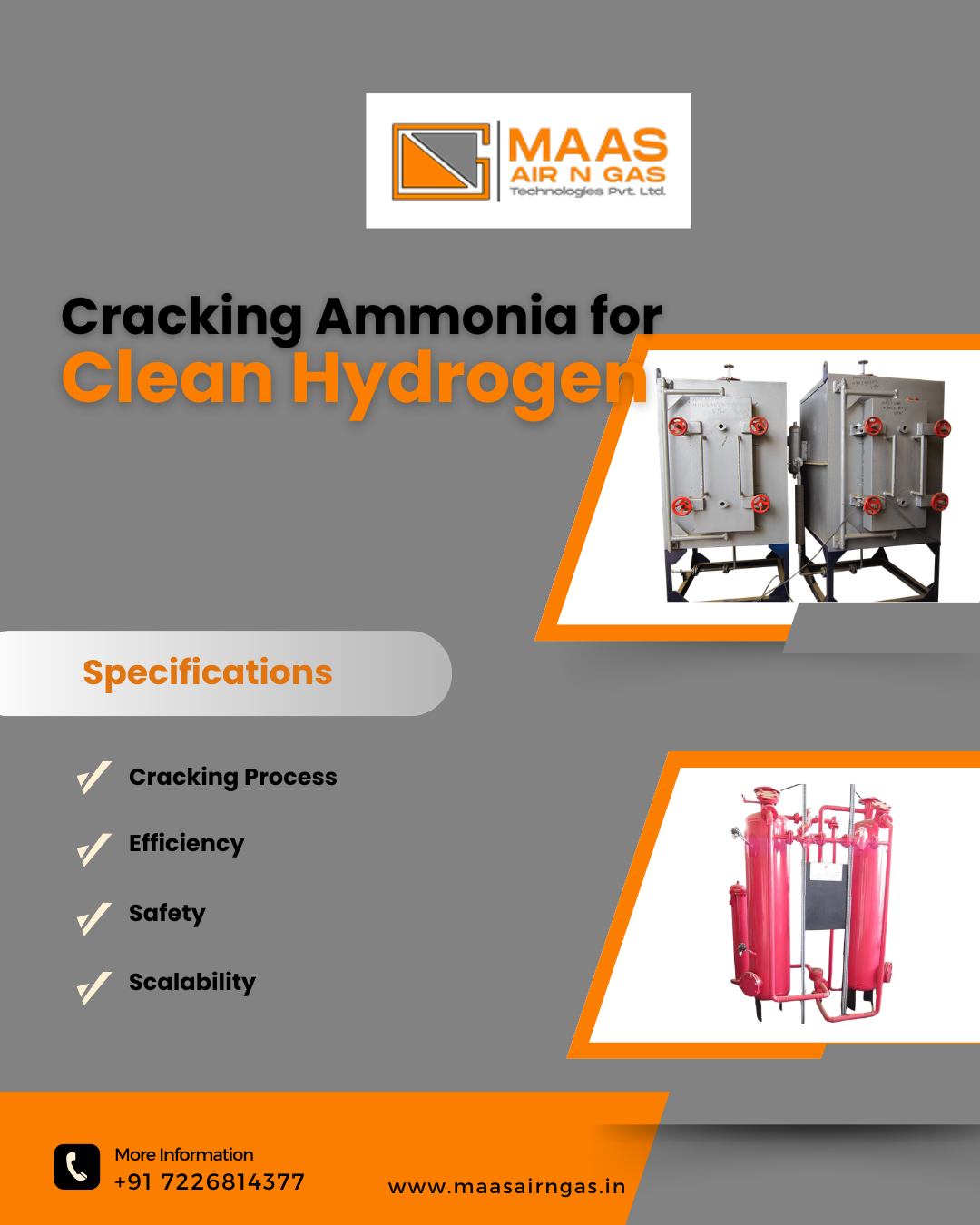
The uploaded MAAS Air N Gas image highlights four important aspects of its ammonia cracking solution: Cracking Process, Efficiency, Safety and Scalability. MAAS Air N Gas Technologies Pvt. Ltd. lists an Ammonia Cracker for Hydrogen Generation among its industrial products and works in gas-generation, adsorption-based separation, air/gas drying and related process technologies.
This blog explains the ammonia cracking process, how hydrogen is generated from ammonia, important system components, industrial applications, efficiency considerations, safety requirements, scalability and factors to consider when selecting an ammonia cracker.
Table of Contents
- Introduction
- What Is an Ammonia Cracker?
- How Does Ammonia Cracking Produce Hydrogen?
- Why Is Ammonia Used for Hydrogen Generation?
- Key Features of an Ammonia Cracker
- Benefits of Ammonia Cracking Technology
- Ammonia Cracker Working Process
- Industrial Applications of Hydrogen
- Safety Considerations
- Efficiency and Performance Factors
- Scalability of Hydrogen Generation Systems
- Major Components of an Ammonia Cracker
- How to Select an Ammonia Cracker
- Maintenance and Operational Considerations
- Why Choose MAAS Air N Gas?
- Frequently Asked Questions
- Conclusion
Introduction
Hydrogen is increasingly used across industrial processes because of its chemical properties and its ability to serve as a feedstock, reducing agent, process gas and energy carrier. However, transporting and storing hydrogen can create logistical and infrastructure challenges. Ammonia provides one possible pathway for transporting and storing hydrogen in chemical form because ammonia contains hydrogen that can be released through a cracking process.
An ammonia cracker uses controlled thermal and catalytic processing to decompose ammonia into hydrogen and nitrogen. The basic chemical reaction is:
2NH₃ → N₂ + 3H₂
In practical systems, the generated gas stream may then require purification depending on the hydrogen purity required by the final application.
MAAS Air N Gas identifies Ammonia Cracker for Hydrogen Generation as one of its product categories. The company’s broader portfolio also includes PSA nitrogen generation, PSA oxygen plants, biogas-to-CNG technology and air/gas dryers.
The uploaded product image specifically highlights cracking process, efficiency, safety and scalability, making these four areas important when evaluating an industrial ammonia-to-hydrogen system.
What Is an Ammonia Cracker?
An Ammonia Cracker is a process system that converts ammonia into hydrogen and nitrogen through a controlled decomposition reaction.
Ammonia, represented chemically as NH₃, contains three hydrogen atoms for every nitrogen atom. When ammonia is subjected to suitable temperature and catalytic conditions, its molecules can split into hydrogen and nitrogen.
The resulting gas mixture contains hydrogen and nitrogen, with the exact composition and purity depending on the process design and subsequent purification stages.
An industrial ammonia cracker generally incorporates controlled heating, catalytic reaction, gas handling and process monitoring. Depending on the required hydrogen quality, additional purification equipment can be integrated into the overall hydrogen-generation system.
Basic reaction
2NH₃ → N₂ + 3H₂
This means ammonia can act as a carrier from which hydrogen is released when required.
The overall system therefore involves much more than simply heating ammonia. Proper engineering is required to manage temperature, flow, pressure, catalyst performance, gas composition and safety.
How Does Ammonia Cracking Produce Hydrogen?
The ammonia cracking process is based on the thermal decomposition of ammonia.
Ammonia enters the cracking system and is exposed to a controlled reaction environment. A catalyst can be used to facilitate the decomposition reaction at practical operating conditions. The resulting gas stream contains hydrogen and nitrogen.
A simplified process can be understood as follows:
- Ammonia is supplied to the cracking system.
- The ammonia is vaporized or conditioned as required.
- The process stream enters the heated cracking section.
- Ammonia passes through the catalytic reaction zone.
- Ammonia decomposes into hydrogen and nitrogen.
- The resulting gas is cooled and conditioned where required.
- Additional purification can be applied when higher hydrogen purity is necessary.
- Hydrogen is supplied to the connected industrial application.
The exact configuration depends on the required hydrogen flow, purity, operating pressure, temperature and end-use conditions.
Why Is Ammonia Used for Hydrogen Generation?
One of the important reasons ammonia is considered for hydrogen-related applications is that it contains a substantial amount of hydrogen by mass and can be handled as an established industrial chemical.
Hydrogen itself can require specialized compression, storage and transportation infrastructure. Ammonia can provide another way of transporting hydrogen in chemically bound form and then releasing the hydrogen at the point of use through cracking.
For industrial users, this approach can be relevant when hydrogen is required continuously or when a facility wants an integrated hydrogen-generation solution.
The suitability of ammonia cracking depends on the application, available ammonia supply, hydrogen demand, required purity, energy availability and overall process economics.
Key Features of an Ammonia Cracker
The uploaded MAAS Air N Gas image highlights four key areas: cracking process, efficiency, safety and scalability. These can be considered the main design priorities when evaluating an ammonia-to-hydrogen generation system.
Controlled Cracking Process
The cracking section is the core of the system. It must provide suitable thermal and catalytic conditions for ammonia decomposition.
A properly designed process aims to achieve consistent ammonia conversion while maintaining stable operating conditions.
Efficiency
Energy consumption is an important consideration because ammonia cracking requires controlled heating. System design, heat management, insulation, catalyst selection and operating conditions can influence overall efficiency.
Safety
Ammonia and hydrogen both require appropriate safety engineering. Industrial systems should incorporate suitable monitoring, controls, ventilation, isolation arrangements and operating procedures according to the application and applicable regulations.
Scalability
Hydrogen demand can vary significantly between applications. A scalable design allows the generation system to be matched to the required hydrogen capacity and potentially expanded as process requirements change.
Benefits of Ammonia Cracking Technology
Ammonia cracking can provide several process-level advantages when it is appropriately designed for the application.
The most important benefit is that hydrogen can be generated close to the point of consumption. This can reduce dependence on delivered hydrogen in applications where an ammonia supply chain is more practical.
Main benefits include:
- On-site hydrogen generation
- Hydrogen production from ammonia
- Reduced dependence on delivered hydrogen cylinders in suitable applications
- Potential integration with existing industrial processes
- Controlled hydrogen availability
- Scalable system configurations
- Automated process monitoring possibilities
- Integration with downstream purification systems
- Suitable for continuous industrial hydrogen requirements
The actual benefit depends on the ammonia source, required hydrogen purity, operating hours, energy consumption and overall plant design.
Ammonia Cracker Working Process
Step 1: Ammonia Supply
The process begins with a controlled ammonia supply. The ammonia must be delivered to the cracking system under conditions suitable for the equipment.
Step 2: Feed Conditioning
Depending on the system design, ammonia may require vaporization, filtration or other conditioning before entering the cracking reactor.
Step 3: Heating
The conditioned ammonia stream enters a heated reaction section. Maintaining appropriate temperature is essential for the cracking reaction.
Step 4: Catalytic Cracking
Inside the reaction section, ammonia passes over a suitable catalyst. The catalyst supports the decomposition reaction:
2NH₃ → N₂ + 3H₂
Step 5: Gas Conditioning
After cracking, the product gas can be cooled and conditioned. Depending on the final application, additional treatment may be required.
Step 6: Hydrogen Purification
Some applications may require hydrogen with a higher purity than the direct cracker outlet provides. In such cases, a suitable downstream purification system can be incorporated.
Step 7: Hydrogen Supply
The treated hydrogen stream is then supplied to the required industrial process, equipment or storage system.
Industrial Applications of Hydrogen
Hydrogen is used in several industrial sectors, and an ammonia cracker can be considered where hydrogen generation is required close to the process.
Potential applications can include:
- Industrial heat-treatment processes
- Metal processing
- Chemical manufacturing
- Hydrogen-based process environments
- Fuel-cell-related applications, where appropriate purity is achieved
- Laboratory and research applications
- Hydrogen blending or controlled process-gas applications
- Other specialized industrial processes requiring hydrogen
The exact application should determine the required hydrogen purity, pressure, flow rate and treatment arrangement.
Ammonia Cracker for Chemical Industries
Chemical industries frequently require controlled process gases. Hydrogen can be used as a feedstock, reducing agent or process gas depending on the manufacturing process.
An ammonia cracking system can provide an alternative method of supplying hydrogen where an ammonia-based feedstock is practical.
The advantage of an integrated system is that hydrogen production can be coordinated with the industrial process instead of relying solely on external hydrogen deliveries.
For chemical plants, system design should consider:
- Required hydrogen flow
- Hydrogen purity
- Ammonia availability
- Operating hours
- Process pressure
- Temperature requirements
- Vent and exhaust arrangements
- Safety systems
- Maintenance requirements
Safety Considerations
Safety is one of the most important aspects of ammonia and hydrogen systems.
Ammonia is a hazardous chemical that requires controlled handling. Hydrogen is highly flammable, so hydrogen-containing systems must be engineered with suitable controls and safety measures.
An industrial ammonia cracker should therefore be designed with appropriate process instrumentation and safety systems.
Important areas can include:
- Ammonia leak detection
- Hydrogen leak detection
- Proper ventilation
- Temperature monitoring
- Pressure monitoring
- Emergency shutdown arrangements
- Isolation valves
- Appropriate piping and equipment materials
- Controlled exhaust and venting
- Preventive maintenance
- Operator safety procedures
Safety requirements should always be finalized according to the actual installation, applicable standards, local regulations and the characteristics of the process.
Efficiency and Performance Factors
Efficiency is not determined by the cracking reactor alone. The complete system should be considered.
Heating requirements, insulation, heat recovery, ammonia conversion, catalyst performance, hydrogen purification and operating conditions can all influence energy consumption and output.
Important performance factors include:
| Parameter | Why It Matters |
|---|---|
| Ammonia feed rate | Determines available hydrogen production |
| Hydrogen demand | Helps size the system |
| Operating temperature | Influences cracking performance |
| Catalyst | Supports ammonia decomposition |
| Hydrogen purity | Determines downstream requirements |
| Operating pressure | Affects equipment and process design |
| Heat management | Influences energy efficiency |
| Operating hours | Impacts overall system economics |
| Control system | Supports stable operation |
| Maintenance | Helps maintain long-term performance |
For this reason, an ammonia cracker should be selected according to actual process requirements rather than only the nameplate hydrogen capacity.
Scalability of Hydrogen Generation Systems
Different industries have different hydrogen requirements. A small process may require a relatively modest hydrogen flow, while a larger industrial plant may require significantly higher continuous production.
Scalability allows the system configuration to be matched to the present requirement and considered for future expansion.
Before selecting a system, businesses should identify their current and expected hydrogen demand.
A scalable design can be evaluated based on:
- Current hydrogen consumption
- Future production expansion
- Required operating hours
- Available installation space
- Ammonia storage capacity
- Utility availability
- Hydrogen storage requirements
- Purification requirements
MAAS Air N Gas states that its systems are designed according to client requirements and use cases, with its engineering workflow covering conceptualization, designing, manufacturing, setup and commissioning.
Major Components of an Ammonia Cracker
The exact equipment arrangement varies according to the plant design, but an industrial ammonia cracking system can include several major sections.
Ammonia Feed System
This section manages the controlled supply of ammonia to the cracking unit.
Vaporization and Conditioning Section
Ammonia may need to be converted into a suitable process stream before entering the reactor.
Cracking Reactor
This is the main reaction section where ammonia decomposition takes place under controlled thermal and catalytic conditions.
Heating System
The cracking reaction requires suitable thermal conditions. The heating arrangement is therefore an important part of the overall design.
Cooling and Gas Conditioning
The outlet gas may require cooling or conditioning before downstream treatment.
Purification System
If the application requires higher-purity hydrogen, an additional purification stage can be integrated.
Instrumentation and Control Panel
Sensors, valves, controllers and control logic help monitor and regulate the process.
How to Select an Ammonia Cracker
Choosing an ammonia cracker requires an understanding of the complete application rather than simply selecting equipment based on hydrogen output.
The first requirement is to determine the required hydrogen flow rate. The next consideration is hydrogen purity.
The ammonia source and its availability should also be considered because the cracking system depends on a consistent feed.
Before selecting a system, evaluate:
- Required hydrogen capacity
- Required hydrogen purity
- Hydrogen delivery pressure
- Ammonia availability
- Operating hours
- Installation environment
- Available utilities
- Heating requirements
- Safety requirements
- Purification requirements
- Automation level
- Future expansion requirements
- Maintenance and service support
A customized engineering assessment can help ensure that the system is appropriate for the actual industrial process.
Maintenance and Operational Considerations
Regular maintenance is important for any industrial gas-generation system. Stable operation depends on the condition of process equipment, valves, instrumentation, heating systems and safety devices.
Operators should follow the manufacturer’s maintenance recommendations and maintain suitable inspection schedules.
Routine attention may include:
- Checking valves and connections
- Inspecting instrumentation
- Monitoring operating temperature
- Monitoring pressure
- Checking for ammonia leakage
- Checking hydrogen detection systems
- Inspecting electrical and control components
- Reviewing catalyst performance
- Checking insulation and heating equipment
- Maintaining safety shutdown systems
- Keeping maintenance records
MAAS Air N Gas states that it provides yearly maintenance, system modifications and optimal process-parameter adjustment as part of its support approach.
Why Choose MAAS Air N Gas for Hydrogen Generation?
MAAS Air N Gas Technologies Pvt. Ltd. lists Ammonia Cracker for Hydrogen Generation within its product portfolio. The company also works with PSA gas-generation systems, air and gas dryers, filtration and biogas purification technologies.
The company describes its engineering workflow through conceptualization, designing, manufacturing, setup and commissioning, with systems developed around customer requirements and applications.
MAAS also states that it is an ISO 9001-certified company and provides maintenance, system modification and configuration support.
For an ammonia cracking project, the most important step is to discuss the actual hydrogen requirement with the technical team so that the appropriate process configuration can be considered.
Frequently Asked Questions
What is an ammonia cracker?
An ammonia cracker is an industrial system that decomposes ammonia into hydrogen and nitrogen through a controlled cracking process.
What is the chemical reaction of ammonia cracking?
The basic reaction is:
2NH₃ → N₂ + 3H₂
The resulting gas mixture contains hydrogen and nitrogen.
Why use ammonia for hydrogen generation?
Ammonia can serve as a chemical carrier of hydrogen. A cracker can release hydrogen close to the point of use, depending on the application and infrastructure.
Does ammonia cracking produce pure hydrogen?
The direct cracking reaction produces a gas mixture primarily containing hydrogen and nitrogen. If the application requires higher hydrogen purity, a downstream purification stage may be required.
Is an ammonia cracker suitable for industrial applications?
It can be considered for industrial processes requiring hydrogen, provided the system is correctly designed around hydrogen flow, purity, pressure, ammonia supply and safety requirements.
Is safety important in an ammonia cracker?
Yes. Ammonia and hydrogen require appropriate handling and safety measures. Leak detection, ventilation, process monitoring, isolation and emergency shutdown arrangements should be considered.
Can an ammonia cracker be customized?
The appropriate configuration can depend on the customer’s hydrogen requirement, purity, operating conditions and application. MAAS states that its systems are designed according to client requirements and use cases.
What industries can use hydrogen generated from ammonia?
Potential applications include chemical processing, metal processing, heat treatment and other industrial processes where hydrogen is required. The required purity and process conditions should be evaluated for each application.
How do I select the correct ammonia cracker?
Start with the required hydrogen flow, purity, pressure, operating hours and ammonia availability. Then evaluate heating, purification, automation, safety and future expansion requirements.
Does MAAS provide support after installation?
MAAS states that it provides annual maintenance, system modifications and process-parameter adjustment services.
Conclusion
An Ammonia Cracker for Hydrogen Generation provides a method of converting ammonia into hydrogen and nitrogen through a controlled cracking process. The technology can be relevant for industrial users looking for a hydrogen-generation arrangement based on ammonia as the feedstock.
The most important considerations are not limited to hydrogen output. Cracking process, efficiency, safety and scalability all play an important role in determining whether a particular system is appropriate for an industrial application. https://www.india.gov.in/
A properly engineered system can combine ammonia feed handling, controlled heating, catalytic cracking, gas conditioning, purification and process monitoring into an integrated hydrogen-generation solution.
MAAS Air N Gas Technologies Pvt. Ltd. includes ammonia crackers for hydrogen generation in its product portfolio and provides engineering services covering system conceptualization, design, manufacturing, setup and commissioning
Leave A Comment