24/7 Phone Services

-
-
Visit Our Place
S. G. Highway, Ahmedabad - 380051
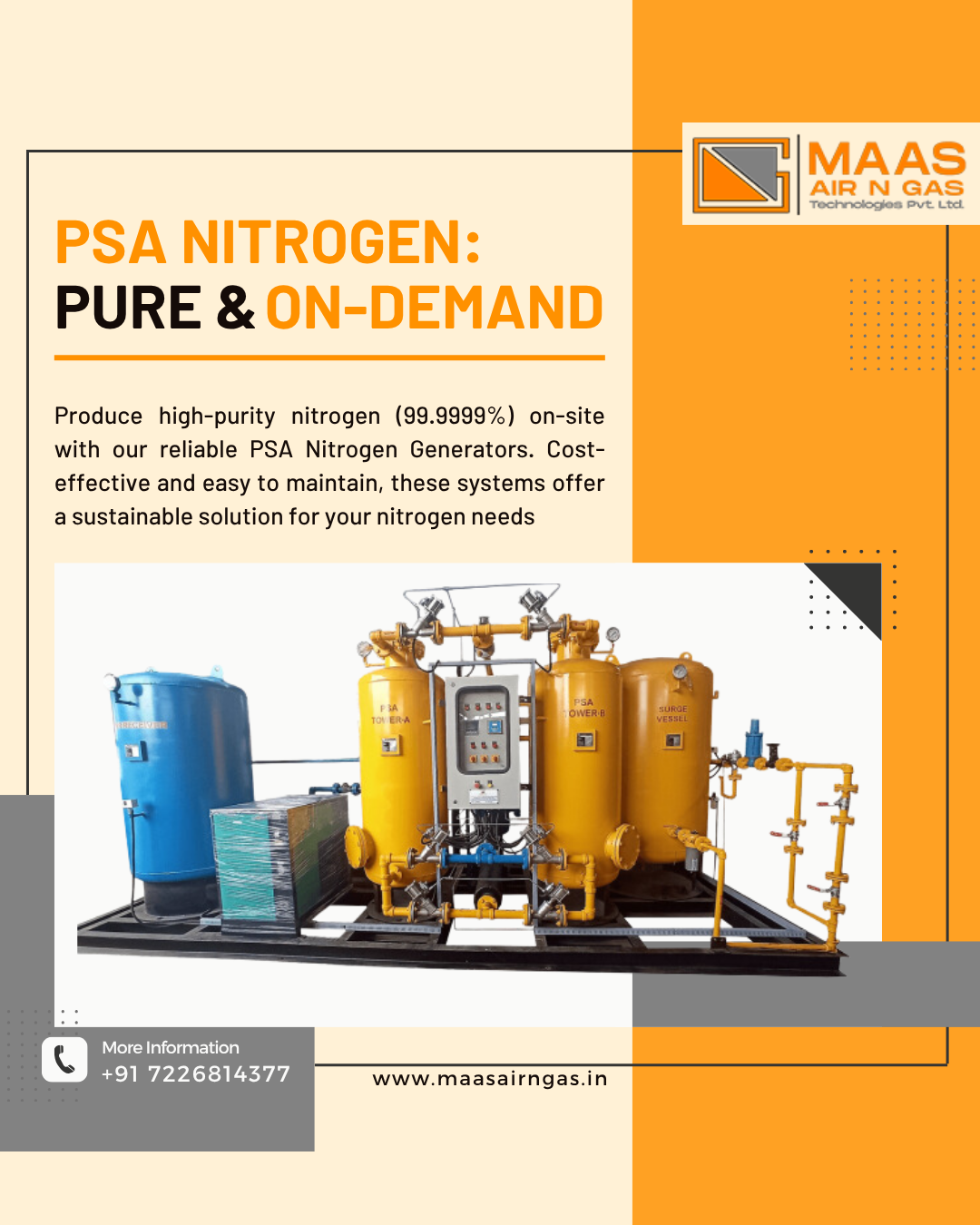
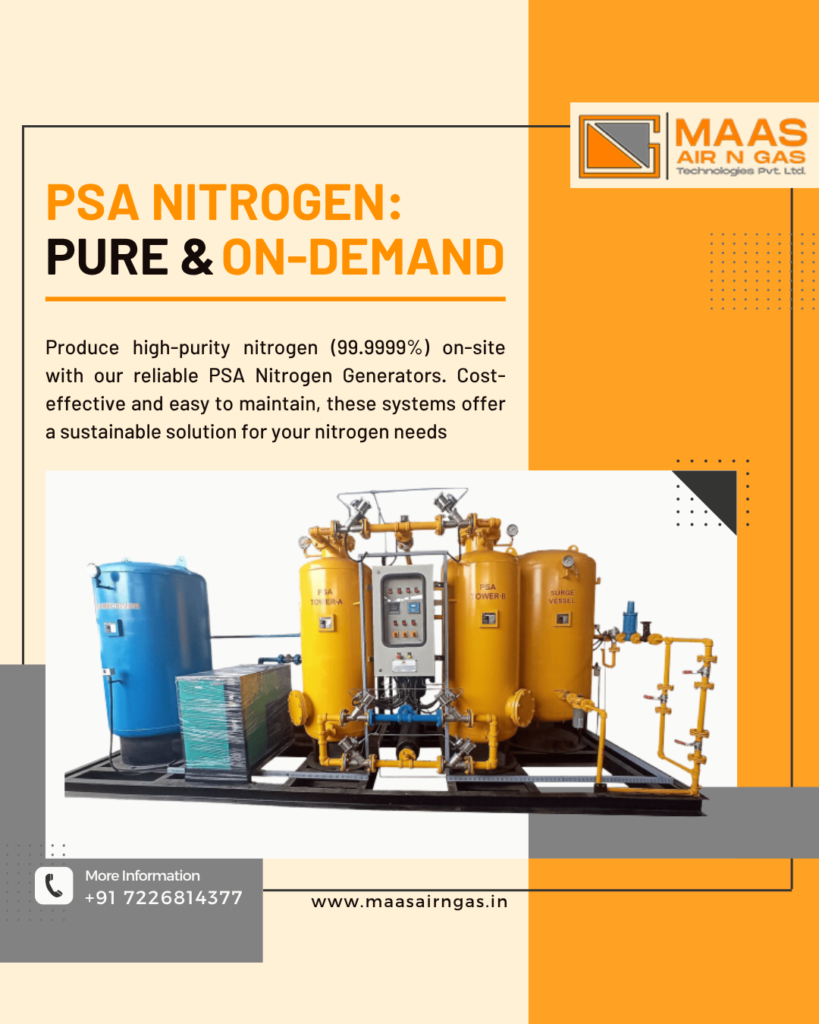
powerful PSA Nitrogen Generator: Pure & On-Demand Nitrogen Generation for Industrial Applications
A PSA Nitrogen Generator is an advanced industrial gas-generation system designed to produce high-purity nitrogen directly from compressed air. Instead of depending completely on nitrogen cylinders or external gas deliveries, industries can generate nitrogen on-site according to their actual production requirements. This makes PSA nitrogen generation a practical solution for businesses that require a reliable, continuous, and controlled nitrogen supply.
The PSA Nitrogen Generator shown in the supplied image is promoted for pure and on-demand nitrogen generation, with nitrogen purity of up to 99.9999%. The system uses Pressure Swing Adsorption technology, where compressed and treated air passes through adsorption vessels containing Carbon Molecular Sieve. Oxygen is preferentially adsorbed, while nitrogen passes through as the product gas. MAAS Air N Gas explains that its PSA system uses a twin-tower arrangement, automatic changeover valves, activated alumina for moisture removal, Carbon Molecular Sieve for nitrogen separation, and a surge vessel for maintaining product-gas pressure.
For industries where nitrogen is an important part of production, an on-site nitrogen generator can provide greater control over gas availability. It can also reduce dependence on cylinder handling, transportation, and external supply schedules. The exact economics, however, depend on nitrogen demand, purity, pressure, operating hours, compressed-air requirements, and the existing gas-supply method.
Table of Contents
- Introduction
- What Is a PSA Nitrogen Generator?
- How Does a PSA Nitrogen Generator Work?
- Key Features of PSA Nitrogen Generator
- Benefits of On-Demand Nitrogen Generation
- Major Components of a PSA Nitrogen Generator
- Industrial Applications of PSA Nitrogen
- PSA Nitrogen Generator vs Traditional Nitrogen Supply
- Factors to Consider Before Selecting a PSA Nitrogen Generator
- Maintenance and Operation
- Why Choose MAAS Air N Gas?
- Frequently Asked Questions
- Conclusion
Introduction
Nitrogen is one of the most widely used industrial gases because of its ability to provide an inert atmosphere for many manufacturing and processing operations. It is used in industries such as food packaging, pharmaceuticals, chemicals, electronics, metal processing, automotive manufacturing, laser cutting, and several other applications where oxygen control, product protection, purging, or inerting is required.
Many businesses traditionally obtain nitrogen through cylinders or bulk liquid nitrogen supplied by an external gas company. While this method can work for certain applications, industries with regular or continuous nitrogen consumption may need a more controlled supply arrangement. Cylinder replacement, transportation, storage, delivery schedules, and fluctuating consumption can become important operational considerations.
A PSA Nitrogen Generator provides another approach by producing nitrogen directly at the user’s facility. The system takes compressed air as the raw material and separates nitrogen using Pressure Swing Adsorption technology.
MAAS Air N Gas Technologies Pvt. Ltd. describes its PSA Nitrogen Gas Generation Plant as a twin-tower system with automatic changeover valves. Its published process explains that compressed air passes through activated alumina for moisture removal before entering the Carbon Molecular Sieve stage, where oxygen is preferentially adsorbed and nitrogen is produced.
What Is a PSA Nitrogen Generator?
Understanding Pressure Swing Adsorption
PSA stands for Pressure Swing Adsorption. It is a gas-separation technology that uses differences in the adsorption characteristics of gases.
In a nitrogen generator, specially selected Carbon Molecular Sieve (CMS) is used as the adsorption material. When treated compressed air enters the adsorption tower, oxygen and certain other components are preferentially adsorbed by the CMS, while nitrogen passes through the bed and is collected as product gas.
The term “pressure swing” refers to the change in pressure between the adsorption and regeneration stages. During production, the adsorption vessel operates under pressure. During regeneration, the vessel is depressurized so that the adsorbed gases are released and the CMS can be prepared for another production cycle. MAAS describes this alternating operation in its PSA nitrogen-generation process.
What Does Pure and On-Demand Nitrogen Mean?
The phrase pure and on-demand nitrogen means that the nitrogen is generated at the facility according to the required application and operating demand.
The supplied image highlights nitrogen purity of 99.9999%. MAAS’s published product information also states that nitrogen can be purified up to 99.9999%, although the achievable purity and flow combination depends on the system design and operating conditions.
How Does a PSA Nitrogen Generator Work?
Compressed Air Preparation
The first stage of nitrogen generation begins with compressed air. Proper air treatment is important because moisture, oil, dust, and other contaminants can negatively affect downstream adsorption equipment.
According to MAAS, compressed air enters the PSA nitrogen-generation module and passes through a layer of activated alumina near the bottom of the PSA towers. The activated alumina absorbs moisture before the air reaches the Carbon Molecular Sieve.
This preparation stage is important because the performance and service life of adsorption media depend significantly on the quality of the feed air.
Nitrogen Separation
After drying, the compressed air enters the CMS adsorption bed. The Carbon Molecular Sieve preferentially adsorbs oxygen molecules. Nitrogen passes through the adsorption bed and becomes the product gas.
The resulting nitrogen is then directed toward the product side of the system.
Tower Regeneration
The CMS inside an adsorption tower has a limited adsorption capacity during each operating cycle. Once the tower completes its production cycle, it needs to be regenerated.
The regeneration process is achieved by reducing the pressure of the tower, allowing the adsorbed gases to be released. The tower can then return to the adsorption stage.
Automatic Tower Switching
A PSA nitrogen generator generally uses two adsorption towers operating alternately.
While one tower produces nitrogen, the other tower is undergoing regeneration. After the required cycle time, the control system automatically changes the flow path so that the regenerated tower starts production.
MAAS states that its PSA nitrogen system uses automatic changeover valves controlled through the system’s timer and control panel. Its published process describes a changeover cycle of approximately 1 + 1 minute for its described configuration.
This alternating cycle is what enables continuous nitrogen production rather than requiring one vessel to perform both adsorption and regeneration at the same time.
Key Features of PSA Nitrogen Generator
High-Purity Nitrogen Generation
One of the most important characteristics of a nitrogen generator is the purity of the final product gas. The supplied product image highlights 99.9999% nitrogen purity, while MAAS’s product page also lists purification up to 99.9999%.
The required purity should always be selected according to the application. Not every industrial process requires the same nitrogen specification, so generator sizing and operating conditions should be designed around the actual process requirement.
On-Demand Nitrogen Production
The generator is designed to produce nitrogen when it is required. This can be useful for industries that consume nitrogen regularly and want greater control over their gas supply.
Instead of maintaining a large inventory of cylinders, the facility can generate nitrogen according to its process requirements, with suitable storage or surge capacity where required.
Twin-Tower PSA Configuration
The twin-tower arrangement allows one tower to remain in production while the second tower regenerates. Automatic switching then alternates the operating roles of the vessels.
This design provides a continuous production cycle and forms the central operating principle of the PSA system.
Fully Automatic Operation
MAAS states that its PSA nitrogen-generation plant is designed for fully automatic operation and does not require particular care during normal operation.
Automation can simplify daily operation by controlling the tower changeover, pressure sequence, and other operating functions through the control system.
Easy Installation and Maintenance
The MAAS product information highlights simple installation and maintenance as features of its PSA nitrogen generation system.
Regular preventive maintenance is still necessary because the overall system includes compressors, filters, valves, controls, pressure equipment, adsorption vessels, and other components.
Benefits of On-Demand Nitrogen Generation
A PSA nitrogen generator can offer several operational benefits for industries with consistent nitrogen requirements. The most important benefit is control over nitrogen production. Instead of relying completely on an outside supplier, the user can generate nitrogen at the facility.
This can be particularly relevant for manufacturing plants where nitrogen is required every day or where production schedules make external gas deliveries inconvenient. On-site generation can also reduce the need for frequent cylinder movement and associated handling.
Another important consideration is operating cost. MAAS states on its PSA nitrogen page that its nitrogen can be generated at a fraction of the cost of cylinder nitrogen, including a claim of approximately one-tenth of cylinder nitrogen cost. Actual savings should be evaluated for the individual installation because electricity consumption, compressed-air requirements, maintenance, utilization, and nitrogen demand vary from plant to plant.
Important Benefits
- On-site nitrogen generation
- High-purity nitrogen capability
- Nitrogen generation according to demand
- Automatic tower changeover
- Reduced dependence on external cylinder deliveries
- Suitable for continuous industrial applications
- Easy integration with downstream processes
- Controlled nitrogen pressure through suitable regulation
- Potential reduction in recurring nitrogen procurement costs
- Industrially proven PSA technology
Major Components of a PSA Nitrogen Generator
Air Compressor and Air Treatment
Compressed air is the feedstock for the nitrogen generator. The compressor provides the required pressure and flow, while filtration and drying equipment help prepare the air before it enters the PSA section.
The quality of compressed air is particularly important because moisture and contaminants can affect adsorption performance.
Activated Alumina Bed
MAAS’s described PSA process uses activated alumina near the bottom of the PSA towers to absorb moisture from compressed air before the air reaches the CMS stage.
Carbon Molecular Sieve
The CMS is the central adsorption material responsible for nitrogen separation. It preferentially adsorbs oxygen molecules while allowing nitrogen to pass through.
PSA Towers
The adsorption vessels contain the adsorbent material and alternate between production and regeneration.
Automatic Changeover Valves
Automatic valves control the flow path and switch the towers between production and regeneration according to the programmed operating sequence.
Control Panel
The control panel manages the automatic operating cycle. Electrical signals and pneumatic controls coordinate the automatic changeover process in the MAAS-described configuration.
Surge Vessel
The generated nitrogen is directed toward a surge vessel through a backpressure regulator. MAAS describes the surge vessel as maintaining minimum nitrogen pressure before the product gas is supplied to the consumer point.
Industrial Applications of PSA Nitrogen
Nitrogen has applications across a wide range of industries because it can provide an inert environment and reduce unwanted exposure to oxygen.
Food and Beverage Industry
Nitrogen is used in food packaging and controlled-atmosphere applications. It can be used where oxygen reduction and packaging protection are important.
Pharmaceutical Industry
Pharmaceutical manufacturing may use nitrogen for inerting, blanketing, purging, and controlled process environments. The required nitrogen quality should always be determined according to the applicable process and standards.
Chemical Industry
Chemical plants use nitrogen in applications such as tank blanketing, purging, inerting, and process protection.
Electronics Industry
Electronics manufacturing can require controlled atmospheres during selected manufacturing and processing operations. Nitrogen can be used where oxygen and contamination control are important.
Metal and Manufacturing Industry
Nitrogen can be used in metal processing, heat treatment, furnace applications, laser cutting, and other manufacturing processes depending on the specific equipment and process requirements.
Automotive and Tyre Applications
Nitrogen is also used in selected automotive and tyre-related applications.
MAAS identifies industries and applications including food and beverage, pharmaceuticals, chemicals, electronics, metals, glass, automotive, and tyre-related uses for nitrogen-generation solutions.
PSA Nitrogen Generator vs Traditional Nitrogen Supply
| Parameter | PSA Nitrogen Generator | Nitrogen Cylinders | Bulk Liquid Nitrogen |
|---|---|---|---|
| Production | On-site | External supplier | External supplier |
| Supply | Generated as required | Delivered | Delivered |
| External delivery dependence | Lower | Higher | Higher |
| Storage | Surge/storage as required | Cylinder storage | Cryogenic storage |
| Automation | Possible | Limited | System dependent |
| Purity | Designed according to requirement | Supplier specification | Supplier specification |
| Suitable for | Regular industrial consumption | Lower/intermittent consumption | High-volume requirements |
| Supply control | User-controlled generation | Delivery dependent | Delivery dependent |
The appropriate option depends on the site’s nitrogen consumption, purity requirement, pressure, operating schedule, available utilities, storage capacity, and overall cost structure.
Factors to Consider Before Selecting a PSA Nitrogen Generator
Nitrogen Purity Requirement
The first step is to identify the purity required by the actual application. A process requiring very high-purity nitrogen will have different design requirements from a process that can operate with lower purity.
Nitrogen Flow Requirement
The generator should be selected according to the required nitrogen flow. Both normal consumption and peak demand should be evaluated.
Operating Pressure
The required pressure at the point of use should be considered while designing the system. MAAS’s described process uses pressure regulation between the surge vessel and consumer point.
Compressed-Air Availability
Because PSA nitrogen generation uses compressed air, the available compressor capacity, pressure, air quality, temperature, and moisture conditions should be evaluated before installation.
Operating Hours
A plant operating continuously will have a different nitrogen requirement from a facility operating only for a few hours per day.
Installation Area
The available space should be considered for PSA vessels, compressor equipment, air treatment, control panel, surge vessel, piping, and maintenance access.
Maintenance Support
The availability of technical support and preventive maintenance is another important consideration for long-term operation.
Maintenance and Operation
Although PSA nitrogen generators can be designed for automatic operation, regular maintenance remains essential. Automated operation does not mean that the equipment can be ignored indefinitely.
Compressed-air filters should be inspected and maintained according to the manufacturer’s recommendations. Moisture control should also be monitored because excessive moisture can affect adsorption performance.
The valves and pneumatic connections should be inspected regularly. Changes in nitrogen purity, pressure, flow, or operating behaviour should be investigated rather than ignored.
The Carbon Molecular Sieve and other adsorption materials should be maintained according to the manufacturer’s recommended operating conditions and replacement schedule.
Important Maintenance Activities
- Inspect compressed-air filters
- Monitor feed-air quality
- Check operating pressure
- Monitor nitrogen purity
- Inspect automatic valves
- Check pneumatic connections
- Inspect control-panel operation
- Check surge-vessel pressure
- Follow preventive-maintenance schedules
- Investigate unexpected purity or flow changes
MAAS states that it provides services including yearly maintenance, PSA gas-generator upgrades, purity correction, system modification, and process-parameter adjustment.
Why Choose MAAS Air N Gas?
MAAS Air N Gas Technologies Pvt. Ltd. focuses on adsorption-based gas separation systems, air filters, air dryers, and PSA gas-generation technologies. The company’s website states that it was established in 2021 and provides solutions including PSA nitrogen gas generation plants, PSA oxygen plants, ammonia crackers, biogas-to-CNG technology, and air and gas dryers.
The company describes its project process as covering conceptualization, designing, manufacturing, setup, and commissioning. It also states that its plants are intended to meet individual client requirements and applications.
For an industrial nitrogen project, customization is important because nitrogen purity, flow, pressure, operating hours, feed-air conditions, and application requirements can differ significantly between facilities.
MAAS Air N Gas Highlights
- PSA Nitrogen Gas Generation Plants
- PSA Oxygen Plants
- Air and Gas Dryers
- Adsorption-based gas separation technology
- System customization
- Installation and commissioning
- PSA generator upgrades
- Purity correction and system modification
- Annual maintenance support
- Process-parameter optimization
MAAS lists its contact number as +91 7226814377 and its Ahmedabad office address on its official contact page.
Frequently Asked Questions
What is a PSA Nitrogen Generator?
A PSA Nitrogen Generator is an industrial system that produces nitrogen from compressed air using Pressure Swing Adsorption technology. Carbon Molecular Sieve is used to preferentially adsorb oxygen while nitrogen passes through as the product gas.
How does a PSA Nitrogen Generator produce nitrogen?
Compressed air is first treated and dried. It then enters a PSA tower containing Carbon Molecular Sieve. Oxygen is preferentially adsorbed while nitrogen passes through. When one tower reaches the end of its adsorption cycle, it is regenerated while the second tower takes over production.
What nitrogen purity can be achieved?
The supplied image promotes 99.9999% purity, and MAAS’s official PSA nitrogen product page states that nitrogen can be purified up to 99.9999%. Actual purity depends on the system configuration and operating conditions.
Is a PSA Nitrogen Generator fully automatic?
MAAS describes its PSA nitrogen-generation system as fully automatic, with automatic changeover between the two adsorption towers.
Is nitrogen generated continuously?
The twin-tower operating principle allows one tower to produce nitrogen while the other regenerates. Automatic changeover allows the cycle to continue during normal operation.
What is Carbon Molecular Sieve?
Carbon Molecular Sieve, commonly called CMS, is an adsorption material used in PSA nitrogen generators. It preferentially adsorbs oxygen from compressed air, allowing nitrogen to pass through as the product gas.
What industries use PSA nitrogen?
PSA nitrogen systems can be used in food and beverage, pharmaceutical, chemical, electronics, metal, automotive, glass, tyre, and other industrial applications depending on process requirements.
Does the generator require compressed air?
Yes. PSA nitrogen generation uses compressed air as its feed gas. The compressor and air-treatment system should be appropriately selected according to the nitrogen generator’s requirements.
Is on-site nitrogen generation cost-effective?
On-site generation can reduce dependence on externally supplied nitrogen, but the actual financial benefit depends on nitrogen consumption, compressor power, operating hours, maintenance, purity, and the cost of the existing cylinder or bulk supply.
How often does a PSA Nitrogen Generator require maintenance?
Maintenance frequency depends on the system design and operating conditions. Filters, valves, controls, pressure equipment, and adsorption components should be inspected according to the manufacturer’s recommended maintenance schedule.
Conclusion
A PSA Nitrogen Generator is a practical on-site solution for industries that require a reliable supply of nitrogen. Using Pressure Swing Adsorption technology, the system separates nitrogen from compressed air through a controlled adsorption and regeneration cycle.
The twin-tower design allows one adsorption vessel to produce nitrogen while the other undergoes regeneration. Automatic changeover valves and a control system coordinate the cycle, allowing nitrogen generation to continue during normal operation. MAAS’s published PSA process also includes activated alumina for moisture removal, Carbon Molecular Sieve for gas separation, a backpressure regulator, and a surge vessel for product-gas pressure management.
The PSA Nitrogen Generator featured in the supplied image focuses on pure and on-demand nitrogen generation, with a promoted purity of up to 99.9999%. For industries with regular nitrogen demand, producing nitrogen at the point of use can provide greater supply control and reduce dependence on external deliveries. https://www.bis.gov.in/
Before selecting a system, industries should carefully evaluate nitrogen purity, flow rate, operating pressure, compressed-air quality, production schedule, installation space, maintenance requirements, and total operating cost.
MAAS Air N Gas Technologies Pvt. Ltd. provides PSA nitrogen generation systems along with other industrial gas and air-treatment technologies and states that its systems can be configured around individual customer requirements
Leave A Comment