24/7 Phone Services

-
-
Visit Our Place
S. G. Highway, Ahmedabad - 380051
Fully Automatic Biogas Up-Gradation Plant: Working, Features, Benefits and Applications
Table of Contents
- Introduction
- What Is a Fully Automatic Biogas Up-Gradation Plant?
- How Does a Biogas Up-Gradation Plant Work?
- Key Features of a Fully Automatic Biogas Up-Gradation Plant
- Major Components of a Biogas Up-Gradation Plant
- Benefits of a Fully Automatic Biogas Up-Gradation Plant
- Applications of Biogas Up-Gradation Plants
- Biogas Up-Gradation vs Raw Biogas
- Factors to Consider Before Selecting a Biogas Up-Gradation Plant
- VPSA Technology for Biogas Up-Gradation
- Importance of Pre-Treatment in Biogas Up-Gradation
- Maintenance of a Biogas Up-Gradation Plant
- Why Choose MAAS Air N Gas for Biogas Up-Gradation Solutions?
- Frequently Asked Questions
- Conclusion
Introduction
Explore fully automatic biogas up-gradation plant technology, working process, adsorber towers, VPSA purification, key features, benefits and Bio-CNG applications.
The demand for renewable and alternative energy solutions is increasing as industries and organizations look for efficient ways to utilize organic waste and produce useful energy. Biogas is one such renewable energy source generated through the anaerobic digestion of suitable organic materials.
However, raw biogas contains methane along with carbon dioxide, hydrogen sulfide, moisture and other unwanted components. To obtain a cleaner and methane-rich gas suitable for applications such as Bio-CNG production, the raw biogas needs to undergo appropriate treatment and upgrading.
A Fully Automatic Biogas Up-Gradation Plant is designed to purify and upgrade biogas by using multiple treatment and gas-separation stages. Depending on the technology, the system can include pre-treatment, moisture removal, contaminant filtration, adsorption and gas-quality monitoring.
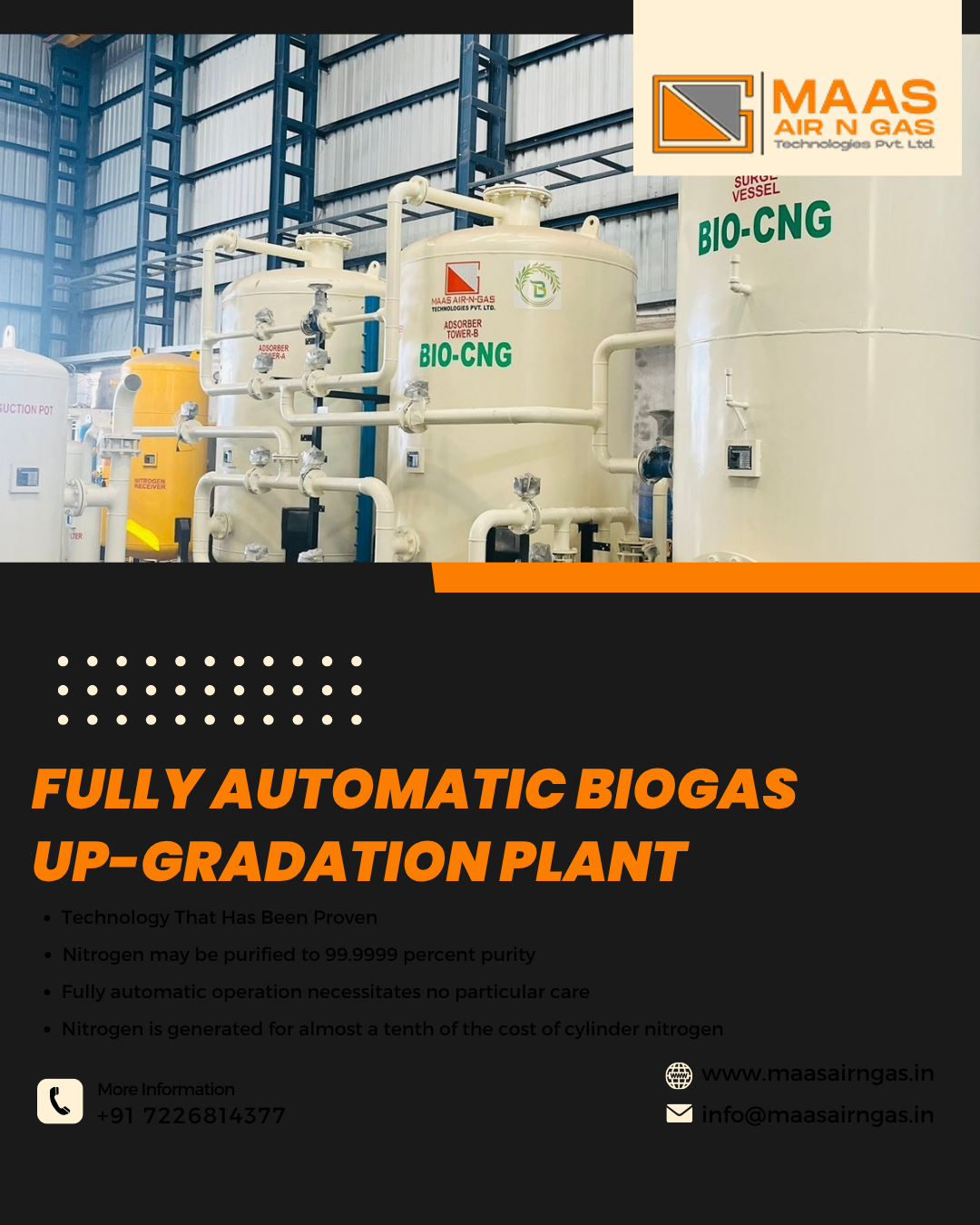
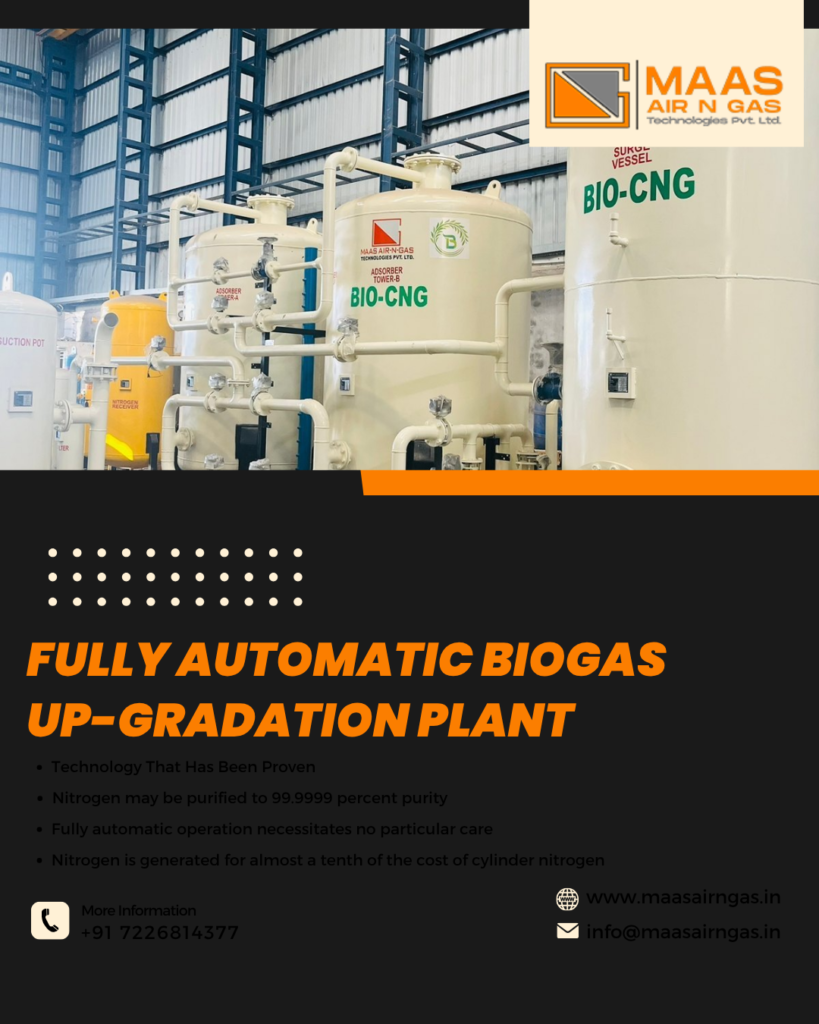
The image shown here features a Fully Automatic Biogas Up-Gradation Plant from MAAS Air N Gas Technologies Pvt. Ltd. The installation includes equipment marked Adsorber Tower-A, Adsorber Tower-B, Bio-CNG and Surge Vessel.
MAAS Air N Gas describes its Bio Gas to CNG process as a VPSA-based system involving biogas pre-treatment, dehumidification, activated carbon filtration and CO₂ removal through adsorption technology.
What Is a Fully Automatic Biogas Up-Gradation Plant?
A Fully Automatic Biogas Up-Gradation Plant is an integrated system used to improve the quality of raw biogas by reducing unwanted gases and contaminants and increasing the concentration of methane.
Raw biogas generated through anaerobic digestion can contain:
- Methane
- Carbon dioxide
- Hydrogen sulfide
- Moisture
- VOCs
- Siloxanes
- Other trace gases
The exact composition depends on the feedstock and anaerobic digestion process.
The purpose of an up-gradation plant is to treat this raw gas and produce a cleaner methane-rich gas that can be further compressed or utilized according to the required application and gas-quality specification.
A typical plant can contain several stages, including:
- Biogas pre-treatment
- Water scrubbing
- Chemical treatment
- Dehumidification
- Activated carbon filtration
- CO₂ separation
- Adsorption
- Regeneration
- Surge vessel
- Gas-quality analysis
- Automatic control
How Does a Biogas Up-Gradation Plant Work?
Biogas Collection
The process starts with the collection of raw biogas produced from an anaerobic digestion system.
The gas is transferred from the gas holder toward the purification and upgrading system through suitable piping and a blower or gas-handling arrangement.
The raw gas should be analyzed before designing the plant because methane, CO₂, H₂S, moisture and other contaminant levels can vary depending on the feedstock.
Biogas Pre-Treatment
Pre-treatment is an important stage because contaminants present in raw biogas can affect downstream equipment and purification materials.
MAAS Air N Gas describes a multi-stage pre-treatment process for reducing contaminants such as H₂S, VOCs and moisture before the main VPSA purification stage.
Water Scrubbing
In the process described by MAAS Air N Gas, pressurized biogas passes through a water scrubber.
Water is used as an absorbent to partially remove H₂S and ammonia. The raw biogas flows upward through the scrubber while water is supplied from the top.
Chemical Scrubbing
After water scrubbing, the gas can pass through a chemical scrubber for further H₂S removal.
This stage helps prepare the gas for subsequent moisture removal and purification.
Dehumidification
The treated gas then passes through a biogas dehumidification system.
Moisture is condensed and separated from the gas. MAAS Air N Gas describes a customized biogas dehumidifier that cools the gas and removes condensed moisture through a cyclonic moisture separator with automatic drainage.
Activated Carbon Filtration
After dehumidification, activated carbon filtration can be used to reduce impurities such as H₂S, VOCs and siloxanes.
This additional treatment prepares the biogas for the main adsorption-based upgrading stage.
VPSA-Based CO₂ Removal
The treated and dried biogas enters the adsorption section.
In the VPSA process described by MAAS Air N Gas, molecular-sieve adsorbents selectively adsorb CO₂ while methane-rich gas leaves the adsorption towers.
Key Features of a Fully Automatic Biogas Up-Gradation Plant
Fully Automatic Operation
Automation allows the plant to perform defined process sequences with limited routine manual intervention.
Automatic valves, PLC controls, sensors and process monitoring can coordinate different stages of the system.
Adsorber Tower System
The image clearly shows two major vessels labelled Adsorber Tower-A and Adsorber Tower-B.
These towers form an important part of the adsorption-based gas separation process.
While one tower can perform adsorption, another can undergo regeneration according to the programmed operating cycle.
Bio-CNG Production
The upgraded methane-rich gas can be further processed and compressed for Bio-CNG applications when it meets the required gas-quality and safety specifications.
Surge Vessel
The large vessel visible on the right side of the image is marked Surge Vessel.
The surge vessel provides an intermediate volume for the purified gas and can help stabilize the gas-handling process.
MAAS Air N Gas describes sending purified gas to a surge vessel for purity analysis before final storage when the required methane percentage is achieved.
PLC-Based Control
PLC-based automation can coordinate valve switching, adsorption cycles, regeneration and other programmed operations.
MAAS Air N Gas describes PLC and HMI-based operation and provision for remote access to process control.
Multi-Stage Purification
The system uses several treatment stages before the final gas-upgrading process.
This approach helps reduce contaminants before the biogas reaches the adsorption section.
Customized Plant Design
Biogas characteristics vary between projects. Therefore, plant capacity and configuration should be determined according to feedstock, gas flow, pressure, methane concentration, CO₂ concentration and contaminant levels.
Major Components of a Biogas Up-Gradation Plant
Biogas Blower
A blower can be used to move and pressurize the raw biogas before it enters the treatment system.
Water Scrubber
The water scrubber provides an initial treatment stage for reducing selected soluble contaminants.
Chemical Scrubber
The chemical scrubber provides additional treatment for contaminants such as hydrogen sulfide.
Biogas Dehumidifier
The dehumidifier removes moisture from the treated biogas before it enters the main purification stage.
Activated Carbon Filter
Activated carbon filtration can reduce selected impurities such as H₂S, VOCs and siloxanes.
Adsorber Towers
Adsorber towers contain specialized adsorption materials that selectively capture specific components from the gas stream.
The image shows two adsorption vessels labelled Tower-A and Tower-B.
Vacuum Pump
A vacuum pump can be used during regeneration in VPSA systems to assist in removing adsorbed components from the adsorption material.
Surge Vessel
The surge vessel receives the purified gas and provides an intermediate storage or buffering function before the next stage.
PLC and HMI
The PLC and HMI system allows the plant to control, monitor and coordinate different process stages.
Benefits of a Fully Automatic Biogas Up-Gradation Plant
Higher Methane Concentration
The upgrading process removes selected unwanted components, particularly CO₂, resulting in a methane-rich product gas.
Improved Gas Quality
Pre-treatment and purification can reduce moisture, H₂S and other contaminants according to the process design.
Supports Bio-CNG Production
Methane-rich upgraded biogas can be further compressed for Bio-CNG/CBG applications when the required specifications are achieved.
Reduced Manual Intervention
Automation allows programmed process sequences to operate through PLC-controlled systems.
Better Process Monitoring
Sensors, HMI systems and gas-quality analysis provide operators with information about important plant parameters.
Continuous Operation
Alternating adsorption and regeneration cycles can allow continuous gas processing.
Waste-to-Energy Solution
The technology can form part of a larger waste-to-energy project by converting suitable organic waste into biogas and subsequently upgrading the gas into a useful energy product.
Applications of Biogas Up-Gradation Plants
Bio-CNG and CBG Production
Biogas upgrading is an important stage in producing methane-rich gas for Bio-CNG or CBG applications.
Industrial Fuel
Upgraded biogas can be considered for suitable industrial fuel applications where the gas quality and equipment are compatible.
Power Generation
Biogas treatment and upgrading systems can be integrated with suitable power-generation projects.
Agricultural Waste
Agricultural residues and animal waste can be processed through anaerobic digestion to generate biogas.
Food Processing Waste
Food-processing industries can utilize suitable biodegradable waste as feedstock for biogas generation.
Wastewater Treatment
Biogas generated from wastewater treatment processes can be treated and upgraded for appropriate applications.
Biogas Up-Gradation vs Raw Biogas
| Parameter | Raw Biogas | Upgraded Biogas |
|---|---|---|
| Methane | Present in varying concentration | Higher concentration after upgrading |
| CO₂ | Present | Reduced |
| Moisture | Usually present | Reduced through dehumidification |
| H₂S | May be present | Reduced through treatment |
| VOCs | May be present | Can be reduced through filtration |
| Gas Quality | Variable | Controlled according to application |
| Further Compression | Requires suitable treatment | Possible when required specifications are achieved |
| Main Purpose | Fuel/feed gas for treatment | Methane-rich gas for further use |
Factors to Consider Before Selecting a Biogas Up-Gradation Plant
Raw Biogas Composition
A detailed gas analysis should be performed before selecting the purification technology.
Biogas Flow Rate
The quantity of biogas available determines the required plant capacity.
Methane Concentration
The initial methane concentration affects the upgrading process and expected output.
Carbon Dioxide Concentration
CO₂ concentration is an important factor when designing an adsorption-based upgrading system.
H₂S Level
Hydrogen sulfide concentration should be evaluated because it affects pre-treatment requirements.
Moisture Content
Moisture levels should be evaluated to determine appropriate dehumidification requirements.
Required Final Gas Quality
The intended application determines the quality requirements of the final methane-rich gas.
Automation Requirements
The required level of automation should be decided according to operating conditions, manpower and monitoring requirements.
VPSA Technology for Biogas Up-Gradation
What Is VPSA?
VPSA stands for Vacuum Pressure Swing Adsorption.
It is an adsorption-based gas-separation technology that uses pressure and vacuum cycles to separate selected components from a gas mixture.
How Does VPSA Work?
After pre-treatment and moisture removal, the biogas enters an adsorption tower containing molecular-sieve material.
According to MAAS Air N Gas’s process description, CO₂ is adsorbed by the molecular sieves while methane-rich gas exits from the top of the adsorption tower.
After the adsorption stage, the tower undergoes regeneration through depressurization and vacuum.
The process then changes from one tower to another through automatic valves controlled by a PLC. This allows the plant to continue producing purified gas while the adsorption material is regenerated.
Importance of Pre-Treatment in Biogas Up-Gradation
Protection of Adsorption Material
Proper pre-treatment helps reduce contaminants before the gas reaches the adsorption towers.
Moisture Control
Dehumidification reduces water content and helps prepare the gas for the adsorption stage.
H₂S Removal
Reducing H₂S before the main purification stage helps protect downstream equipment and process components.
VOC and Siloxane Removal
Activated carbon filtration can be used to reduce selected VOCs and siloxanes.
Stable Process Operation
Consistent pre-treatment can support stable operation of the downstream upgrading system.
MAAS Air N Gas specifically highlights a four-stage pre-treatment process and the use of stainless-steel pre-treatment equipment in its listed Bio Gas to CNG technology.
Maintenance of a Biogas Up-Gradation Plant
Regular Equipment Inspection
Plant components should be inspected according to operating conditions and the equipment manufacturer’s maintenance schedule.
Adsorber Tower Inspection
Adsorber towers, valves, connections and associated instrumentation should be checked periodically.
Gas Quality Monitoring
Regular gas analysis helps determine whether the plant is producing gas according to the required specification.
Pressure Monitoring
Pressure readings across different plant sections can help identify abnormal operating conditions.
Valve and PLC Maintenance
Automatic valves, PLC controls, sensors and HMI systems should be maintained and tested periodically.
Filter Maintenance
Filters and contaminant-removal equipment should be monitored according to operating conditions.
Preventive Maintenance
A preventive maintenance program can help identify potential equipment issues before they cause unexpected downtime.
Why Choose MAAS Air N Gas for Biogas Up-Gradation Solutions?
MAAS Air N Gas Technologies Pvt. Ltd. lists Biogas Purification Plants and Bio Gas to CNG Technology among its solutions. Its official website describes experience in PSA/VPSA-based gas separation technology and related gas-treatment equipment.
The company’s published Bio Gas to CNG process includes multiple pre-treatment stages, moisture removal, activated carbon filtration, VPSA-based CO₂ removal, methane-loss recovery and PLC/HMI-based operation.
According to the company’s published information, its engineering approach covers areas such as conceptualization, design, manufacturing, setup and commissioning.
For every Bio-CNG project, the final plant configuration should be selected based on the actual raw-biogas composition, flow rate, pressure, contaminant concentration and required final gas quality.
Frequently Asked Questions
What is a Fully Automatic Biogas Up-Gradation Plant?
It is an integrated system that treats and upgrades raw biogas by removing selected contaminants and increasing methane concentration through processes such as pre-treatment and adsorption-based gas separation.
What is Bio-CNG?
Bio-CNG is compressed methane-rich gas produced by upgrading biogas generated from suitable organic feedstocks.
How does a Biogas Up-Gradation Plant work?
The process generally includes biogas pre-treatment, moisture removal, contaminant filtration, CO₂ separation, gas-quality analysis and further compression or storage depending on the application.
What are Adsorber Towers?
Adsorber towers are vessels containing adsorption material used to selectively remove particular components from a gas mixture.
What is the purpose of the Surge Vessel?
A surge vessel provides an intermediate volume for purified gas and can help stabilize the gas flow before the next stage. In the MAAS process, purified gas is sent to the surge vessel for analysis before final storage when the required methane percentage is achieved.
What is VPSA technology?
VPSA means Vacuum Pressure Swing Adsorption. It uses adsorption and vacuum-based regeneration cycles to separate selected gases from a gas mixture.
Why is biogas pre-treatment important?
Pre-treatment reduces contaminants such as H₂S, moisture, VOCs and siloxanes before the main gas-upgrading stage.
Can upgraded biogas be used for Bio-CNG?
Yes, upgraded methane-rich biogas can be compressed for Bio-CNG/CBG applications when it meets the required specifications and applicable safety requirements.
Is the plant fully automatic?
The level of automation depends on the plant configuration. MAAS Air N Gas describes PLC/HMI-based operation and automatic valve changeover for its VPSA-based biogas purification process.
What information is needed before installing a Bio-CNG plant?
Important information includes raw biogas flow rate, methane concentration, CO₂ concentration, H₂S level, moisture, pressure, other contaminants and required final gas quality.
Where are Biogas Up-Gradation Plants used?
They can be used in Bio-CNG projects, agricultural waste projects, food-processing facilities, wastewater-treatment applications and other suitable anaerobic-digestion projects.
Conclusion
A Fully Automatic Biogas Up-Gradation Plant provides an integrated approach for treating and upgrading raw biogas into a cleaner, methane-rich gas. The process can involve several stages, including pre-treatment, water and chemical scrubbing, dehumidification, activated carbon filtration and VPSA-based CO₂ separation.
The plant shown in the image includes Adsorber Tower-A, Adsorber Tower-B and a Surge Vessel, which are important components of the adsorption-based upgrading arrangement. In the process described by MAAS Air N Gas, the adsorption towers operate through alternating adsorption and regeneration cycles, with automatic valves controlled through a PLC.
Biogas up-gradation technology can be used as part of Bio-CNG projects, industrial energy systems, agricultural-waste projects, food-processing applications and wastewater-treatment facilities.
The appropriate plant configuration depends on the project’s raw-biogas composition, flow rate, pressure, contaminants, required methane concentration and intended end use. Proper pre-treatment, gas-quality monitoring and preventive maintenance are also important for reliable plant operation. https://www.justdial.com/
For businesses planning a Biogas Up-Gradation Plant or Bio-CNG project, MAAS Air N Gas Technologies provides Bio Gas to CNG and PSA/VPSA-based gas-treatment solutions according to the company’s published product information.
Leave A Comment