24/7 Phone Services

-
-
Visit Our Place
S. G. Highway, Ahmedabad - 380051
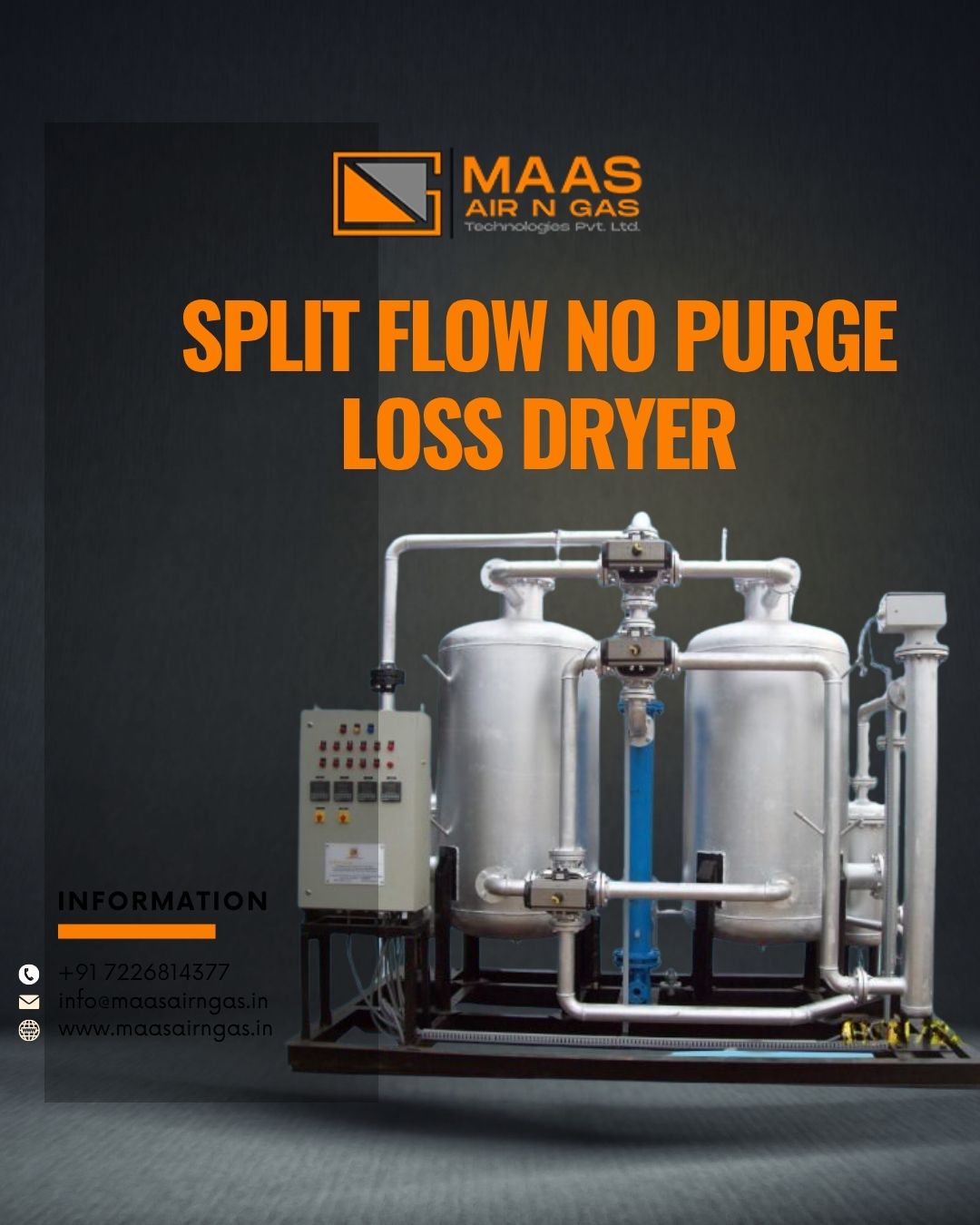
Split Flow No Purge Loss Dryer technology is designed for industrial compressed air applications where reliable moisture removal and efficient operation are important. Compressed air often contains water vapor and other contaminants that can create problems in pneumatic equipment, pipelines, production machinery, and downstream processes. A properly selected air dryer helps control this moisture and supports consistent air quality.
In conventional regenerative desiccant drying systems, a portion of the compressed air may be used as purge air during desiccant regeneration. This purge requirement can represent a loss of usable compressed air. A Split Flow No Purge Loss Dryer is designed around an alternative regeneration approach that can eliminate the need for compressed-air purge during the regeneration stage, depending on the specific configuration and operating conditions.
For industries that operate compressors continuously, reducing unnecessary compressed-air consumption can be an important part of improving overall system efficiency. The U.S. Department of Energy notes that regenerative desiccant dryers can consume purge air, while heated and heat-of-compression dryer technologies can reduce or eliminate purge requirements through alternative regeneration methods.
Table of Contents
- What Is a Split Flow No Purge Loss Dryer?
- How Does a Split Flow No Purge Loss Dryer Work?
- Why Is Purge Air Important in Compressed Air Systems?
- Key Benefits of Split Flow No Purge Loss Dryer Technology
- Applications of No Purge Loss Dryers
- Factors to Consider Before Selecting a Dryer
- Maintenance and Performance Considerations
- Why Choose MAAS Air N Gas?
- Frequently Asked Questions
- Conclusion
What Is a Split Flow No Purge Loss Dryer?
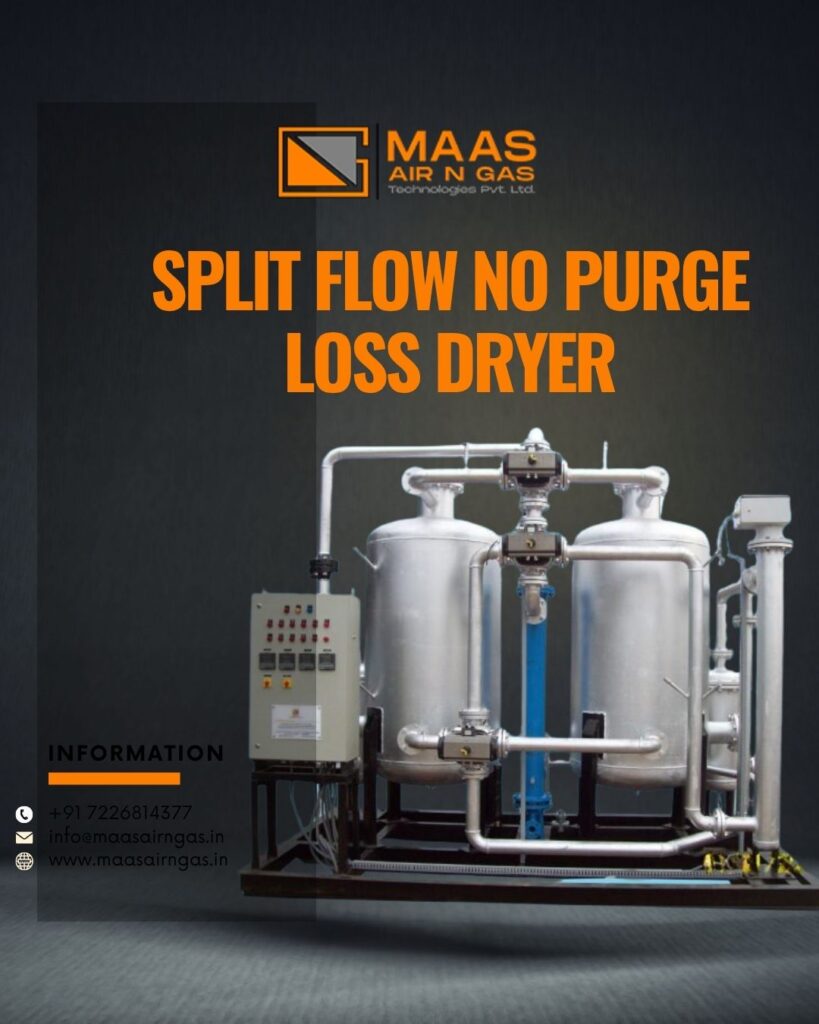
A Split Flow No Purge Loss Dryer is an industrial air-drying system designed to remove moisture from compressed air while minimizing or eliminating the use of product compressed air for desiccant regeneration. The basic objective is to deliver dry compressed air without sacrificing a portion of the treated air as conventional purge air.
Moisture is naturally present in atmospheric air. When air is compressed, the concentration of moisture and the resulting condensation behavior change. If this moisture is not properly controlled, it can travel through the compressed air distribution system and reach equipment and production processes. The Department of Energy explains that atmospheric air contains moisture and that cooling compressed air can cause water vapor to condense.
A properly engineered dryer therefore becomes an important part of an industrial compressed air treatment system. The required dryer technology depends on factors such as pressure, inlet temperature, flow rate, required pressure dew point, ambient conditions, and the application.
For industrial users looking to improve efficiency, a no-purge-loss configuration can be particularly attractive because compressed air that would otherwise be used for regeneration remains available for production.
How Does a Split Flow No Purge Loss Dryer Work?
The operating principle of a Split Flow No Purge Loss Dryer depends on controlled airflow through the drying and regeneration sections. The drying side removes moisture from the compressed air, while the regeneration side restores the moisture-removal capacity of the desiccant.
Instead of relying on a continuous portion of product air as purge air, the system can use a dedicated regeneration flow or an alternative regeneration method. This separation of the drying and regeneration functions is an important part of the technology.
During normal operation, one section of the dryer is responsible for drying the compressed air while another section undergoes regeneration. Once the regeneration cycle is complete, the flow arrangement changes so that the regenerated section can return to the drying cycle.
The exact sequence, regeneration temperature, flow arrangement, switching time, and control strategy depend on the equipment design and required performance. For this reason, industrial dryer selection should be based on actual process conditions rather than simply selecting equipment according to compressor capacity.
Typical operating sequence includes:
- Compressed air enters the treatment system.
- Moisture is removed through the active drying section.
- A separate flow path supports regeneration.
- The saturated desiccant section is regenerated.
- Automatic valves change the operating cycle.
- The regenerated section returns to service.
- The process continues to provide dry compressed air.
Why Is Purge Air Important in Compressed Air Systems?
Purge air is an important consideration when selecting a regenerative desiccant dryer. In a traditional pressure-swing regenerative dryer, part of the dried compressed air can be expanded and directed through the offline desiccant bed to remove accumulated moisture.
The problem is that this air has already been compressed, which means energy has already been spent to produce it. If a portion of that air is used for regeneration, it is not available for the intended production process.
According to the U.S. Department of Energy, pressure-swing regenerative dryers can require approximately 10–18% of dryer-rated airflow as purge air, depending on the type and operating conditions. The same source explains that heated and heat-of-compression dryer configurations can reduce purge-air requirements.
This makes purge consumption an important factor when evaluating the total operating cost of a compressed air system.
For plants operating large compressors for long periods, even a relatively small percentage of air loss can become significant over time. A properly designed Split Flow No Purge Loss Dryer can therefore help improve the utilization of the compressed air being generated.
7 Powerful Benefits of Split Flow No Purge Loss Dryer Technology
1. Reduced Compressed Air Loss
One of the most important advantages of a Split Flow No Purge Loss Dryer is the potential to eliminate compressed-air purge consumption. Instead of intentionally using part of the finished compressed air for regeneration, the dryer uses a separate or alternative regeneration approach.
This means more of the compressed air produced by the compressor can remain available for production equipment. For facilities where compressed air demand is high, this can contribute to better overall system utilization.
The actual energy and cost benefit depends on compressor efficiency, operating hours, dryer configuration, pressure, flow, and regeneration requirements.
2. Improved Energy Efficiency
Compressed air is an energy-intensive utility. Every cubic metre of compressed air has an associated generation cost because compressors require electrical energy to raise atmospheric air to operating pressure.
Reducing unnecessary air losses can therefore support overall energy management. The U.S. Department of Energy recommends evaluating compressed-air systems systematically, including air treatment equipment, pressure, leaks, controls, and end-use requirements.
A Split Flow No Purge Loss Dryer can form part of an energy-conscious compressed-air treatment strategy, particularly when the plant has a high and continuous demand for dry air.
3. Reliable Moisture Control
Moisture control is essential in many industrial applications. Water inside compressed air pipelines can contribute to corrosion, equipment problems, product contamination, and unreliable pneumatic operation.
A dryer helps reduce the amount of moisture reaching downstream equipment. The required pressure dew point should always be selected according to the application rather than choosing the lowest possible dew point simply because it is available.
The Department of Energy specifically recommends drying compressed air only to the degree required by the equipment and end use because excessive drying can add unnecessary energy and operating costs.
4. Better Utilization of Compressor Capacity
A compressor generates compressed air for the production system. When a dryer consumes part of that air for purge regeneration, the compressor may need to produce additional air to compensate for the loss.
With a no-purge-loss approach, more of the generated compressed air can be directed toward actual plant requirements. This can be especially relevant for facilities operating close to their compressor capacity.
A properly engineered dryer can therefore contribute to better utilization of existing compressed-air infrastructure without necessarily increasing compressor capacity.
5. Suitable for Continuous Industrial Operation
Industrial production facilities often require dry compressed air continuously. Unexpected moisture problems can affect production quality and equipment reliability.
A well-designed Split Flow No Purge Loss Dryer can use automated switching and control systems to maintain the drying cycle while regeneration takes place in another section.
Typical applications may include:
- Pharmaceutical manufacturing
- Chemical processing
- Food and beverage production
- Automotive manufacturing
- Electronics production
- Metal processing
- Pneumatic automation
- Instrument air systems
- Packaging operations
- General industrial compressed-air systems
The final dryer configuration should always be selected according to the required flow, pressure dew point, inlet conditions, and process requirements.
6. Lower Operating Waste
Reducing compressed-air losses is different from simply reducing electricity consumption at the compressor. It addresses how effectively the compressed air is used after it has already been generated.
If a dryer can provide the required moisture removal without consuming product air for purge, the system can reduce one source of compressed-air waste.
This is particularly relevant for facilities where the compressor operates for extended shifts or continuously. The Department of Energy identifies leaks, inappropriate compressed-air uses, pressure management, storage, controls, and equipment upgrades as important areas for compressed-air efficiency improvement.
7. Supports Better Overall Air Treatment
A dryer is only one part of a complete compressed-air treatment system. Filters, separators, drains, compressors, receivers, piping, and controls all influence final air quality.
A Split Flow No Purge Loss Dryer can be integrated into a properly engineered treatment system to provide dry air suitable for the specific industrial application.
The goal should not simply be to achieve the lowest possible dew point. Instead, the system should provide the required air quality with an appropriate balance between reliability, energy consumption, maintenance, and capital cost.
Applications of Split Flow No Purge Loss Dryer
A Split Flow No Purge Loss Dryer can be considered for industrial facilities where moisture control and compressed-air efficiency are both important.
In manufacturing environments, dry compressed air can support pneumatic tools, control systems, instrumentation, automation equipment, and production processes. In pharmaceutical and food-related applications, air quality requirements may be particularly demanding, so the complete treatment system must be designed according to the applicable process and quality requirements.
The technology can also be useful where compressed air consumption is high and operating costs need to be controlled. A dryer with low or zero purge-air consumption can become an important part of an overall compressed-air optimization program.
For facilities involved in gas generation, proper air treatment is also important. For example, MAAS Air N Gas explains that compressed air supplied to its PSA nitrogen generation systems is dried before entering the molecular-sieve stage.
Factors to Consider Before Selecting a Dryer
Selecting the right dryer requires more than knowing the compressor’s horsepower. The dryer must be matched to the actual operating conditions and required air quality.
Consider these factors before purchasing:
- Compressed-air flow: Determine the normal, peak, and future flow requirement.
- Operating pressure: Dryer capacity can vary with pressure.
- Inlet temperature: High inlet temperatures can affect dryer performance.
- Ambient temperature: Environmental conditions influence heat transfer and equipment operation.
- Required pressure dew point: Select the dew point according to the application.
- Air quality: Consider particulate, oil, and moisture requirements.
- Operating hours: Continuous plants can benefit more from efficiency improvements.
- Regeneration method: Compare purge, heated, blower-assisted, heat-of-compression, and other configurations.
- Maintenance requirements: Consider valve, desiccant, filter, drain, and control-system maintenance.
- Future expansion: Select a configuration that can accommodate expected changes in demand.
Maintenance and Performance Considerations
Even a high-efficiency dryer requires appropriate maintenance. Filters should be monitored because pressure drop can increase when filter elements become contaminated. Drains should also operate correctly so that collected condensate does not enter the downstream air system.
Desiccant condition is another important consideration for adsorption-based systems. Depending on the design and application, desiccant may require inspection or replacement after a specified operating period.
Operators should also monitor pressure dew point, inlet and outlet pressure, temperature, switching cycles, valve performance, and alarms. Early detection of abnormal conditions can help prevent moisture from reaching downstream equipment.
The Department of Energy recommends operating air-treatment equipment close to its design conditions and selecting the level of air treatment according to actual end-use requirements.
Why Choose MAAS Air N Gas for Industrial Air Treatment?
MAAS Air N Gas Technologies Pvt. Ltd. works in the fields of air dryers, gas separation systems, air filtration, and related industrial technologies. The company states that it was established in 2021 and focuses on adsorption-based gas separation systems, air filters, and air dryers.
Its product portfolio includes air and gas dryers along with PSA nitrogen and oxygen generation systems. The company also describes its approach as covering conceptualization, system design, manufacturing, installation, and commissioning.
For industrial users, selecting drying equipment should begin with a clear understanding of the application. Flow rate, operating pressure, inlet temperature, pressure dew point, air quality, operating hours, and regeneration requirements should all be evaluated before finalizing the system.
You can learn more about MAAS Air N Gas and its industrial solutions through the company’s MAAS Air N Gas official website
For related gas-generation applications, explore the PSA Nitrogen Gas Generation Plant and PSA Oxygen Plant. PSA Nitrogen Gas Generation Plant PSA Oxygen Plant
You can also review MAAS Air N Gas’s Bio Gas Dryer solution for applications involving gas dehydration. Bio Gas Dryer
Understanding the wider compressed-air system is important when evaluating a dryer. The U.S. Department of Energy provides resources covering compressed-air efficiency, system analysis, air quality, leaks, storage, controls, and end-use optimization.
For additional technical information about compressed-air treatment, the Compressed Air and Gas Institute provides resources covering dryers and filters.Compressed air is an energy-intensive utility, so improving system efficiency can have a direct impact on operating costs. Businesses can review established practices for compressed air system efficiency to identify opportunities involving leaks, pressure management, controls, storage, and equipment selection.
U.S. Department of Energy – Compressed Air Sourcebook
Anchor text: compressed air technology and efficiency
Improving Compressed Air System Performance – DOE Sourcebook
Frequently Asked Questions
What is a Split Flow No Purge Loss Dryer?
A Split Flow No Purge Loss Dryer is an industrial drying system designed to remove moisture from compressed air while avoiding or minimizing the use of product compressed air as purge air during regeneration. The exact operating principle depends on the dryer configuration.
Why is a no-purge dryer useful?
A no-purge design can keep more compressed air available for production instead of using part of it for regeneration. This can help improve compressed-air utilization and potentially reduce operating waste.
What is pressure dew point?
Pressure dew point is the temperature at which water vapor in compressed air begins to condense at the system’s operating pressure. Selecting the correct pressure dew point is important because different industrial applications require different levels of dryness.
Is a no-purge dryer suitable for every industry?
Not necessarily. Dryer selection depends on flow, pressure, inlet temperature, required dew point, air quality, operating environment, and process requirements. A technical evaluation should be completed before selecting the equipment.
Can a dryer reduce compressed-air operating costs?
It can contribute to lower operating costs when its design reduces unnecessary compressed-air consumption and is correctly matched to the application. Total savings depend on compressor efficiency, operating hours, electricity costs, pressure, flow, and the complete system configuration.
Conclusion
A Split Flow No Purge Loss Dryer can be an effective solution for industrial facilities that need reliable moisture removal while focusing on compressed-air efficiency. By separating the drying and regeneration functions and avoiding conventional purge-air consumption, this type of dryer can help make better use of the compressed air already being generated.
The most important consideration is not simply choosing a dryer with the lowest advertised dew point. The equipment should be engineered around the actual operating conditions, including airflow, pressure, temperature, air quality, dew point requirements, and production schedule.
For industries where compressed air is a critical utility, improving air treatment can contribute to better equipment reliability, reduced moisture-related problems, and more efficient system operation. MAAS Air N Gas provides air and gas treatment solutions and can be considered for industrial applications requiring customized air-treatment systems.
Leave A Comment