24/7 Phone Services

-
-
Visit Our Place
S. G. Highway, Ahmedabad - 380051
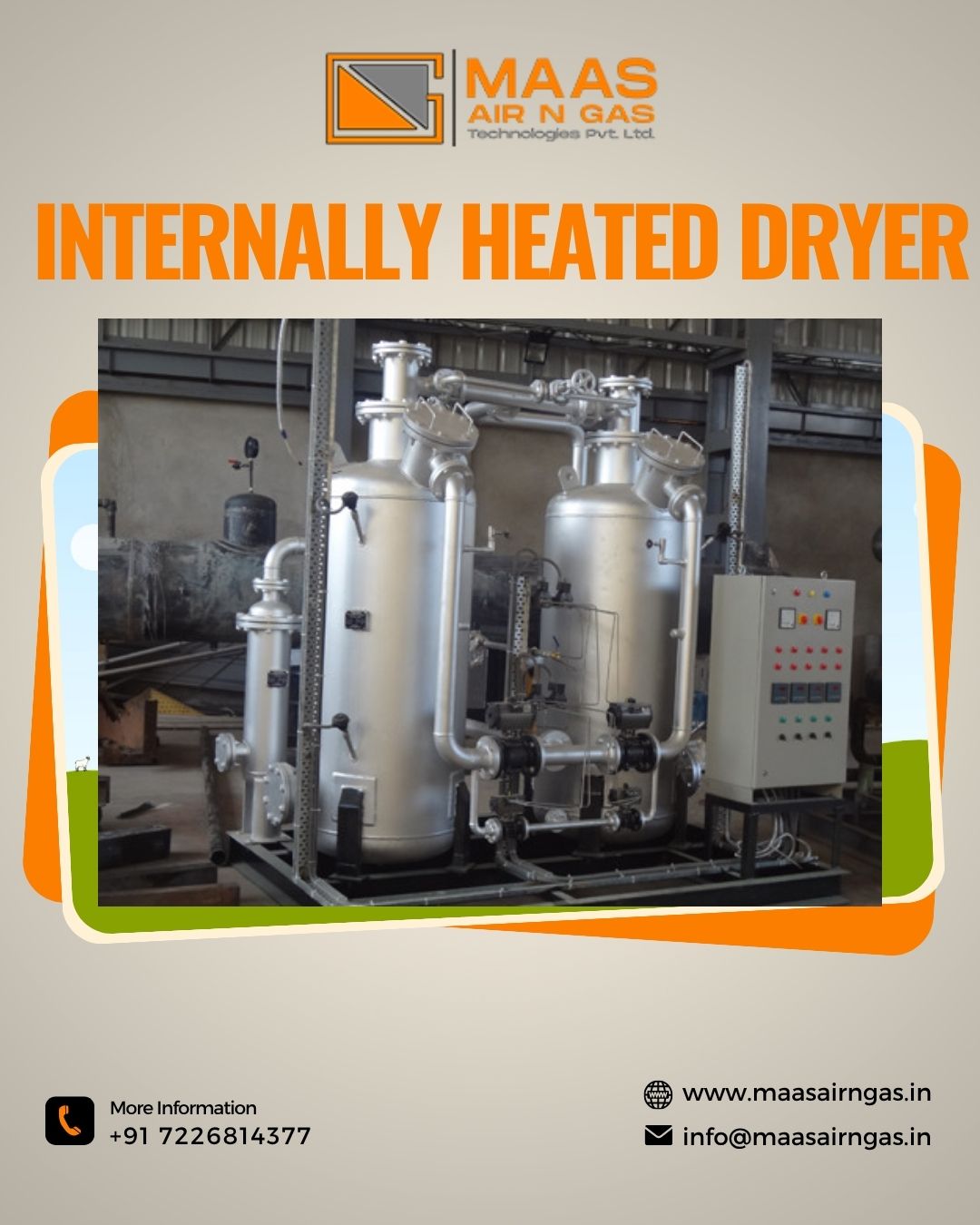
Internally Heated Dryer technology is an important solution for industrial applications where compressed air must be maintained at a low moisture level. Moisture in compressed air can create problems such as corrosion, condensation, equipment damage, poor process performance, and contamination. An efficient drying system helps remove water vapour before the compressed air reaches sensitive equipment or production processes.
In industrial environments, the choice of dryer depends on factors such as required pressure dew point, compressed air flow, operating pressure, inlet temperature, ambient conditions, energy consumption, and application requirements. Internally heated dryers use heat as an important part of the regeneration process, helping restore the drying capacity of the desiccant so the system can continue operating efficiently.
For industrial air and gas treatment solutions, MAAS Air N Gas Technologies Pvt. Ltd. provides air and gas drying solutions along with PSA-based gas generation and related process technologies.


5
Table of Contents
- What Is an Internally Heated Dryer?
- How Does an Internally Heated Dryer Work?
- 7 Powerful Benefits of an Internally Heated Dryer
- Internally Heated Dryer vs Heatless Dryer
- Applications of Internally Heated Dryers
- Important Factors When Selecting a Dryer
- Maintenance Requirements
- Why Proper Air Drying Matters
- Why Choose MAAS Air N Gas?
- Frequently Asked Questions
What Is an Internally Heated Dryer?
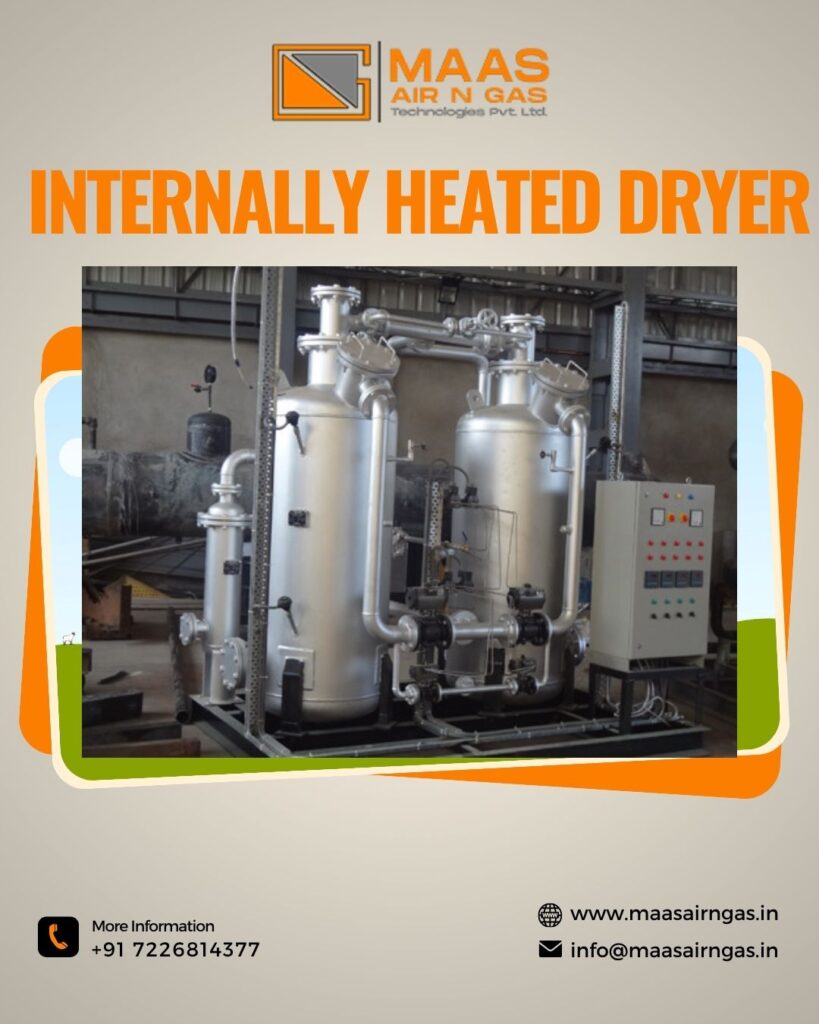
An Internally Heated Dryer is a type of regenerative desiccant dryer designed to remove moisture from compressed air while using heat during the regeneration cycle. The dryer generally uses desiccant material that adsorbs water vapour from compressed air. Once the desiccant becomes loaded with moisture, it needs to be regenerated before it can continue drying.
The regeneration stage uses heat to drive the accumulated moisture away from the desiccant. Depending on the equipment design, the heat may be generated internally through heating elements or another integrated heating arrangement. This approach can reduce dependence on large quantities of compressed-air purge compared with conventional heatless regeneration systems.
Desiccant dryers are commonly selected when applications require pressure dew points below the range normally achieved with refrigerated dryers. Atlas Copco explains that regenerative desiccant dryers use alternating adsorption and regeneration cycles, with one vessel drying while another is regenerated.
For an overview of compressed-air purity requirements, ISO 8573-1 defines purity classes for contaminants including particles, water, and oil.
How Does an Internally Heated Dryer Work?
The working principle of an Internally Heated Dryer is based on adsorption and regeneration. During the drying cycle, wet compressed air enters the active drying vessel and passes through the desiccant bed. The desiccant attracts and holds water molecules on its surface, allowing drier air to leave the vessel.
When the desiccant approaches its moisture capacity, the system changes its operating cycle. The saturated bed is regenerated using heat so that the accumulated moisture can be removed. After regeneration, the vessel is prepared for the next drying cycle.
In a typical twin-tower arrangement, the two vessels operate alternately. One tower performs the drying operation while the other undergoes regeneration. This arrangement allows the dryer to provide a continuous supply of dry compressed air.
Typical operating stages include:
- Adsorption: Wet compressed air passes through the active desiccant bed.
- Heating: Heat is applied to the saturated desiccant during regeneration.
- Moisture removal: The heat helps release accumulated water vapour.
- Cooling: The regenerated desiccant is brought back toward operating conditions.
- Repressurization: The regenerated tower is prepared for the next cycle.
- Changeover: The towers alternate their drying and regeneration functions.
The exact sequence, temperatures, cycle duration, and control strategy depend on the dryer design and operating requirements.
7 Powerful Benefits of an Internally Heated Dryer
An Internally Heated Dryer can provide several operational advantages when correctly sized and configured for an industrial compressed-air system. The most important benefit is its ability to combine desiccant drying with heated regeneration.
1. Efficient Moisture Removal
The primary purpose of the dryer is to remove water vapour from compressed air. Moisture can condense in downstream piping and equipment when compressed air cools. Effective drying helps reduce this risk and supports more reliable operation.
This is particularly important where moisture-sensitive pneumatic equipment, instrumentation, production machinery, or process air is involved.
2. Reduced Purge-Air Requirement
One important advantage of heated regeneration is the potential to reduce the quantity of compressed air used for regeneration compared with heatless designs. Heatless dryers use a portion of already dried compressed air as purge gas, while heated regeneration introduces heat to remove moisture from the desiccant.
The exact energy and purge-air savings depend on the dryer design, operating pressure, flow rate, regeneration method, and control system.
3. Consistent Dry-Air Quality
Industrial production often requires stable compressed-air conditions. A properly designed regenerative dryer can maintain a consistent pressure dew point by continuously alternating between drying and regeneration.
Stable air quality is particularly important for processes where moisture can influence product quality or equipment performance.
4. Suitable for Moisture-Sensitive Processes
Low-moisture compressed air can be valuable in industries where water vapour may cause operational or quality problems. Desiccant dryers are commonly used when applications require pressure dew points below 0°C.
Potential applications include:
- Pneumatic instrumentation
- Pharmaceutical processes
- Food and beverage processing
- Chemical industries
- Electronics manufacturing
- Industrial automation
- Gas processing
- Process air systems
5. Protection of Downstream Equipment
Water vapour and condensation can contribute to corrosion and malfunction in compressed-air systems. Removing moisture before it reaches downstream equipment helps protect valves, pneumatic tools, instruments, pipelines, and other components.
A complete compressed-air treatment system may also require appropriate filtration because desiccant dryers primarily address moisture rather than all forms of contamination. ISO 8573-1 addresses compressed-air purity in relation to particles, water, and oil.
6. Better Energy Management
Energy efficiency is an important consideration when selecting an industrial dryer. A heated regeneration system can be designed to minimize unnecessary compressed-air losses while using controlled heat for regeneration.
The actual energy performance should always be evaluated against the application’s flow rate, inlet conditions, required dew point, regeneration method, and operating schedule rather than relying on a generic efficiency figure.
7. Continuous Industrial Operation
Twin-tower regenerative systems are designed to alternate drying and regeneration duties. This makes them suitable for industrial facilities where compressed air is required continuously.
Proper automatic controls can manage valve switching, regeneration timing, heating, and monitoring to maintain reliable operation.
Internally Heated Dryer vs Heatless Dryer
Both internally heated and heatless desiccant dryers use adsorption to remove moisture, but their regeneration methods are different.
A heatless dryer normally regenerates saturated desiccant using a portion of dry compressed air that is expanded to atmospheric pressure. Heated designs introduce heat during regeneration, which can reduce the amount of compressed air required for the regeneration process.
| Feature | Internally Heated Dryer | Heatless Dryer |
|---|---|---|
| Drying technology | Desiccant adsorption | Desiccant adsorption |
| Regeneration | Uses heat | Uses purge air |
| Purge-air requirement | Can be reduced | Required |
| Energy consideration | Heating energy + system losses | Compressed-air purge losses |
| Application | Industrial continuous-duty systems | Smaller and selected industrial systems |
| Main consideration | Heating/control efficiency | Purge-air consumption |
The best choice depends on the application’s air flow, required dew point, energy costs, operating conditions, and available utilities.
Applications of Internally Heated Dryers
An Internally Heated Dryer can be considered for a wide range of industrial compressed-air applications. The correct configuration depends on the process requirements and desired air quality.
In manufacturing facilities, dry compressed air can help protect pneumatic equipment and automation systems. In process industries, moisture control may also be necessary to protect product quality and maintain stable process conditions.
Common applications include:
- Manufacturing plants
- Pharmaceutical industries
- Food and beverage processing
- Chemical processing
- Automotive manufacturing
- Electronics and instrumentation
- Pneumatic control systems
- Gas processing facilities
- Process air systems
- Industrial automation
MAAS Air N Gas also works with air and gas treatment technologies for industrial applications. Its website includes information about Air and Gas Dryers and other process equipment.
Important Factors When Selecting an Internally Heated Dryer
Choosing a dryer only by compressor capacity can result in an incorrectly sized system. The dryer should be selected according to the actual operating conditions and required air quality.
Before purchasing an Internally Heated Dryer, consider:
- Compressed-air flow rate
- Operating pressure
- Inlet air temperature
- Ambient temperature
- Required pressure dew point
- Desiccant type
- Regeneration temperature
- Available electrical power
- Required filtration
- Continuous or intermittent operation
- Installation environment
- Maintenance requirements
- Control and monitoring requirements
Pressure dew point is especially important because different industries have different moisture-control requirements. Desiccant dryer systems can be designed for significantly lower dew points than refrigerated dryers.
Maintenance Requirements
Even a high-quality dryer requires regular inspection and maintenance. Proper maintenance helps protect the desiccant, valves, heaters, filters, sensors, and control system.
The maintenance schedule should follow the manufacturer’s recommendations and actual operating conditions.
Important maintenance activities include:
- Inspecting inlet and outlet filters
- Checking differential pressure
- Inspecting valves and actuators
- Checking heater operation
- Monitoring dew point
- Inspecting electrical connections
- Checking temperature sensors
- Inspecting desiccant condition
- Checking for air leakage
- Verifying automatic changeover
- Servicing drains and filtration equipment
Pre-filtration is particularly important because liquid water and oil contamination can damage or reduce the effectiveness of desiccant material. Atlas Copco notes that bulk liquid water should be removed before the desiccant bed and that oil contamination can impair desiccant performance.
Why Proper Air Drying Matters
Compressed air naturally contains atmospheric moisture. During compression, the concentration of water vapour increases, and when the compressed air subsequently cools, moisture can condense.
Without appropriate moisture treatment, condensation can create problems throughout an air distribution system. Corrosion, contaminated condensate, sticking valves, damaged pneumatic components, and production-quality issues are among the potential consequences.
For this reason, compressed-air treatment should be considered as part of the complete air system rather than as an isolated piece of equipment.
For example, MAAS Air N Gas describes drying as part of its PSA nitrogen-generation process, where compressed air is treated before entering the adsorption stage.
Why Choose MAAS Air N Gas?
MAAS Air N Gas Technologies Pvt. Ltd. works in the field of air dryers, gas dryers, adsorption-based gas separation systems, PSA plants, and related process technologies. The company’s website states that its solutions are designed around individual client requirements and applications.
The company provides technologies associated with:
- Air and gas dryers
- PSA nitrogen generation plants
- PSA oxygen plants
- Biogas purification
- Gas dehydration
- Industrial filtration
- Customized process systems
For project-specific requirements, customers can contact MAAS Air N Gas to discuss flow rate, pressure, dew point, application requirements, and system configuration.
The company also provides other gas-treatment solutions, including PSA Nitrogen Gas Generation Plants and Biogas Dryer solutions.
Frequently Asked Questions
1. What is an Internally Heated Dryer?
An Internally Heated Dryer is a regenerative desiccant dryer that uses heat during the regeneration cycle to remove accumulated moisture from the desiccant bed.
2. How does an Internally Heated Dryer work?
Wet compressed air passes through a desiccant bed during adsorption. When the desiccant becomes moisture-loaded, the system uses a heating-based regeneration cycle to remove the accumulated moisture and restore the desiccant’s drying capacity.
3. Why is dry compressed air important?
Dry compressed air helps reduce condensation, corrosion, and moisture-related problems in downstream equipment and processes.
4. Is an Internally Heated Dryer better than a heatless dryer?
Neither technology is universally better. The appropriate choice depends on air flow, required pressure dew point, energy costs, operating conditions, available utilities, and the specific application.
5. What industries use desiccant dryers?
Desiccant dryers are used across manufacturing, pharmaceutical, food and beverage, chemical, electronics, instrumentation, automation, and other moisture-sensitive applications.
6. What information is required to select a dryer?
Important parameters include flow rate, pressure, inlet temperature, required pressure dew point, operating environment, air quality requirements, and duty cycle.
Conclusion
An Internally Heated Dryer can be an effective solution for industrial applications requiring reliable moisture removal and controlled compressed-air quality. By combining desiccant adsorption with heated regeneration, the system can support low-moisture air requirements while potentially reducing the compressed-air losses associated with conventional heatless regeneration.
ISO 8573-1 – Compressed Air Purity Classes:ISO 8573-1 Official StandardDesiccant Dryer Working Principle:Atlas Copco – Desiccant Air Dryers
However, dryer selection should always be based on actual operating conditions rather than capacity alone. Flow rate, pressure, dew point, inlet temperature, filtration, energy consumption, and maintenance requirements all influence the final system configuration.
For customized industrial air and gas drying requirements, MAAS Air N Gas Technologies Pvt. Ltd. can be approached to discuss the appropriate drying technology and configuration for a specific application.
Leave A Comment