24/7 Phone Services

-
-
Visit Our Place
S. G. Highway, Ahmedabad - 380051
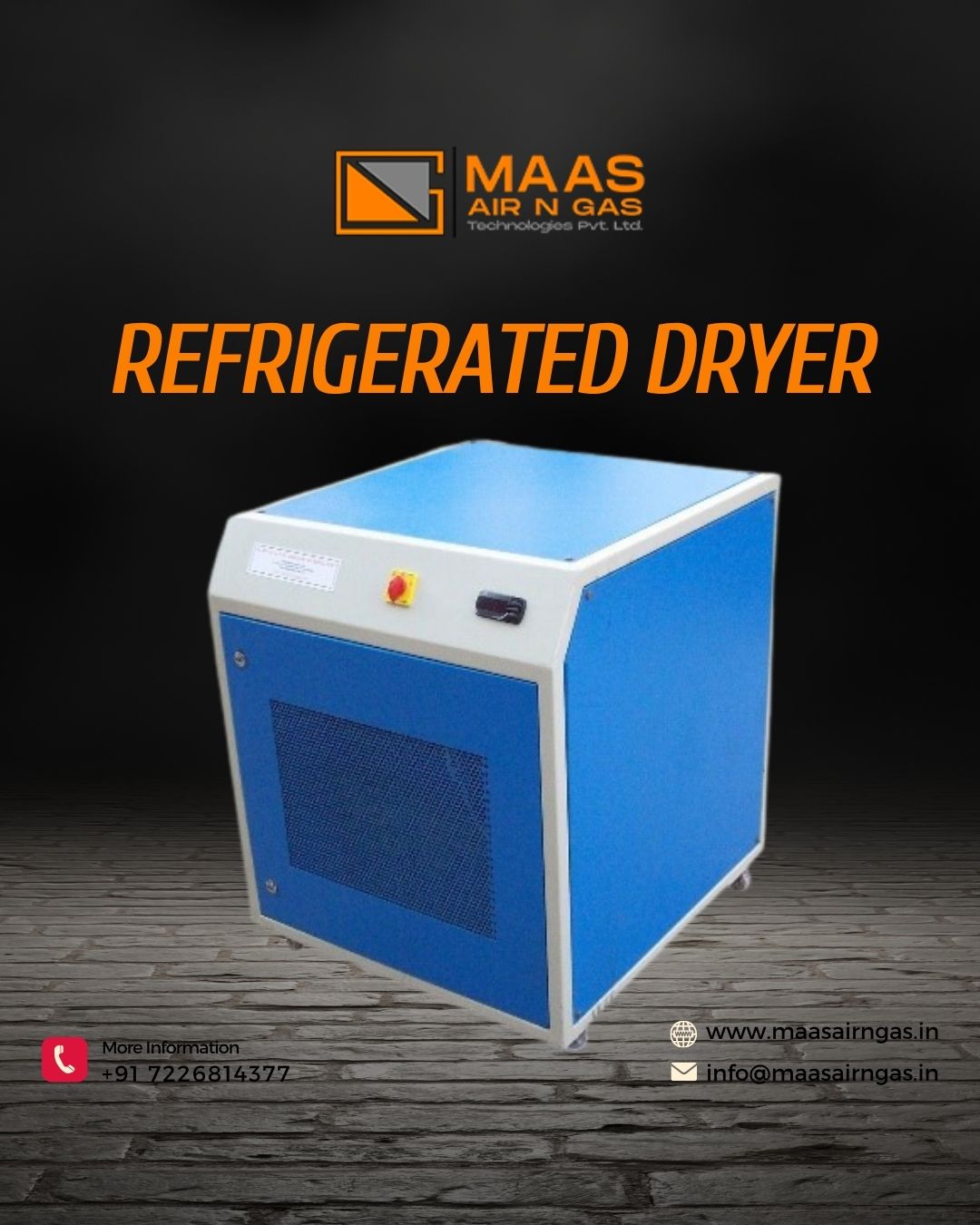
Refrigerated Air Dryer systems play an important role in maintaining the quality and reliability of compressed air used in industrial environments. Compressed air naturally contains moisture, and when this moisture isn’t properly controlled, it can cause condensation, corrosion, equipment problems, and inconsistent production performance.
A properly selected Refrigerated Air Dryer cools compressed air so that water vapor condenses and can be separated from the airstream before the air reaches downstream equipment. This makes refrigerated drying a practical solution for many general industrial compressed air applications.
For companies looking for reliable air-treatment equipment, understanding how refrigerated dryers work, where they are used, and what benefits they provide is essential. MAAS Air N Gas Technologies provides air and gas drying solutions as part of its industrial equipment range. Explore the company’s [air and gas dryer solutions]Air and Gas Dryers – MAAS Air N Gas and learn more about its complete product range on the [MAAS Air N Gas website]MAAS Air N Gas Technologies.
Table of Contents
- What Is a Refrigerated Air Dryer?
- How Does a Refrigerated Air Dryer Work?
- 7 Benefits of a Refrigerated Air Dryer
- Applications of Refrigerated Air Dryers
- Refrigerated Dryer vs. Desiccant Dryer
- How to Choose the Right Refrigerated Air Dryer
- Maintenance Requirements
- Frequently Asked Questions
- Conclusion
What Is a Refrigerated Air Dryer?
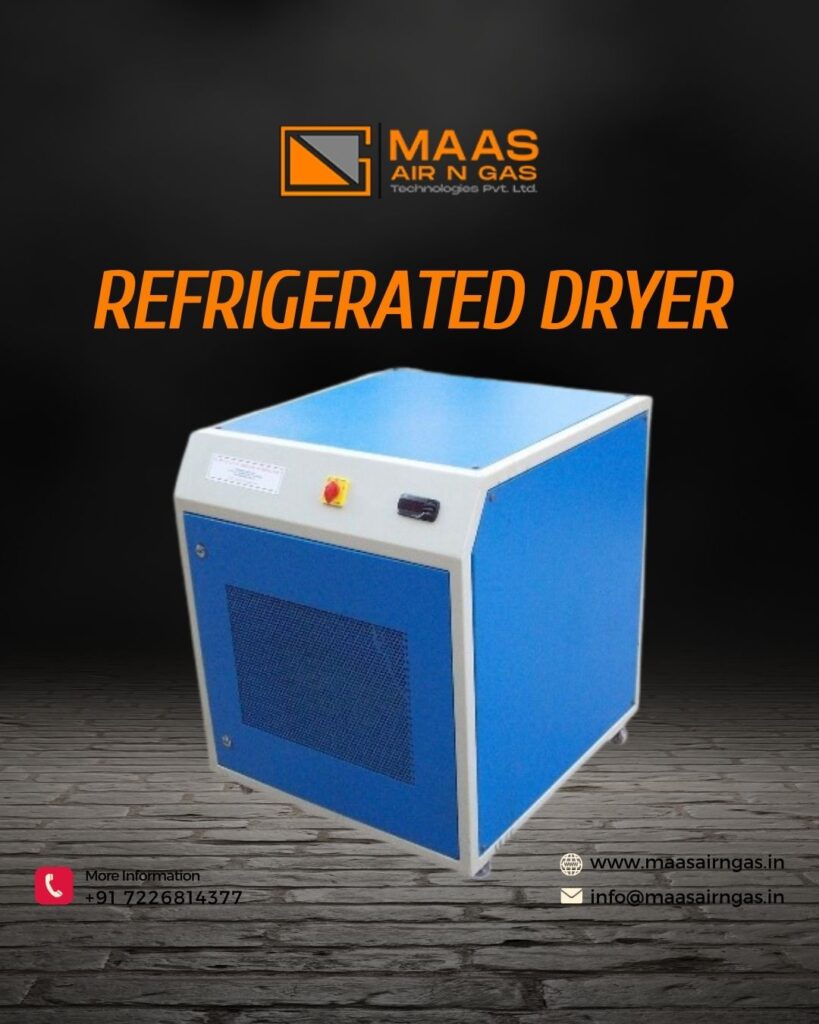
A Refrigerated Air Dryer is a compressed air treatment system designed to remove water vapor and moisture from compressed air. During compression, atmospheric air is compressed into a smaller volume, which concentrates its moisture content. As compressed air cools, this water vapor can turn into liquid water and enter the compressed air distribution system.
This moisture can cause several problems, particularly in industrial environments where pneumatic tools, valves, production machinery, pipelines, and control systems depend on reliable compressed air. Moisture can contribute to corrosion, premature wear, contamination, and operational problems.
The primary purpose of a refrigerated dryer is therefore to reduce the moisture content of compressed air before it reaches downstream equipment. For many general industrial applications, refrigerated dryers offer a practical balance between moisture control, operating simplicity, and efficiency.
How Does a Refrigerated Air Dryer Work?
The working principle of a Refrigerated Air Dryer is based on cooling compressed air. The incoming compressed air passes through heat exchangers where its temperature is reduced. As the air becomes colder, water vapor condenses into liquid water.
The condensed water is then separated from the compressed air and removed through a condensate drainage system. The resulting air is reheated before leaving the dryer in many designs, helping reduce the possibility of condensation in downstream piping.
A simplified process includes:
- Hot, moisture-containing compressed air enters the dryer.
- The air is cooled through a refrigeration-based heat-exchange system.
- Water vapor condenses into liquid moisture.
- A separator removes the condensed water.
- The condensate is drained from the system.
- The dried compressed air continues toward the point of use.
Atlas Copco explains that refrigerated dryers typically operate around a pressure dew point suitable for general industrial applications, while applications requiring much lower dew points may require desiccant drying.
7 Benefits of a Refrigerated Air Dryer
1. Effective Moisture Removal
One of the biggest advantages of a Refrigerated Air Dryer is its ability to remove moisture from compressed air. Without adequate drying, moisture can travel through the compressed air network and collect inside pipes, valves, tools, and production equipment.
By cooling the compressed air and separating condensed water, the dryer helps deliver cleaner and significantly drier air to downstream applications.
This is particularly useful for manufacturing plants, workshops, automotive applications, packaging systems, and other industries where compressed air is used continuously.
2. Protects Compressed Air Equipment
Moisture can contribute to corrosion and premature wear of compressed air components. Water inside pneumatic systems may affect valves, cylinders, tools, filters, pipelines, and other equipment.
A refrigerated dryer helps reduce this moisture before it reaches the point of use. As a result, businesses can support better equipment reliability and reduce moisture-related maintenance problems.
This is one reason moisture control should be considered an important part of a complete compressed air system rather than an optional addition.
3. Supports Reliable Industrial Operations
Industrial processes often depend on consistent compressed air quality. When excessive moisture enters the air network, it can cause pressure fluctuations, equipment issues, contamination, and interruptions.
A correctly sized Refrigerated Air Dryer helps maintain more consistent air quality for general industrial applications. This can contribute to smoother operation of pneumatic equipment and production systems.
The correct dryer should always be selected according to the compressor capacity, operating pressure, inlet temperature, ambient conditions, and required pressure dew point.
4. Suitable for Many Industrial Applications
Refrigerated dryers are commonly used for general plant air applications where extremely low dew points are not required. They are suitable for many indoor industrial environments.
Typical applications include:
- Manufacturing facilities
- Automotive workshops
- Metalworking industries
- Packaging machinery
- Pneumatic tools
- General engineering plants
- Woodworking equipment
- Production and automation systems
Kaeser notes that refrigerated dryers are commonly used in manufacturing, automotive, metalworking, packaging, and woodworking applications where reliable moisture control is required.
5. Helps Reduce Corrosion
Water and moisture inside compressed air pipelines can accelerate corrosion. Over time, corrosion can affect the internal surfaces of pipes and components and may introduce unwanted particles into the air system.
Using an appropriately designed Refrigerated Air Dryer helps control moisture and therefore supports better protection of the compressed air distribution network.
For organizations that operate compressed air systems for long periods, moisture management can be an important part of preventive maintenance.
6. Practical and Efficient for General Plant Air
For applications that do not require extremely low pressure dew points, refrigerated drying can be a practical solution. Compared with more specialized drying technologies, refrigerated systems are commonly used for standard industrial compressed air requirements.
The actual efficiency of a dryer depends on factors such as load, inlet air temperature, ambient temperature, operating pressure, and system design. In hot conditions, dryer loading can increase, which is why proper sizing is particularly important.
7. Improves Overall Compressed Air Quality
Compressed air quality can affect production equipment and processes. ISO 8573-1 classifies compressed air purity according to contaminants including particles, water, and oil. The appropriate air-treatment equipment therefore depends on the quality requirements of the application.
A refrigerated dryer can form an important part of a complete compressed air treatment system when the application requires effective moisture control.
Applications of a Refrigerated Air Dryer
A Refrigerated Air Dryer can be used across a wide range of industries. Its suitability depends on the required pressure dew point and the operating environment.
In manufacturing plants, compressed air may operate pneumatic machinery, automation equipment, actuators, and production tools. Removing moisture helps protect these systems and supports consistent operation.
Automotive workshops also use compressed air for pneumatic tools, cleaning, paint preparation, tire inflation, and other applications. Moisture control can help prevent water from entering tools and air lines.
Packaging and production facilities can similarly benefit from dry compressed air for actuators, controls, valves, and production equipment.
For more specialized applications requiring extremely dry air or operation in freezing conditions, a different dryer technology may be more appropriate.
Refrigerated Air Dryer vs. Desiccant Dryer
Choosing between a refrigerated dryer and a desiccant dryer depends primarily on the required pressure dew point and application conditions.
| Feature | Refrigerated Air Dryer | Desiccant Air Dryer |
|---|---|---|
| Main principle | Cooling and condensation | Adsorption |
| Typical application | General industrial air | Critical/dry-air applications |
| Dew point | Moderate | Very low |
| Freezing conditions | Generally unsuitable | Better suited |
| Operating complexity | Generally simpler | More complex |
| Common uses | Manufacturing, workshops, packaging | Instrumentation, pharmaceuticals, sensitive processes |
Refrigerated dryers are generally appropriate for applications where the air must be dry enough to prevent condensation but does not require an extremely low dew point. Desiccant dryers are better suited to applications demanding much lower pressure dew points.
How to Choose the Right Refrigerated Air Dryer
Selecting the correct Refrigerated Air Dryer is important because an undersized or incorrectly specified dryer may not provide the required moisture control.
Before purchasing a dryer, evaluate the operating conditions of the complete compressed air system.
Important selection factors include:
- Compressed air flow: Determine the required flow rate in CFM, m³/min, or another appropriate unit.
- Operating pressure: Dryer performance depends on the working pressure.
- Inlet air temperature: Higher inlet temperatures can increase the drying load.
- Ambient temperature: Consider the maximum expected environmental temperature.
- Required pressure dew point: Identify the actual dryness requirement.
- Installation conditions: Check ventilation, cooling, space, and environmental conditions.
- Future capacity: Consider whether compressed air demand is expected to increase.
Pressure dew point is particularly important because it indicates the temperature at which water vapor begins to condense at operating pressure. Atlas Copco recommends considering the lowest downstream temperature when determining the appropriate dew-point requirement.
For customized equipment requirements, businesses can also review the complete [MAAS Air N Gas product range]MAAS Air N Gas Products and contact the company for application-specific guidance.
Maintenance Requirements for a Refrigerated Air Dryer
Regular maintenance helps a Refrigerated Air Dryer operate reliably over its service life. Maintenance requirements vary according to the equipment design and operating environment, but the dryer should be inspected as part of the overall compressed air maintenance program.
Particular attention should be given to condensate drainage, heat exchangers, filters, ventilation, refrigeration components, and abnormal pressure drops.
A basic maintenance routine may include:
- Checking condensate drainage.
- Cleaning or inspecting heat-transfer surfaces.
- Checking filters and separators.
- Inspecting refrigerant-system performance.
- Monitoring pressure dew point.
- Checking for unusual noise or vibration.
- Maintaining adequate ventilation around the dryer.
Following the manufacturer’s recommended maintenance schedule is important for maintaining stable performance.
Frequently Asked Questions
What is a Refrigerated Air Dryer?
A Refrigerated Air Dryer is a compressed air treatment system that cools compressed air to condense and remove water vapor. It is widely used for general industrial compressed air applications.
Why is a refrigerated dryer required for compressed air?
Compressed air contains moisture. If this moisture is not removed, it can condense inside pipelines and equipment, potentially contributing to corrosion, wear, and operational problems. A refrigerated dryer helps control this moisture.
Is a Refrigerated Air Dryer suitable for every industry?
No. Refrigerated dryers are well suited to many general industrial applications, but applications requiring extremely low dew points or protection against freezing may need desiccant drying or another specialized solution.
What is pressure dew point?
Pressure dew point is the temperature at which water vapor begins to condense from compressed air at operating pressure. It is an important specification when selecting compressed air drying equipment.
Can a refrigerated dryer protect pneumatic equipment?
Yes. By reducing moisture in compressed air, a refrigerated dryer can help protect pneumatic tools, valves, pipelines, and other downstream equipment from moisture-related issues.
How do I select the right dryer size?
Dryer selection should consider compressed air flow, operating pressure, inlet temperature, ambient temperature, required pressure dew point, and application conditions. Proper sizing is especially important in high-temperature environments.
Why Choose MAAS Air N Gas for Air and Gas Drying Solutions?
MAAS Air N Gas Technologies Pvt. Ltd. operates in the field of adsorption-based gas separation systems, air filters, and air dryers. The company’s website lists air and gas dryers among its product range and describes its approach as involving conceptualization, system design, manufacturing, setup, and commissioning.
For businesses evaluating compressed air and gas treatment requirements, the right equipment should be selected according to the application’s actual flow, pressure, temperature, dew-point, and air-quality requirements rather than simply choosing a dryer based on compressor size.
You can learn more about [MAAS Air N Gas Technologies]MAAS Air N Gas Technologies and explore its [Air and Gas Dryers]Air and Gas Dryers for further information.
Conclusion
A Refrigerated Air Dryer is an important component of many industrial compressed air systems. By cooling compressed air and separating condensed moisture, it helps reduce water-related problems and supports reliable operation of downstream equipment.
For general industrial applications, refrigerated drying can provide an effective balance of moisture control, reliability, and practical operation. However, choosing the correct dryer requires careful consideration of flow rate, pressure, temperature, required pressure dew point, and the environment in which the system operates.
For broader technical information about compressed air quality, the [International Organization for Standardization’s ISO 8573-1 information]ISO 8573-1 – Compressed Air Purity Classes provides the relevant framework for contaminants including water, particles, and oil. You can also refer to [Atlas Copco’s compressed-air drying guide]Atlas Copco – Dry Compressed Air Explained for additional technical information.
Leave A Comment