24/7 Phone Services

-
-
Visit Our Place
S. G. Highway, Ahmedabad - 380051
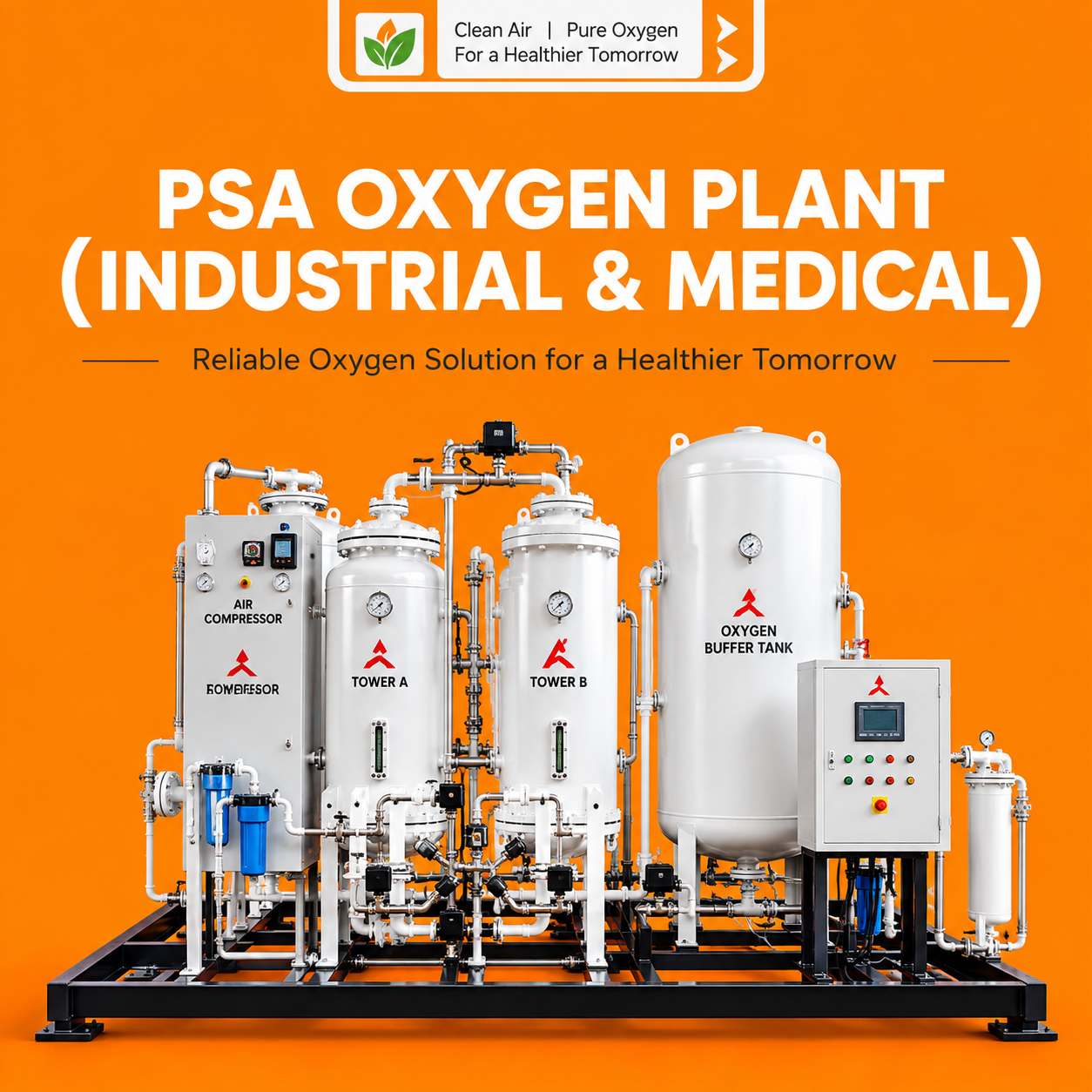
PSA Oxygen Plant for Industrial & Medical Applications
Oxygen is one of the most important gases used across healthcare, manufacturing and several industrial processes. Traditionally, oxygen requirements can be fulfilled through cylinders or bulk liquid oxygen supplies. However, organizations that require a continuous and dependable oxygen supply can benefit from an on-site oxygen generation system. A PSA Oxygen Plant provides a practical solution by generating oxygen directly from atmospheric air.
PSA stands for Pressure Swing Adsorption. In this technology, compressed atmospheric air is passed through specially designed molecular sieve material, generally zeolite. The molecular sieve preferentially adsorbs nitrogen while allowing oxygen-rich gas to pass through. By repeatedly changing the pressure between adsorption and regeneration stages, the system can continuously produce oxygen. The Indian Ministry of Health and Family Welfare describes PSA oxygen generation as a process in which nitrogen is adsorbed by zeolite molecular sieves while oxygen passes through, with medical PSA oxygen commonly produced in the approximately 90–96% purity range depending on the system and standard.
PSA oxygen technology can therefore be used where an organization needs a reliable on-site oxygen source rather than depending entirely on delivered cylinders. Medical facilities can use appropriately specified systems for medical oxygen supply, while industries can use oxygen generation for various production and processing applications.
Introduction to PSA Oxygen Plant
A PSA Oxygen Plant is an oxygen generation system that separates oxygen from compressed atmospheric air. Instead of storing the entire oxygen requirement in cylinders, the plant generates oxygen according to the connected demand and system capacity.
The basic principle is relatively simple. Atmospheric air contains approximately 21% oxygen and around 78% nitrogen, along with argon and other gases. The air is first compressed, filtered and conditioned before entering adsorption vessels containing molecular sieve material. Under pressure, the molecular sieve preferentially captures nitrogen. Oxygen and other less strongly adsorbed gases pass through the bed as an oxygen-enriched product gas.
The adsorption vessel eventually becomes loaded with nitrogen. At this stage, the pressure is reduced so that the adsorbed nitrogen can be released and the molecular sieve regenerated. A second vessel operates while the first vessel is regenerating. This alternating operation enables continuous oxygen production.
What Is Pressure Swing Adsorption Technology?
Pressure Swing Adsorption is a gas-separation technology that uses pressure changes and selective adsorption material to separate components of a gas mixture.
In an oxygen PSA system, the molecular sieve has a stronger affinity for nitrogen than oxygen. During the high-pressure adsorption stage, nitrogen is retained by the sieve while oxygen passes through. During the low-pressure regeneration stage, the nitrogen is released from the molecular sieve.
The four basic stages generally associated with PSA operation are:
- Pressurization
- Adsorption
- Depressurization
- Regeneration
These stages are repeated continuously between two or more adsorption vessels. This allows the plant to provide a steady oxygen supply instead of producing oxygen only during one isolated batch cycle.
How Does a PSA Oxygen Plant Work?
The operation of a PSA Oxygen Plant starts with atmospheric air. The air is taken into the system through an intake arrangement and then compressed using an air compressor.
The compressed air is passed through filtration and air-treatment equipment to remove unwanted contaminants and moisture. Proper feed-air conditioning is important because oil, moisture and contaminants can affect molecular sieve performance and equipment life.
After conditioning, the compressed air enters one of the adsorption towers. The tower contains zeolite molecular sieve. Nitrogen is preferentially adsorbed by the zeolite, while oxygen-rich gas passes through the tower and moves toward the product oxygen storage or buffer tank.
When the first tower approaches its adsorption capacity, the system changes the operating condition. The second tower takes over oxygen production while the first tower is depressurized and regenerated. The trapped nitrogen is released during regeneration.
This cycle continues automatically, allowing the two towers to alternate between oxygen production and regeneration.
Main Components of a PSA Oxygen Plant
A complete PSA oxygen generation system consists of several interconnected components. The exact configuration depends on the required capacity, pressure, purity, application and installation design.
Important components generally include:
- Air compressor
- Air receiver
- Air filters
- Air dryer
- Molecular sieve adsorption towers
- Oxygen buffer or storage tank
- Pneumatic or automatic valves
- Control panel
- Pressure sensors
- Oxygen purity monitoring system
- Flow measurement system
- Safety devices
- Oxygen booster compressor, where required
- Cylinder filling manifold, where cylinder filling is required
WHO technical specifications also identify major elements such as the compressor, dryer, filters, dual separation chambers, reservoir and control system as part of a PSA oxygen generator plant.
Key Features of PSA Oxygen Plant
A well-designed PSA Oxygen Plant offers several features that make it suitable for continuous oxygen generation.
- On-site oxygen generation
- Automatic operation
- Continuous oxygen production
- Modular system configuration
- Compact installation compared with some large-scale oxygen production technologies
- Reduced dependence on oxygen cylinder deliveries
- Oxygen purity monitoring
- Automated pressure control
- Alternating adsorption and regeneration cycles
- Suitable for industrial and appropriately specified medical applications
- Oxygen can be supplied to a connected pipeline or storage system
Medical PSA systems are designed to provide medical-grade oxygen when they meet the required technical and quality specifications. WHO notes that PSA plants can be designed for continuous operation and can supply medical oxygen at scale.
Table of Contents
- Introduction to PSA Oxygen Plant
- What Is Pressure Swing Adsorption Technology?
- How Does a PSA Oxygen Plant Work?
- Main Components of a PSA Oxygen Plant
- Key Features of PSA Oxygen Plant
- PSA Oxygen Plant for Medical Applications
- PSA Oxygen Plant for Industrial Applications
- Benefits of On-Site Oxygen Generation
- Oxygen Purity and Performance
- Maintenance of PSA Oxygen Plant
- Factors to Consider Before Selecting a PSA Plant
- PSA Oxygen Plant Applications
- Frequently Asked Questions
- Conclusion
PSA Oxygen Plant for Medical Applications
Medical oxygen is an essential requirement for hospitals, clinics, emergency departments and other healthcare facilities. A medical PSA oxygen generation plant can produce oxygen on-site and supply it through a hospital oxygen pipeline system or, when appropriately configured, through a cylinder filling arrangement.
Medical applications require much greater attention to oxygen quality, monitoring, safety, maintenance and compliance than ordinary industrial applications. WHO specifically states that only high-quality medical-grade oxygen should be administered to patients and provides technical specifications for PSA oxygen plants intended for medical oxygen production.
A medical PSA system can be connected to an oxygen reservoir or buffer tank. From there, oxygen can be distributed through a properly designed pipeline network to different areas of a healthcare facility.
Common Medical Applications
PSA oxygen plants can support oxygen requirements in:
- Hospitals
- Intensive care units
- Emergency departments
- Operation theatres
- Medical wards
- Clinics
- Healthcare centres
- Oxygen pipeline systems
- Cylinder filling facilities when designed for this purpose
The actual plant capacity should be selected according to the healthcare facility's oxygen demand, peak consumption, future expansion and applicable medical-gas requirements.
PSA Oxygen Plant for Industrial Applications
Industrial oxygen is used in many manufacturing and processing operations. PSA technology can provide oxygen on-site where a suitable oxygen purity and flow rate match the process requirements.
Industrial users may benefit from generating oxygen near the point of consumption instead of depending entirely on external oxygen deliveries. PSA oxygen generation is used in applications including metal processing, welding and cutting, combustion-related processes, wastewater treatment and other oxygen-intensive operations.
Major Industrial Applications
Some common applications include:
- Metal cutting
- Welding and fabrication
- Glass manufacturing
- Steel and metal processing
- Wastewater treatment
- Chemical processing
- Combustion enhancement
- Aquaculture
- Pulp and paper processing
- Furnace applications
- Mining-related processes
- Ozone generation
- Industrial oxidation processes
The exact oxygen purity and flow requirement should always be matched to the specific industrial process.
Benefits of Installing a PSA Oxygen Plant
One of the biggest advantages of PSA technology is the ability to generate oxygen at the point of use. This can provide greater control over oxygen availability and reduce dependence on scheduled external oxygen deliveries.
For facilities with a consistent oxygen requirement, on-site generation can be particularly useful. The system can be designed around the required flow rate, pressure and oxygen quality.
Reduced Dependence on Cylinders
A properly designed on-site oxygen generation system can reduce the need for frequent cylinder handling and replacement. This can simplify oxygen supply management for facilities with continuous consumption.
Continuous Oxygen Availability
Because adsorption vessels operate alternately, one vessel can produce oxygen while another regenerates. This operating principle allows continuous production when the plant is correctly designed and maintained.
Automated Operation
Modern PSA systems can incorporate automatic valves, pressure sensors, oxygen analyzers and PLC-based controls. Automation helps monitor important operating parameters and supports consistent plant operation.
Suitable for Different Capacities
PSA plants can be configured for different oxygen requirements. WHO documentation notes that PSA generator capacities can vary considerably according to calculated oxygen demand.
Oxygen Purity and Performance
Oxygen purity is an important factor when selecting a PSA Oxygen Plant. PSA systems commonly produce oxygen in the low-to-mid 90% range, although the exact output depends on plant design, operating conditions and the intended specification. India's medical oxygen guidance indicates approximately 90–96% purity for PSA-generated medical oxygen.
For industrial applications, the required purity should be determined by the production process. A higher oxygen concentration may require different technology or additional purification depending on the application.
It is therefore important not to select a PSA plant based only on its nominal oxygen flow. Purity, pressure, operating conditions, feed-air quality and performance at the required flow should also be evaluated.
Maintenance Requirements of PSA Oxygen Plant
Regular maintenance is essential for reliable PSA oxygen production. Since the system depends on compressed air, valves, molecular sieve beds, sensors and control equipment, every part of the system should be monitored.
WHO guidance emphasizes specialized operator training, maintenance schedules and availability of appropriate spare parts for PSA oxygen plants.
Important Maintenance Activities
A typical maintenance program may include:
- Checking compressor performance
- Replacing air and oil filters as required
- Checking air dryer operation
- Inspecting pipelines and valves
- Checking pressure readings
- Monitoring oxygen purity
- Inspecting automatic valves
- Checking electrical connections
- Testing alarms and safety devices
- Inspecting molecular sieve performance
- Checking oxygen leakage
- Maintaining control panels and sensors
The maintenance frequency should be based on the manufacturer's recommendations, operating hours and site conditions.
Factors to Consider Before Selecting a PSA Oxygen Plant
Selecting the correct PSA plant requires understanding the actual oxygen requirement rather than simply choosing the largest available system.
Oxygen Demand
Determine average and peak oxygen consumption. Medical facilities should consider patient load, existing pipeline demand and future expansion. Industrial facilities should consider process demand and operating schedules.
Required Oxygen Purity
The required purity should be defined according to the application. Medical oxygen requirements should comply with the applicable medical and regulatory specifications.
Required Oxygen Pressure
The required outlet pressure should be considered because different applications may need different supply pressures. If higher-pressure cylinder filling is required, an additional oxygen booster system may be necessary.
Feed-Air Quality
Clean and dry compressed air is important for protecting the molecular sieve and maintaining plant performance.
Automation and Monitoring
An effective control system should monitor critical parameters such as oxygen purity, pressure, flow and alarms.
Installation Space
The available space should be considered for the compressor, air treatment system, adsorption vessels, oxygen receiver, control panel and related piping.
PSA Oxygen Plant Applications
The versatility of PSA technology allows it to be used in both healthcare and industrial environments.
| Application Area | Typical Purpose |
|---|---|
| Hospitals | Medical oxygen supply |
| Clinics | Patient oxygen requirements |
| Metal Industry | Cutting, welding and processing |
| Glass Industry | Combustion and manufacturing processes |
| Wastewater Treatment | Oxygenation processes |
| Chemical Industry | Oxidation and processing |
| Aquaculture | Water oxygenation |
| Manufacturing | Process oxygen |
| Ozone Generation | Oxygen feed |
| Research Facilities | Controlled oxygen supply |
The appropriate oxygen purity, flow rate and pressure can vary significantly from one application to another.
Why Choose an On-Site PSA Oxygen Generation System?
An on-site PSA system provides organizations with greater control over their oxygen supply. Instead of relying completely on delivered oxygen, the organization can generate oxygen at its own facility.
For applications where oxygen is consumed continuously, this approach can offer operational advantages. The system can be integrated with storage, pipelines, monitoring equipment and backup oxygen arrangements.
However, plant selection should always be based on engineering calculations, application requirements, applicable standards and professional installation practices.
Frequently Asked Questions About PSA Oxygen Plant
What is a PSA Oxygen Plant?
A PSA Oxygen Plant is an oxygen generation system that uses Pressure Swing Adsorption technology to separate oxygen from atmospheric air. Zeolite molecular sieve preferentially adsorbs nitrogen, allowing oxygen-rich gas to pass through.
What does PSA stand for?
PSA stands for Pressure Swing Adsorption. The technology uses changes in pressure to adsorb and subsequently release selected gases from a molecular sieve material.
How does a PSA Oxygen Plant generate oxygen?
The plant compresses atmospheric air and passes it through a molecular sieve. Nitrogen is preferentially adsorbed by the sieve, while oxygen-rich gas passes through. The sieve is then regenerated by reducing pressure, and the cycle repeats.
What is the oxygen purity of a PSA Oxygen Plant?
PSA oxygen purity depends on the design and operating conditions. Medical PSA oxygen systems commonly produce oxygen around the 90–96% range, with approximately 93% being a commonly referenced medical PSA specification.
Can a PSA Oxygen Plant be used in hospitals?
Yes. PSA plants are used as sources of medical-grade oxygen when the complete system meets the applicable medical oxygen quality, safety and technical requirements. WHO specifically recognizes PSA oxygen-generating plants as a source of medical-grade oxygen.
Can PSA Oxygen Plants be used for industrial purposes?
Yes. PSA oxygen generation can be used for several industrial applications, including metal processing, welding, cutting, wastewater treatment and other oxygen-consuming processes.
Does a PSA Oxygen Plant require an air compressor?
Yes. A conventional PSA oxygen system requires compressed feed air. The compressor provides the pressure required for the adsorption process.
What is the role of zeolite in a PSA plant?
Zeolite acts as the molecular sieve or adsorbent. Under the appropriate pressure conditions, it preferentially adsorbs nitrogen from compressed air while allowing oxygen-rich gas to pass through.
Can a PSA Oxygen Plant operate continuously?
Yes. PSA systems use alternating adsorption and regeneration cycles. While one adsorption vessel produces oxygen, another vessel can regenerate. This enables continuous oxygen production when the plant is properly designed and maintained.
Is maintenance required for a PSA Oxygen Plant?
Yes. Regular maintenance is important for compressors, filters, dryers, valves, sensors, molecular sieve systems, control panels and oxygen monitoring equipment.
Can oxygen from a PSA plant be stored?
Yes. Oxygen can be collected in an oxygen buffer or storage tank. Depending on the system configuration, oxygen may also be compressed further for cylinder filling.
What factors determine PSA plant capacity?
Capacity is determined by oxygen demand, required flow rate, operating hours, pressure, oxygen purity requirements, peak demand and future expansion requirements.
Conclusion
A PSA Oxygen Plant is a reliable technology for generating oxygen directly from atmospheric air through the Pressure Swing Adsorption process. By using molecular sieve material to preferentially adsorb nitrogen, the system produces oxygen-enriched gas that can be used for suitable industrial and medical applications.
The technology offers important advantages such as on-site oxygen production, continuous operation, automated control and reduced dependence on external oxygen deliveries. Medical facilities can use appropriately specified PSA systems for medical oxygen supply, while industries can use PSA oxygen generation for a wide range of oxygen-intensive processes. https://www.digitalindia.gov.in/
Choosing the right PSA Oxygen Plant requires careful consideration of oxygen demand, purity, pressure, feed-air quality, automation, installation space and maintenance requirements. With proper engineering, installation and regular maintenance, a PSA oxygen generation system can become an important part of a facility's long-term oxygen supply infrastructure.
Leave A Comment