
powerful Zero Purge Loss: Split Flow Dryer for Maximum Efficiency
A Split Flow No Purge Loss Dryer is an industrial compressed-air drying solution designed to remove moisture while avoiding the conventional loss of compressed air used for purge regeneration. This makes the technology particularly relevant for industries where compressed air is continuously required and energy efficiency is an important operating consideration.
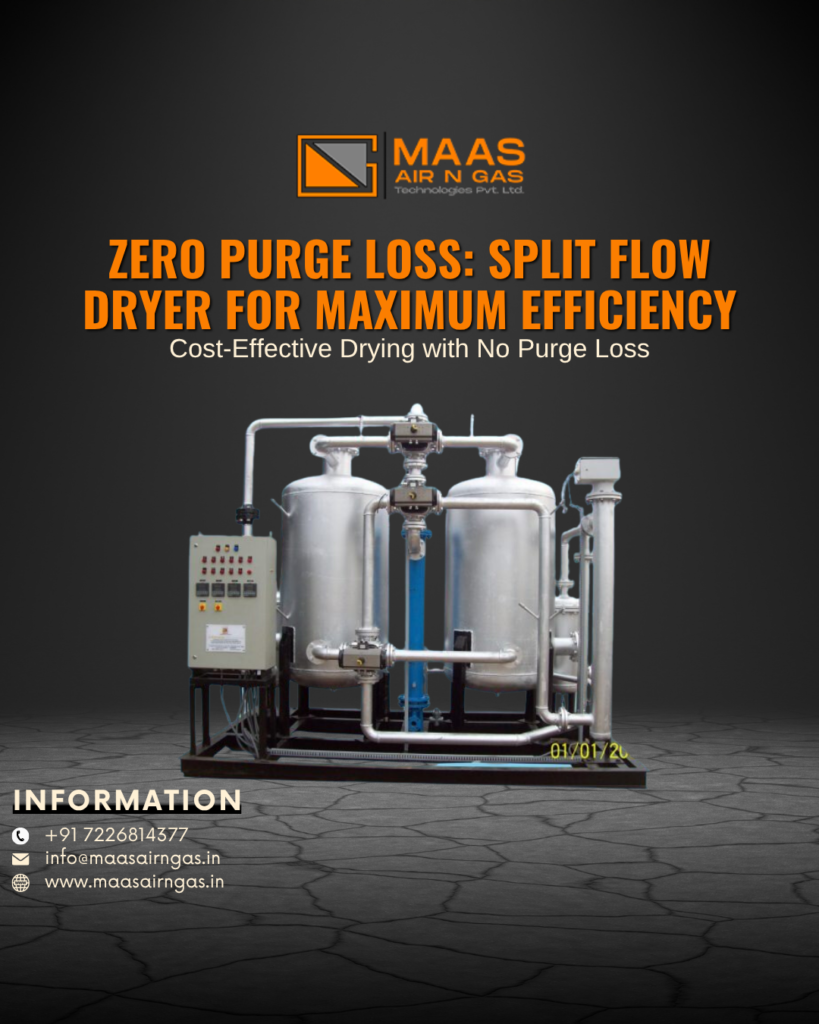
The supplied MAAS Air N Gas image highlights the main concept as “Zero Purge Loss: Split Flow Dryer for Maximum Efficiency” and describes it as “Cost-Effective Drying with No Purge Loss.” MAAS explains that its Split Flow No Purge Loss Dryer is intended for industrial compressed-air applications where reliable moisture removal and efficient operation are required.
This blog explains the working principle, key features, benefits, applications, purge-air losses, efficiency considerations, maintenance requirements and important factors to consider when selecting a Split Flow No Purge Loss Dryer.
Table of Contents
- Introduction
- What Is a Split Flow No Purge Loss Dryer?
- Why Is Moisture Removal Important in Compressed Air?
- How Does a Split Flow Dryer Work?
- Understanding Purge Loss in Conventional Dryers
- Key Features of Split Flow No Purge Loss Dryer
- Benefits of Zero Purge Loss Drying
- Applications of Split Flow Dryers
- Energy Efficiency and Operating Cost
- Important Dryer Selection Factors
- Major Components of the System
- Maintenance and Performance
- Why Choose MAAS Air N Gas?
- Frequently Asked Questions
- Conclusion
Introduction
Compressed air is an important utility in manufacturing plants, processing industries, automation systems and many other industrial applications. However, atmospheric air naturally contains moisture. When air is compressed, moisture can become a problem because water can condense inside pipelines and reach downstream machinery, pneumatic equipment and production processes.
An industrial air dryer is therefore used to control moisture and provide compressed air with the required level of dryness.
Traditional regenerative desiccant dryers may use a portion of the already compressed air as purge air for regeneration. This means that some of the compressed air produced by the compressor is consumed by the drying process instead of being available for production.
A Split Flow No Purge Loss Dryer uses an alternative regeneration arrangement intended to avoid this conventional product-air purge loss. MAAS explains that its split-flow technology separates the drying and regeneration functions and uses a controlled regeneration flow or alternative regeneration method.
For plants operating compressors for long hours, reducing unnecessary compressed-air consumption can be an important part of improving overall system efficiency.
What Is a Split Flow No Purge Loss Dryer?
A Split Flow No Purge Loss Dryer is an industrial compressed-air dryer designed to remove moisture without using the conventional portion of product compressed air as purge air for regeneration.
The basic concept is simple: one part of the drying system performs moisture removal while another part is regenerated. After the regeneration cycle is completed, the operating functions switch between the sections.
This type of arrangement can help preserve more of the compressed air generated by the compressor for actual production requirements.
MAAS describes its Split Flow No Purge Loss Dryer as a solution for industrial compressed-air applications where reliable moisture removal and efficient operation are important.
The basic objective
The main objective of the system is to provide:
- Effective moisture removal
- Continuous drying operation
- Reduced or eliminated product-air purge consumption
- Better utilization of compressor capacity
- Automated drying and regeneration
- Reliable compressed-air quality
- Improved energy-conscious operation
The exact performance depends on the dryer configuration, operating pressure, flow rate, inlet temperature, required dew point and other process conditions.
Why Is Moisture Removal Important in Compressed Air?
Atmospheric air contains water vapor. During compression and subsequent cooling, some of this moisture can condense. If the resulting moisture is not properly removed, it may travel through the compressed-air distribution system.
Moisture can create problems for pneumatic equipment, pipelines, valves, instruments and production machinery. Depending on the application, it can also contribute to corrosion or affect product quality.
A suitable dryer therefore becomes an important component of a complete compressed-air treatment system.
Problems caused by excess moisture
- Corrosion inside pipelines
- Malfunction of pneumatic equipment
- Damage to sensitive instruments
- Reduced reliability of valves and actuators
- Moisture entering production equipment
- Product-quality concerns in sensitive processes
- Increased maintenance requirements
The required dryness should always be selected according to the actual application. Producing air that is significantly drier than necessary can itself increase operating requirements.
How Does a Split Flow Dryer Work?
The Split Flow No Purge Loss Dryer works by dividing the drying and regeneration functions between different sections of the system.
During one stage, the active drying section removes moisture from the compressed air. At the same time, another section undergoes regeneration to restore the moisture-absorbing capacity of its drying material.
Instead of sending a portion of the finished compressed air through the offline drying bed as conventional purge air, the system uses a separate or alternative regeneration arrangement.
Once the regeneration cycle is complete, automatic valves change the flow arrangement and the regenerated section becomes the active drying section.
Typical operating sequence
- Compressed air enters the dryer.
- The active drying section removes moisture.
- Another section is isolated for regeneration.
- A controlled regeneration flow is used.
- Moisture accumulated in the regeneration section is removed.
- Automatic valves change the operating configuration.
- The regenerated section returns to drying service.
- The cycle continues automatically.
The exact switching sequence, regeneration method, flow arrangement and controls depend on the specific system design.
Understanding Purge Loss in Conventional Dryers
Purge loss is an important consideration when comparing different types of regenerative compressed-air dryers.
In a conventional pressure-swing regenerative dryer, a portion of dry compressed air can be expanded and sent through the offline desiccant bed. This air removes moisture from the desiccant and is then discharged.
The important point is that the purge air has already been compressed by the compressor. Therefore, energy has already been spent to produce it.
The U.S. Department of Energy notes that pressure-swing regenerative dryers can consume approximately 10–18% of dryer-rated airflow as purge air, depending on the dryer type and operating conditions.
Why purge loss matters
For a small installation, the loss may appear relatively limited. However, in a plant operating continuously, the cumulative effect can become significant.
For example, when a compressor produces a large volume of air every hour, even a percentage of that air used for regeneration represents air that is not available to production equipment.
A no-purge-loss approach is therefore designed to improve the utilization of compressed air.
Key Features of Split Flow No Purge Loss Dryer
The Split Flow Dryer shown in the supplied MAAS Air N Gas image is positioned around the concept of zero purge loss and maximum efficiency.
No conventional purge-air loss
The key feature is the alternative regeneration arrangement that avoids using a conventional portion of product compressed air as purge air, depending on system configuration and operating conditions.
Split-flow operating principle
The drying and regeneration functions operate through separate flow paths, allowing one section to dry while another section is regenerated.
Automatic operation
Industrial dryers can use automatic valves and control systems to manage switching between drying and regeneration cycles.
Moisture control
The primary function remains reliable moisture removal from compressed air so that downstream equipment receives air with the required dryness.
Industrial construction
The equipment shown in the image uses twin-vessel construction with interconnected piping, valves and a control panel, representing a configuration designed for industrial operation.
Reduced compressed-air waste
By avoiding conventional purge consumption, more of the compressed air generated by the compressor can remain available for the intended production process.
Benefits of Zero Purge Loss Drying
A Split Flow No Purge Loss Dryer can provide several operational benefits when correctly matched to an industrial compressed-air system.
Better compressed-air utilization
The compressor produces compressed air for plant operations. If a dryer consumes a portion of this air as purge, that air is unavailable for production.
A no-purge approach can help retain more of the generated compressed air for actual process requirements.
Improved energy-conscious operation
Compressed air requires electrical energy to generate. Reducing unnecessary air consumption can therefore support overall compressed-air efficiency.
However, actual savings depend on compressor efficiency, operating hours, pressure, airflow, dryer design and plant conditions.
Continuous moisture control
The alternating drying and regeneration process allows the system to continue operating while one section is being regenerated.
Reduced operating waste
Avoiding unnecessary product-air consumption can reduce one source of compressed-air waste.
Better use of existing compressor capacity
Where a plant is operating close to its available compressor capacity, reducing dryer-related air consumption can help make more of the existing compressed air available for production.
Suitable for industrial applications
The technology can be considered for industries that require continuous dry compressed air and want to improve the efficiency of their air-treatment system.
Applications of Split Flow No Purge Loss Dryer
A Split Flow No Purge Loss Dryer can be used in industrial environments where compressed-air quality and efficient operation are important.
Manufacturing industries
Manufacturing facilities often use compressed air for pneumatic tools, actuators, automation equipment and production machinery. Moisture control can help maintain reliable operation.
Chemical processing
Chemical plants may require dry compressed air for instrumentation, control systems and process equipment.
Pharmaceutical applications
Pharmaceutical production can have specific air-quality requirements. The complete compressed-air treatment system should be designed according to the applicable process and quality standards.
Food and beverage processing
Dry and properly treated compressed air can be important for pneumatic equipment and selected production processes.
Automotive manufacturing
Compressed air is commonly used for automation, assembly equipment, pneumatic tools and various manufacturing operations.
Instrumentation and automation
Sensitive pneumatic instruments and automated systems can be affected by moisture, making appropriate air treatment important.
Other possible industrial applications include:
- Electronics manufacturing
- Packaging
- Metal processing
- General engineering
- Pneumatic automation
- Instrument air systems
- Industrial production lines
The final dryer selection should always be based on actual operating conditions and air-quality requirements.
Energy Efficiency and Operating Cost
Compressed air is widely used but can be an energy-intensive industrial utility. Therefore, reducing unnecessary consumption can be an important part of compressed-air management.
A dryer that uses product compressed air for regeneration effectively creates an additional demand on the compressor. A no-purge-loss configuration is designed to avoid this particular consumption.
However, it is important to understand that zero purge loss does not automatically mean zero energy consumption. The complete system still has energy requirements associated with regeneration, controls and other equipment.
Factors affecting operating cost
- Compressor efficiency
- Compressor operating pressure
- Dryer airflow
- Operating hours
- Regeneration method
- Inlet temperature
- Ambient conditions
- Required pressure dew point
- Maintenance condition
- Pressure drop across the system
The most appropriate dryer should therefore be evaluated based on the complete lifecycle cost rather than only the initial equipment price.
Important Dryer Selection Factors
Choosing a dryer only according to compressor horsepower may result in an unsuitable system. The actual operating conditions should be evaluated before selecting equipment.
Flow requirement
Determine normal, peak and expected future compressed-air flow.
Operating pressure
Dryer performance and capacity can depend on operating pressure, so actual plant pressure should be considered.
Inlet temperature
High compressed-air inlet temperatures can affect dryer performance and should be included in the design calculation.
Required pressure dew point
Different applications require different levels of dryness. The pressure dew point should be selected according to the actual process.
Operating hours
Plants operating continuously can have a different efficiency requirement compared with facilities operating for only a few hours per day.
Air quality
Moisture is only one part of compressed-air quality. Filtration, oil removal and particulate control may also be required depending on the application.
Future expansion
If the plant expects production expansion, future airflow requirements should be considered during dryer selection.
Major Components of a Split Flow Dryer
The exact configuration varies according to the manufacturer and application, but an industrial Split Flow Dryer generally contains several important sections.
Drying vessels
The vessels contain the drying medium responsible for removing moisture from the compressed-air stream.
Regeneration section
The regeneration section restores the moisture-removal capacity of the offline drying bed.
Automatic valves
Valves control the direction of air through the drying and regeneration sections.
Control panel
The control system manages the operating sequence, switching cycles, alarms and other functions.
Piping system
Interconnecting piping directs compressed air and regeneration flow through the appropriate sections.
Instrumentation
Pressure, temperature and other process measurements can be used to monitor system operation.
The equipment shown in the supplied image visibly features two main vessels, interconnected piping, automatic valve arrangements and a control panel, consistent with a twin-vessel industrial dryer configuration.
Maintenance and Performance Considerations
Regular maintenance is important for maintaining the performance of any industrial compressed-air dryer.
The dryer should be inspected according to the manufacturer’s recommended maintenance schedule. Operators should monitor pressure, temperature, switching operation and downstream moisture performance.
Maintenance checklist
- Inspect valves and pneumatic actuators.
- Check for abnormal pressure drops.
- Monitor pressure dew point.
- Inspect piping and connections.
- Check control-panel operation.
- Verify automatic switching.
- Inspect filters where applicable.
- Check drains and condensate management.
- Inspect the drying material according to manufacturer recommendations.
- Maintain proper records of servicing and operating conditions.
A dryer should also be operated within its intended design range. Excessive airflow, high inlet temperature or unsuitable pressure conditions can affect performance.
Why Choose MAAS Air N Gas?
MAAS Air N Gas Technologies Pvt. Ltd. provides industrial air and gas treatment solutions, including compressed-air dryers, gas dryers and gas-generation technologies.
The company’s Split Flow No Purge Loss Dryer is specifically presented as a solution for industrial compressed-air applications where moisture removal and efficient operation are important.
MAAS describes its engineering process as covering conceptualization, designing, manufacturing, setup and commissioning, with systems developed according to customer requirements and applications.
The company’s broader product portfolio includes:
- Air and gas dryers
- PSA nitrogen generation systems
- PSA oxygen plants
- Biogas-related systems
- Air filtration solutions
- Other industrial gas-treatment technologies
For a dryer project, the technical team should evaluate the actual flow, pressure, temperature, dew point and application requirements before finalizing the equipment configuration.
Frequently Asked Questions
What is a Split Flow No Purge Loss Dryer?
A Split Flow No Purge Loss Dryer is a compressed-air drying system designed to remove moisture while avoiding the conventional use of product compressed air as purge air during regeneration.
What does zero purge loss mean?
Zero purge loss refers to a configuration in which the dryer does not use the conventional portion of product compressed air for purge regeneration. The exact regeneration arrangement depends on the system design.
Why is purge loss a problem?
Purge air has already been compressed, meaning energy has already been consumed to produce it. When that air is used for regeneration instead of production, it reduces the amount of compressed air available for plant use.
How does a Split Flow Dryer work?
The dryer uses separate drying and regeneration flow paths. One section dries the compressed air while another section is regenerated. After the regeneration cycle, the sections change operating roles.
Is a Split Flow Dryer energy efficient?
A no-purge configuration can improve compressed-air utilization because it avoids conventional product-air purge consumption. Actual energy performance depends on the complete system design and operating conditions.
Where can Split Flow Dryers be used?
They can be considered for manufacturing, chemical processing, pharmaceutical, food and beverage, automotive, electronics, packaging, instrumentation and other industrial compressed-air applications.
Does the dryer remove all moisture?
The dryer is designed to reduce moisture to the required level. The appropriate pressure dew point depends on the application and should be specified during system selection.
How do I select the correct dryer capacity?
Consider compressed-air flow, peak demand, operating pressure, inlet temperature, required pressure dew point, operating hours and future expansion requirements.
Does MAAS Air N Gas manufacture industrial dryers?
MAAS Air N Gas lists air and gas dryers among its industrial product solutions and specifically provides a Split Flow No Purge Loss Dryer for industrial compressed-air applications.
Conclusion
It is designed for industries that need reliable compressed-air drying while focusing on better utilization of the air produced by their compressors. Its key concept is to separate the drying and regeneration functions so that conventional product-air purge consumption can be avoided or minimized according to the system configuration. https://www.bis.gov.in/
For industrial plants, this can be particularly relevant because compressed air is an energy-intensive utility. Reducing unnecessary compressed-air consumption can support better system utilization and may contribute to improved operating efficiency.
The right dryer should not be selected only by looking at compressor capacity. Flow rate, operating pressure, inlet temperature, pressure dew point, air quality, operating hours, regeneration method and future expansion should all be considered.
MAAS Air N Gas presents its Split Flow No Purge Loss Dryer as an industrial solution focused on moisture removal and efficient compressed-air operation.
Leave A Comment