
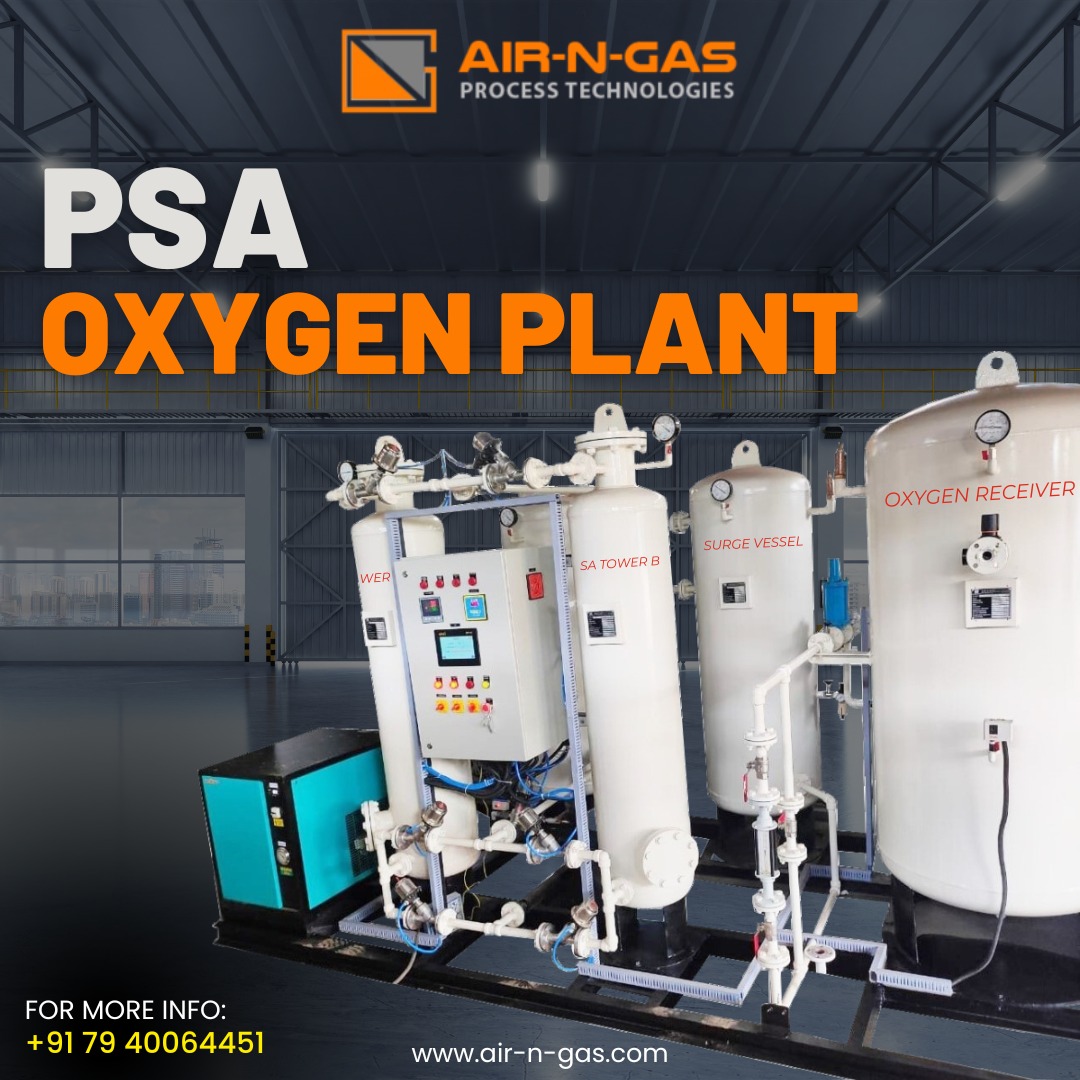
PSA Oxygen Plant technology provides a practical way to generate oxygen directly from ambient air for industrial and medical applications. Instead of depending entirely on oxygen cylinders or externally supplied gas, facilities can use pressure swing adsorption technology to produce oxygen on-site according to their operational requirements.
A PSA oxygen system uses molecular sieve technology to separate nitrogen from compressed air and produce an oxygen-rich gas stream. In medical applications, the World Health Organization describes PSA plants as an on-site source capable of producing medical oxygen at approximately 93% ± 3% purity under its technical specifications.
For industries and healthcare facilities where a consistent oxygen supply is important, choosing the right oxygen generation technology can improve supply control, reduce dependence on transportation, and support continuous operations.
6
Table of Contents
- What Is a PSA Oxygen Plant?
- How Does a PSA Oxygen Plant Work?
- Main Components of a PSA Oxygen Plant
- 7 Benefits of a PSA Oxygen Plant
- Industrial Applications of PSA Oxygen Generation
- Medical Applications of PSA Oxygen Plants
- What to Consider Before Installing a PSA Oxygen Plant
- Why Choose MAAS Air N Gas?
- Frequently Asked Questions
- Conclusion
What Is a PSA Oxygen Plant?
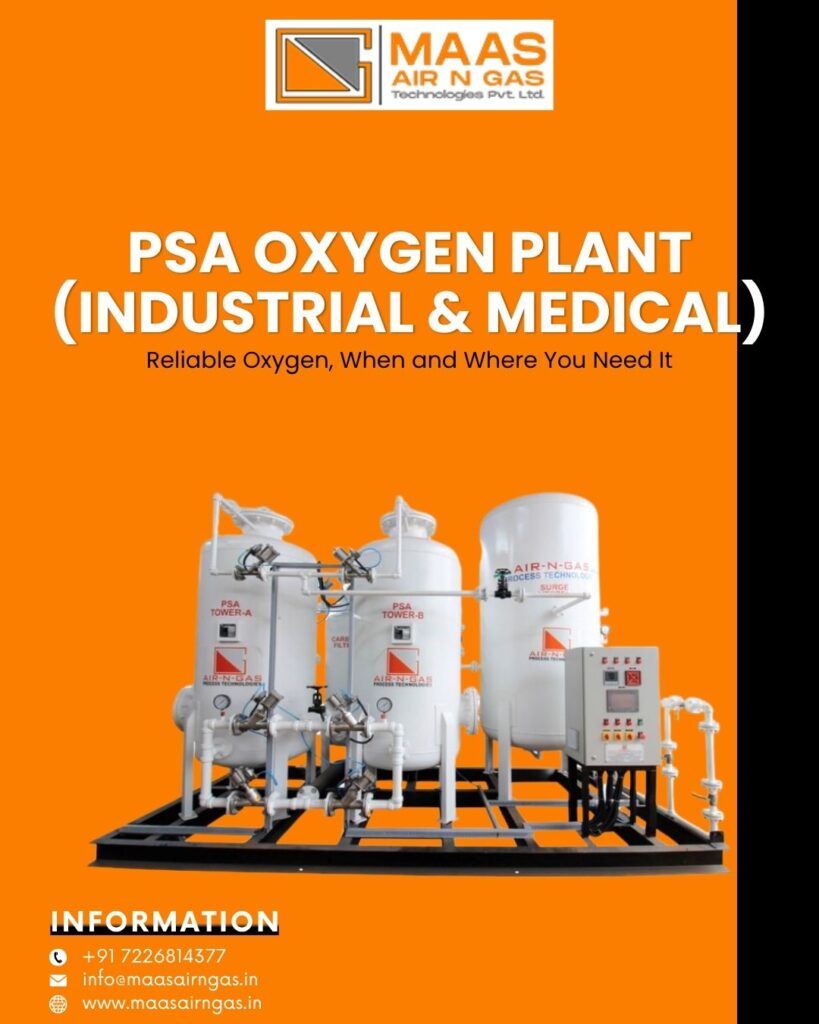
A PSA Oxygen Plant is an oxygen generation system that uses Pressure Swing Adsorption technology to separate oxygen from other components of atmospheric air. The process uses specially selected molecular sieve material, commonly zeolite, which preferentially adsorbs nitrogen when compressed air passes through the adsorption bed.
The remaining gas becomes enriched in oxygen and can then be collected, stored in a surge vessel, and supplied to the required application. The adsorption beds are regenerated by reducing their pressure, allowing the system to repeat the cycle continuously.
According to the WHO, oxygen generator plants based on PSA, VSA, or VPSA technology use molecular sieves to selectively adsorb and release nitrogen, allowing oxygen to be concentrated for downstream use.
MAAS Air N Gas also describes its PSA oxygen technology as a twin-tower system with automated changeover valves, a refrigerated dryer, zeolite molecular sieve beds, and a surge vessel for maintaining oxygen pressure.
For businesses looking for an on-site oxygen generation solution, you can learn more about MAAS Air N Gas and its engineering approach.
How Does a PSA Oxygen Plant Work?
The working principle of a PSA Oxygen Plant is based on pressure-dependent adsorption. Atmospheric air contains oxygen, nitrogen and small quantities of other gases. The system uses compressed air and a molecular sieve to preferentially remove nitrogen.
A typical twin-tower arrangement allows one tower to produce oxygen while the other tower undergoes regeneration. Automated valves then switch the operating roles of the two towers. This alternating cycle makes continuous oxygen generation possible.
A PSA Oxygen Plant works by separating nitrogen from compressed atmospheric air through molecular sieve technology. During the adsorption cycle, the molecular sieve preferentially adsorbs nitrogen while oxygen-rich gas passes through for collection. The adsorption beds are then regenerated by changing the pressure, allowing the process to continue repeatedly. The World Health Organization’s technical specifications for PSA Oxygen Plants explain that PSA technology is used to produce medical oxygen from ambient air and specify important requirements for oxygen generation systems.
The process generally follows these stages:
- Air compression: Ambient air enters the compressor and is compressed.
- Air treatment: Filters and a dryer help remove contaminants and moisture.
- Adsorption: Compressed, dried air enters a molecular sieve tower.
- Nitrogen adsorption: The zeolite preferentially adsorbs nitrogen.
- Oxygen collection: Oxygen-rich gas leaves the adsorption tower.
- Regeneration: The saturated tower is depressurized to release the adsorbed nitrogen.
- Automatic changeover: The towers alternate to maintain production.
The WHO’s technical specifications also identify components such as an air compressor, air dryer, pre-filters, oxygen generator unit, oxygen analyser, and oxygen receiver/buffer tank as important elements of a PSA oxygen generation system.
Main Components of a PSA Oxygen Plant
A properly designed PSA Oxygen Plant consists of several components working together. Each component contributes to the quality, stability and reliability of the generated oxygen.
The major components can include:
- Air Compressor – Supplies compressed ambient air to the system.
- Air Filters – Help remove particles and contaminants from compressed air.
- Refrigerated Dryer – Reduces moisture before air reaches the molecular sieve.
- PSA Towers – Contain the zeolite molecular sieve used for nitrogen adsorption.
- Automatic Valves – Control the adsorption and regeneration cycles.
- Oxygen Surge Vessel – Helps maintain a stable oxygen supply and pressure.
- Oxygen Analyser – Monitors oxygen concentration.
- Control Panel – Controls and monitors plant operation.
Proper air treatment is particularly important because moisture and contaminants can negatively affect adsorption equipment and overall plant performance.
7 Benefits of a PSA Oxygen Plant
1. On-Site Oxygen Generation
One of the most important advantages of a PSA Oxygen Plant is that oxygen can be generated at the point of use. Facilities do not have to depend solely on external oxygen deliveries for their regular requirements.
This can be particularly useful for industrial facilities and healthcare establishments that have predictable and continuous oxygen demand. On-site production also provides greater control over the timing and availability of oxygen.
Instead of planning every operation around cylinder deliveries, a properly designed oxygen generation system can produce oxygen according to the required operating schedule.
2. Reduced Dependence on Oxygen Cylinders
Oxygen cylinders can require transportation, storage, handling and regular replenishment. For facilities with significant oxygen requirements, managing these logistics can become a continuous operational responsibility.
A PSA Oxygen Plant provides an alternative by generating oxygen directly from ambient air. This can reduce the frequency of cylinder handling for applications that are suitable for on-site generation.
WHO guidance also identifies on-site PSA oxygen plants as a source that can supply oxygen directly through a facility’s pipeline system or, with suitable equipment, support cylinder filling.
3. Continuous and Automated Operation
Modern PSA systems can be designed with automated tower switching and process controls. While one adsorption tower is producing oxygen, another can be regenerating.
This alternating operation allows oxygen generation to continue without manually switching the adsorption vessels during every cycle.
Automation can provide several operational advantages:
- Automatic tower changeover
- Continuous monitoring
- Oxygen purity monitoring
- Pressure monitoring
- Alarm systems
- Reduced manual intervention
The exact level of automation depends on the plant configuration and control system.
4. Suitable for Industrial Applications
Oxygen is required in several industrial processes where controlled gas supply can be important. Depending on the required purity, flow rate and process conditions, PSA or related adsorption technologies can be engineered for different industrial applications.
Industries using oxygen can include areas such as:
- Metal processing
- Glass manufacturing
- Chemical processing
- Wastewater treatment
- Aquaculture
- Ozone generation
- Combustion-related processes
Industrial adsorption technologies are used across sectors including oil and gas, petrochemicals, chemicals, iron and steel, and other process industries.
Facilities should select the oxygen generation technology according to their actual process requirements rather than choosing a plant solely on nominal capacity.
5. Useful for Medical Oxygen Applications
A PSA Oxygen Plant can also serve as an on-site oxygen source for healthcare facilities when designed, installed and operated according to applicable medical oxygen requirements.
Oxygen is an essential medicine used in healthcare for conditions involving respiratory difficulties and is also important during surgery and trauma care.
For medical applications, oxygen quality and system safety are critical. The WHO specifies technical requirements for PSA oxygen plants intended to produce medical oxygen and emphasizes the need for high-quality medical-grade oxygen.
Hospitals considering a PSA system should therefore evaluate oxygen demand, pipeline requirements, backup supply, monitoring, maintenance and applicable regulatory requirements before installation.
6. Scalable Plant Configurations
Different facilities have different oxygen requirements. A small medical facility may have very different flow requirements from a large industrial manufacturing plant.
PSA, VPSA and VSA configurations can therefore be considered according to the required output, operating pressure, purity and application.
MAAS Air N Gas states that its PSA systems can be configured for different capacities, with VPSA and VSA arrangements available for larger requirements.
A proper sizing study should consider:
- Required oxygen flow rate
- Required oxygen purity
- Operating pressure
- Daily operating hours
- Peak oxygen demand
- Available electrical power
- Space available for installation
- Backup oxygen requirements
7. Better Control Over Oxygen Supply
For organizations with regular oxygen consumption, generating oxygen on-site can provide greater control over supply planning.
The facility can monitor production, pressure and oxygen concentration rather than depending entirely on an external delivery schedule. This can be especially valuable where interruptions to oxygen availability could affect industrial production or healthcare operations.
The overall financial benefit depends on plant size, electricity consumption, utilization rate, maintenance requirements, existing oxygen costs and the application. Therefore, a technical and economic evaluation should be completed before selecting a system.
Industrial Applications of a PSA Oxygen Plant
A PSA Oxygen Plant can be integrated into industrial processes where oxygen is required continuously or in controlled quantities.
For example, oxygen can support combustion-related processes, oxidation applications, wastewater treatment and other manufacturing operations. The required oxygen purity and flow rate vary considerably between applications.
This is why plant configuration should be based on the customer’s process rather than using a standard system without evaluating actual demand.
Businesses can also consider other gas-generation technologies depending on their requirements. For example, MAAS Air N Gas provides solutions related to PSA nitrogen gas generation plants for applications requiring on-site nitrogen.
Medical Applications of a PSA Oxygen Plant
In healthcare facilities, reliable oxygen availability is an important part of patient care. A PSA Oxygen Plant can generate oxygen on-site and supply it through a central pipeline system when the installation is appropriately designed.
WHO documentation explains that an oxygen generator plant can supply oxygen directly to bedside terminal units or, with suitable equipment, support cylinder filling.
However, medical oxygen systems require careful planning. Facilities should consider:
- Oxygen demand assessment
- Plant capacity
- Oxygen purity monitoring
- Pipeline distribution
- Backup oxygen source
- Electrical power reliability
- Preventive maintenance
- Safety and alarm systems
WHO’s newer technical specifications also identify oxygen generator plants based on PSA, VSA and VPSA technologies and specify medical oxygen production requirements.
What to Consider Before Installing a PSA Oxygen Plant
Selecting an oxygen plant should begin with a detailed assessment of the application. Capacity alone does not determine whether a particular plant is suitable.
The required flow rate, purity, pressure and operating schedule should all be evaluated. A facility should also consider whether the oxygen will be used directly through a pipeline, stored in a receiver, or compressed for cylinder filling.
Power availability is another important consideration. PSA oxygen generation requires electrical power to operate the compressor, controls and associated equipment. WHO guidance recommends considering backup arrangements where reliable power or oxygen availability is a concern.
Before purchasing a plant, buyers should evaluate:
- Required oxygen purity
- Required Nm³/hr capacity
- Operating pressure
- Air quality and pretreatment
- Installation space
- Electrical requirements
- Monitoring and control systems
- Backup oxygen arrangements
- Spare parts availability
- Preventive maintenance support
For installation or technical discussions, businesses can visit the MAAS Air N Gas contact page to discuss their requirements.
Why Choose MAAS Air N Gas for Oxygen Generation Solutions?
MAAS Air N Gas Technologies Pvt. Ltd. works in adsorption-based gas separation systems, air filters and air dryers. Its website describes its engineering process as covering conceptualization, system design, manufacturing, installation and commissioning.
The company’s PSA Oxygen Plant solution uses twin-tower PSA technology with automated changeover and zeolite molecular sieve technology. Its published product information also describes skid-mounted and pre-commissioned configurations.
The company focuses on customized plant configurations based on the customer’s application and oxygen requirements. For organizations evaluating on-site oxygen generation, this approach can help ensure that the selected plant is matched to actual process demand.
You can explore the company’s complete solutions on the MAAS Air N Gas website.
Frequently Asked Questions About PSA Oxygen Plants
What is a PSA Oxygen Plant?
A PSA Oxygen Plant is an oxygen generation system that uses Pressure Swing Adsorption technology and molecular sieve material to separate nitrogen from compressed air and produce an oxygen-rich gas stream.
How does a PSA oxygen generator work?
Compressed and treated air passes through a molecular sieve bed. The sieve preferentially adsorbs nitrogen, allowing oxygen-rich gas to pass through. The adsorption bed is then depressurized and regenerated before the cycle repeats.
What oxygen purity can a PSA plant produce?
Purity depends on the plant design, operating conditions and application. For medical PSA oxygen, WHO technical specifications describe production around 93% ± 3% oxygen from ambient air.
Is a PSA Oxygen Plant suitable for hospitals?
Yes, PSA technology can be used as an on-site medical oxygen source when the plant is appropriately designed, installed, monitored and operated according to applicable medical oxygen requirements.
What is the difference between PSA and VPSA?
Both use adsorption principles, but they operate with different pressure/vacuum configurations and can be selected according to capacity, efficiency and application requirements.
Does a PSA Oxygen Plant require maintenance?
Yes. Compressors, filters, dryers, valves, molecular sieve systems, analysers and control components require appropriate inspection and preventive maintenance. A defined maintenance program helps support reliable operation.
Conclusion
A PSA Oxygen Plant can provide a reliable on-site approach to oxygen generation for industrial and medical applications. By using pressure swing adsorption and molecular sieve technology, the system separates nitrogen from compressed air and generates oxygen according to the plant’s design capacity.
The major advantages include on-site generation, reduced dependence on cylinder logistics, automated operation, scalable configurations and greater control over oxygen supply. For medical applications, however, oxygen purity, system design, monitoring, backup supply and applicable standards must receive particular attention.
For industries and healthcare facilities evaluating an on-site oxygen solution, the right approach is to first calculate oxygen demand and then select the appropriate plant configuration, capacity and supporting equipment.
MAAS Air N Gas Technologies Pvt. Ltd. provides PSA-based oxygen generation solutions for industrial and medical applications. Visit MAAS Air N Gas to explore its oxygen generation technology and discuss your requirements.
Leave A Comment